Kirjojen hintavertailu. Mukana 12 083 983 kirjaa ja 12 kauppaa.

Kirjahaku

Etsi kirjoja tekijän nimen, kirjan nimen tai ISBN:n perusteella.

10 kirjaa tekijältä John L. Pollock

Nomic Probability and the Foundations of Induction

Nomic Probability and the Foundations of Induction

John L. Pollock

Oxford University Press Inc
1990
sidottu
This book deals with the subject of probabilistic reasoning. Professor Pollock attempts to make general philosophical sense of objective probabilities and he explores their relationship to the problem of induction. He argues that probability is fundamental not only to physical science, but to induction, epistemology, the philosophy of science and to much reasoning of interest to artificial intelligence. He attempts to show how his understanding of probability throws light on these related issues. Pollock's main claim is that the fundamental notion of probability is nomic - that is, it involves the notion of natural law, valid across possible worlds. The various epistemic and statistical conceptions of probability, he demonstrates, are derived from this nomic notion. He goes on to provide a theory of statistical induction; an account of computational principles allowing some probabilities to be derived from others; an account of acceptance rules; and a theory of direct inference.
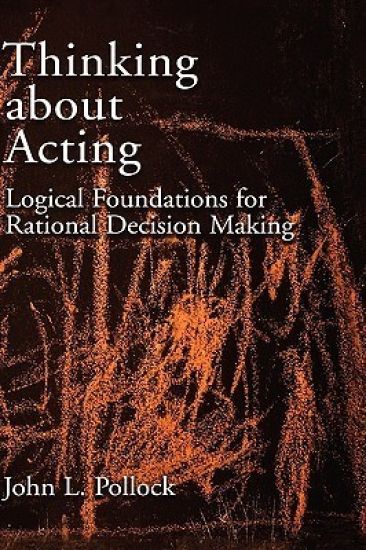
Thinking about Acting

Thinking about Acting

John L. Pollock

Oxford University Press Inc
2006
sidottu
This book aims to construct a theory of rational decision making for real, resource-bounded, agents. Such decision making must be based on objective probabilities rather than subjective probabilities, and cannot be done by choosing single actions with maximal expected values. Actions must be chosen as parts of plans, and plans must be evaluated in the context of other plans.
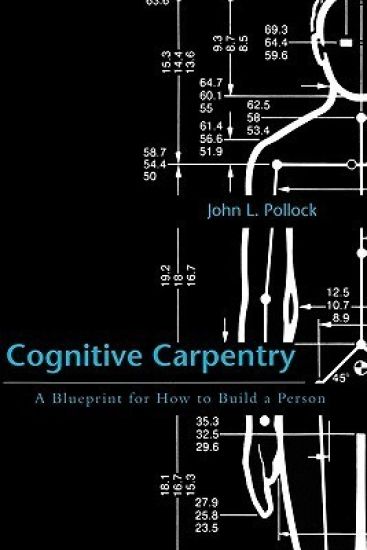
Cognitive Carpentry

Cognitive Carpentry

John L. Pollock

Bradford Books
2003
pokkari
A sequel to Pollock's How to Build a Person, this volume builds upon that theoretical groundwork for the implementation of rationality through artificial intelligence. Pollock argues that progress in AI has stalled because of its creators' reliance upon unformulated intuitions about rationality. Instead, he bases the OSCAR architecture upon an explicit philosophical theory of rationality, encompassing principles of practical cognition, epistemic cognition, and defeasible reasoning.In his groundbreaking new book, John Pollock establishes an outpost at the crossroads where artificial intelligence meets philosophy. Specifically, he proposes a general theory of rationality and then describes its implementation in OSCAR, an architecture for an autonomous rational agent he claims is the first AI system capable of performing reasoning that philosophers would regard as epistemically sophisticated.A sequel to Pollock's How to Build a Person, this volume builds upon that theoretical groundwork for the implementation of rationality through artificial intelligence. Pollock argues that progress in AI has stalled because of its creators' reliance upon unformulated intuitions about rationality. Instead, he bases the OSCAR architecture upon an explicit philosophical theory of rationality, encompassing principles of practical cognition, epistemic cognition, and defeasible reasoning. One of the results is the world's first automated defeasible reasoner capable of reasoning in a rich, logical environment.Underlying Pollock's thesis is a conviction that the tenets of artifical intelligence and those of philosophy can be complementary and mutually beneficial. And, while members of both camps have in recent years grown skeptical of the very possibility of "symbol processing" AI, Cognitive Carpentry establishes that such an approach to AI can be successful.A Bradford Book
The Foundations of Philosophical Semantics

The Foundations of Philosophical Semantics

John L. Pollock

Princeton University Press
2017
pokkari
Although philosophical semantics has become both a discipline in its own right and the source of the analytic techniques used in the rest of philosophy, its foundations have themselves been problematic. To provide a unified account of the field, John L. Pollock discusses issues including the nature of possible worlds, modalities, counterfactuals, and causation. Originally published in 1985. The Princeton Legacy Library uses the latest print-on-demand technology to again make available previously out-of-print books from the distinguished backlist of Princeton University Press. These editions preserve the original texts of these important books while presenting them in durable paperback and hardcover editions. The goal of the Princeton Legacy Library is to vastly increase access to the rich scholarly heritage found in the thousands of books published by Princeton University Press since its founding in 1905.
Language and Thought

Language and Thought

John L. Pollock

Princeton University Press
2014
pokkari
Most philosophical theories of language have assumed that statements (products of assertion) and propositions (objects of belief) are the same things. John L. Pollock denies this, maintaining that even when the speaker is perfectly sincere, what he is thinking need not be the same thing as what he is saying. Originally published in 1982. The Princeton Legacy Library uses the latest print-on-demand technology to again make available previously out-of-print books from the distinguished backlist of Princeton University Press. These editions preserve the original texts of these important books while presenting them in durable paperback and hardcover editions. The goal of the Princeton Legacy Library is to vastly increase access to the rich scholarly heritage found in the thousands of books published by Princeton University Press since its founding in 1905.
Knowledge and Justification

Knowledge and Justification

John L. Pollock

Princeton University Press
2015
pokkari
One of the most firmly entrenched beliefs of contemporary philosophy is that the only way to analyze a concept is to state its truth conditions. In epistemology this has led to the search for reductive analyses, to phenomenalism, behaviorism, and their analogues in other areas of knowledge. Arguing that these attempts at reductive analysis have invariably failed, John L. Pollock defends an alternative theory of conceptual analysis in this book. The author suggests that concepts should be analyzed in terms of their justification conditions rather than their truth conditions. After laying a theoretical foundation for this alternative scheme of analysis, Professor Pollock applies his theory in proposing solutions to a number of traditional epistemological problems. Among the areas of knowledge discussed are perception, knowledge of the past, induction, knowledge of other minds, and a priori knowledge. Originally published in 1975. The Princeton Legacy Library uses the latest print-on-demand technology to again make available previously out-of-print books from the distinguished backlist of Princeton University Press. These editions preserve the original texts of these important books while presenting them in durable paperback and hardcover editions. The goal of the Princeton Legacy Library is to vastly increase access to the rich scholarly heritage found in the thousands of books published by Princeton University Press since its founding in 1905.
The Foundations of Philosophical Semantics

The Foundations of Philosophical Semantics

John L. Pollock

PRINCETON UNIVERSITY PRESS
2017
sidottu
Although philosophical semantics has become both a discipline in its own right and the source of the analytic techniques used in the rest of philosophy, its foundations have themselves been problematic. To provide a unified account of the field, John L. Pollock discusses issues including the nature of possible worlds, modalities, counterfactuals, and causation. Originally published in 1985. The Princeton Legacy Library uses the latest print-on-demand technology to again make available previously out-of-print books from the distinguished backlist of Princeton University Press. These editions preserve the original texts of these important books while presenting them in durable paperback and hardcover editions. The goal of the Princeton Legacy Library is to vastly increase access to the rich scholarly heritage found in the thousands of books published by Princeton University Press since its founding in 1905.
Language and Thought

Language and Thought

John L. Pollock

Princeton University Press
2016
sidottu
Most philosophical theories of language have assumed that statements (products of assertion) and propositions (objects of belief) are the same things. John L. Pollock denies this, maintaining that even when the speaker is perfectly sincere, what he is thinking need not be the same thing as what he is saying. Originally published in 1982. The Princeton Legacy Library uses the latest print-on-demand technology to again make available previously out-of-print books from the distinguished backlist of Princeton University Press. These editions preserve the original texts of these important books while presenting them in durable paperback and hardcover editions. The goal of the Princeton Legacy Library is to vastly increase access to the rich scholarly heritage found in the thousands of books published by Princeton University Press since its founding in 1905.
Knowledge and Justification

Knowledge and Justification

John L. Pollock

Princeton University Press
2016
sidottu
One of the most firmly entrenched beliefs of contemporary philosophy is that the only way to analyze a concept is to state its truth conditions. In epistemology this has led to the search for reductive analyses, to phenomenalism, behaviorism, and their analogues in other areas of knowledge. Arguing that these attempts at reductive analysis have invariably failed, John L. Pollock defends an alternative theory of conceptual analysis in this book. The author suggests that concepts should be analyzed in terms of their justification conditions rather than their truth conditions. After laying a theoretical foundation for this alternative scheme of analysis, Professor Pollock applies his theory in proposing solutions to a number of traditional epistemological problems. Among the areas of knowledge discussed are perception, knowledge of the past, induction, knowledge of other minds, and a priori knowledge. Originally published in 1975. The Princeton Legacy Library uses the latest print-on-demand technology to again make available previously out-of-print books from the distinguished backlist of Princeton University Press. These editions preserve the original texts of these important books while presenting them in durable paperback and hardcover editions. The goal of the Princeton Legacy Library is to vastly increase access to the rich scholarly heritage found in the thousands of books published by Princeton University Press since its founding in 1905.