Kirjojen hintavertailu. Mukana 12 477 142 kirjaa ja 12 kauppaa.

Kirjahaku

Etsi kirjoja tekijän nimen, kirjan nimen tai ISBN:n perusteella.

51 kirjaa tekijältä John Law

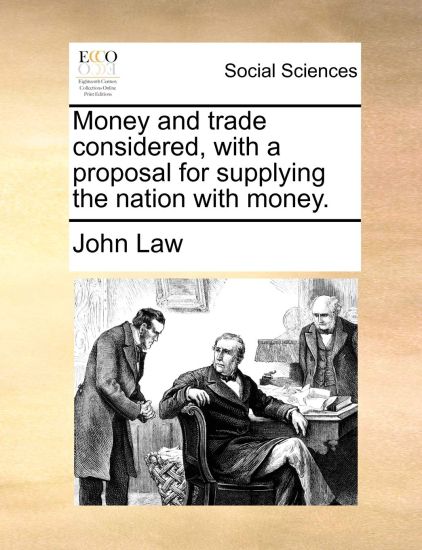
Money and Trade Consider'd; With a Proposal for Supplying the Nation With Money. By Mr. John Law, ... The Second Edition
The 18th century was a wealth of knowledge, exploration and rapidly growing technology and expanding record-keeping made possible by advances in the printing press. In its determination to preserve the century of revolution, Gale initiated a revolution of its own: digitization of epic proportions to preserve these invaluable works in the largest archive of its kind. Now for the first time these high-quality digital copies of original 18th century manuscripts are available in print, making them highly accessible to libraries, undergraduate students, and independent scholars.Delve into what it was like to live during the eighteenth century by reading the first-hand accounts of everyday people, including city dwellers and farmers, businessmen and bankers, artisans and merchants, artists and their patrons, politicians and their constituents. Original texts make the American, French, and Industrial revolutions vividly contemporary.++++The below data was compiled from various identification fields in the bibliographic record of this title. This data is provided as an additional tool in helping to insure edition identification: ++++University of London's Goldsmiths' LibraryT097293With a half-title.London: printed for W. Lewis, 1720. 4],96p.; 8
After Method

After Method

John Law

Routledge
2004
sidottu
John Law argues that methods don't just describe social realities but are also involved in creating them. The implications of this argument are highly significant. If this is the case, methods are always political, and it raises the question of what kinds of social realities we want to create. Most current methods look for clarity and precision. It is usually said that only poor research produces messy findings, and the idea that things in the world might be fluid, elusive, or multiple is unthinkable. Law's startling argument is that this is wrong and it is time for a new approach. Many realities, he says, are vague and ephemeral. If methods want to know and help to shape the world, then they need to reinvent themselves and their politics to deal with mess. That is the challenge. Nothing less will do.
After Method

After Method

John Law

Routledge
2004
nidottu
John Law argues that methods don't just describe social realities but are also involved in creating them. The implications of this argument are highly significant. If this is the case, methods are always political, and it raises the question of what kinds of social realities we want to create. Most current methods look for clarity and precision. It is usually said that only poor research produces messy findings, and the idea that things in the world might be fluid, elusive, or multiple is unthinkable. Law's startling argument is that this is wrong and it is time for a new approach. Many realities, he says, are vague and ephemeral. If methods want to know and help to shape the world, then they need to reinvent themselves and their politics to deal with mess. That is the challenge. Nothing less will do.
Organising Modernity

Organising Modernity

John Law

JOHN WILEY AND SONS LTD
1993
nidottu
In this important theoretical and empirical statement John Law argues against the purity of post-enlightenment political and social theory, and offers an alternative post-modern sociology. Arguing in favor of a sociology of verbs, he suggests that power, organizations, mind-body dualisms, and macro-micro distinctions may all be understood as the local performance of recursive modes of social ordering. Drawing on a range of theoretical traditions including actor-network theory, verstehende sociology, and the writing of Michel Foucault, he explores the production of materials - including agents and architectures - and their importance for these modes of ordering. The book, which draws on organizational ethnography to develop its argument, is essential reading for all those interested in social theory, materialism, or the sociology of organizations at the end of the era of high modernity.
Aircraft Stories

Aircraft Stories

John Law

Duke University Press
2002
sidottu
In Aircraft Stories noted sociologist of technoscience John Law tells “stories” about a British attempt to build a military aircraft-the TSR2. The intertwining of these stories demonstrates the ways in which particular technological projects can be understood in a world of complex contexts. Law works to upset the binary between the modernist concept of knowledge, subjects, and objects as having centered and concrete essences and the postmodernist notion that all is fragmented and centerless. The structure and content of Aircraft Stories reflect Law’s contention that knowledge, subjects, and-particularly- objects are “fractionally coherent”: that is, they are drawn together without necessarily being centered. In studying the process of this particular aircraft’s design, construction, and eventual cancellation, Law develops a range of metaphors to describe both its fractional character and the ways its various aspects interact with each other. Offering numerous insights into the way we theorize the working of systems, he explores the overlaps between singularity and multiplicity and reveals rich new meaning in such concepts as oscillation, interference, fractionality, and rhizomatic networks.The methodology and insights of Aircraft Stories will be invaluable to students in science and technology studies and will engage others who are interested in the ways that contemporary paradigms have limited our ability to see objects in their true complexity.
Aircraft Stories

Aircraft Stories

John Law

Duke University Press
2002
pokkari
In Aircraft Stories noted sociologist of technoscience John Law tells “stories” about a British attempt to build a military aircraft-the TSR2. The intertwining of these stories demonstrates the ways in which particular technological projects can be understood in a world of complex contexts. Law works to upset the binary between the modernist concept of knowledge, subjects, and objects as having centered and concrete essences and the postmodernist notion that all is fragmented and centerless. The structure and content of Aircraft Stories reflect Law’s contention that knowledge, subjects, and-particularly- objects are “fractionally coherent”: that is, they are drawn together without necessarily being centered. In studying the process of this particular aircraft’s design, construction, and eventual cancellation, Law develops a range of metaphors to describe both its fractional character and the ways its various aspects interact with each other. Offering numerous insights into the way we theorize the working of systems, he explores the overlaps between singularity and multiplicity and reveals rich new meaning in such concepts as oscillation, interference, fractionality, and rhizomatic networks.The methodology and insights of Aircraft Stories will be invaluable to students in science and technology studies and will engage others who are interested in the ways that contemporary paradigms have limited our ability to see objects in their true complexity.
Out of Work. [A Novel.]

Out of Work. [A Novel.]

John Law

British Library, Historical Print Editions
2011
pokkari
Title: Out of Work. A novel.]Publisher: British Library, Historical Print EditionsThe British Library is the national library of the United Kingdom. It is one of the world's largest research libraries holding over 150 million items in all known languages and formats: books, journals, newspapers, sound recordings, patents, maps, stamps, prints and much more. Its collections include around 14 million books, along with substantial additional collections of manuscripts and historical items dating back as far as 300 BC.The FICTION & PROSE LITERATURE collection includes books from the British Library digitised by Microsoft. The collection provides readers with a perspective of the world from some of the 18th and 19th century's most talented writers. Written for a range of audiences, these works are a treasure for any curious reader looking to see the world through the eyes of ages past. Beyond the main body of works the collection also includes song-books, comedy, and works of satire. ++++The below data was compiled from various identification fields in the bibliographic record of this title. This data is provided as an additional tool in helping to insure edition identification: ++++ British Library Law, John; null 8 . 012633.l.18.
A Manchester Shirtmaker

A Manchester Shirtmaker

John Law

British Library, Historical Print Editions
2011
pokkari
Title: A Manchester Shirtmaker: a realistic story of to-day.Publisher: British Library, Historical Print EditionsThe British Library is the national library of the United Kingdom. It is one of the world's largest research libraries holding over 150 million items in all known languages and formats: books, journals, newspapers, sound recordings, patents, maps, stamps, prints and much more. Its collections include around 14 million books, along with substantial additional collections of manuscripts and historical items dating back as far as 300 BC.The FICTION & PROSE LITERATURE collection includes books from the British Library digitised by Microsoft. The collection provides readers with a perspective of the world from some of the 18th and 19th century's most talented writers. Written for a range of audiences, these works are a treasure for any curious reader looking to see the world through the eyes of ages past. Beyond the main body of works the collection also includes song-books, comedy, and works of satire. ++++The below data was compiled from various identification fields in the bibliographic record of this title. This data is provided as an additional tool in helping to insure edition identification: ++++ British Library Law, John; 1890]. 168 p.; 8 . 12629.f.2.
Money and Trade Considered, With a Proposal for Supplying the Nation With Money
The 18th century was a wealth of knowledge, exploration and rapidly growing technology and expanding record-keeping made possible by advances in the printing press. In its determination to preserve the century of revolution, Gale initiated a revolution of its own: digitization of epic proportions to preserve these invaluable works in the largest archive of its kind. Now for the first time these high-quality digital copies of original 18th century manuscripts are available in print, making them highly accessible to libraries, undergraduate students, and independent scholars.Delve into what it was like to live during the eighteenth century by reading the first-hand accounts of everyday people, including city dwellers and farmers, businessmen and bankers, artisans and merchants, artists and their patrons, politicians and their constituents. Original texts make the American, French, and Industrial revolutions vividly contemporary.++++The below data was compiled from various identification fields in the bibliographic record of this title. This data is provided as an additional tool in helping to insure edition identification: ++++British LibraryT097650Anonymous. By John Law. The ornament on the titlepage resembles a coastline and its reflection. Variant: the ornament contains an eagle and vines.Edinburgh: printed by the heirs and successors of Andrew Anderson, anno Dom., 1705. 120p.; 4
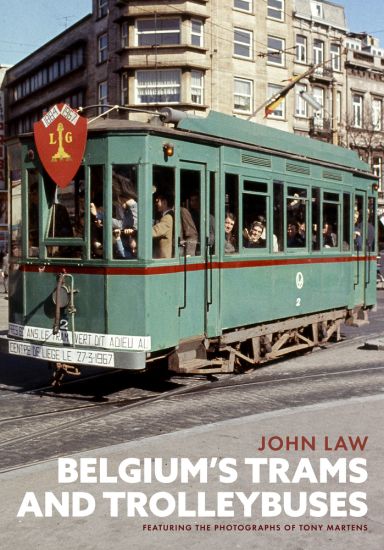
Belgium's Trams and Trolleybuses

Belgium's Trams and Trolleybuses

John Law

AMBERLEY PUBLISHING
2022
nidottu
Like most European countries, Belgium’s main towns and cities developed their own tramway networks. Those that survive today include Brussels, Gent, Antwerpen and Charleroi. In the 1960s both French-speaking Liège and Verviers lost their tramways, though there is a desire in Liège to see it return. In addition to the city systems, there was a rural network of mainly metre gauge tramways throughout the country known as the Vicinal. Tony Martens, though born in Belgium, lived in the UK for most of his life, but started revisiting the country in the 1960s, photographing most of the surviving operations. John Law’s first visit to the country was in 1971, accompanying Tony in Brussels, where the last of the Vicinal routes were still operating and four-wheeled trams were running on the city streets. John has been returning to Belgium on a regular basis ever since. Sadly, Tony Martens passed away in early 2019. Fortunately, John Law was able to gain access to Tony’s slide collection and, along with his own photographic work, has tapped into this archive to bring you a photographic history of Belgium’s trams and trolleybuses from the mid-1960s to the present day.
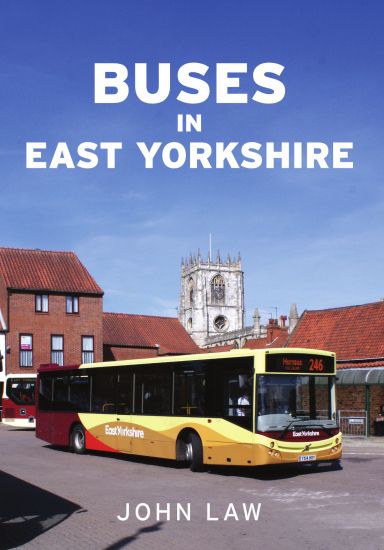
Buses in East Yorkshire

Buses in East Yorkshire

John Law

AMBERLEY PUBLISHING
2023
nidottu
Kingston upon Hull Corporation Transport set about replacing its trams with trolleybuses in the 1930s, but the war meant that trams did not finish until 1945. Motorbuses took over all operations in 1965. The fine blue and white buses of the municipality were a feature of the city until 1994, when the stripes of the Stagecoach Group began to be applied. The area’s other major operator, East Yorkshire Motor Services, can trace its history back to 1919, though the name was not registered until 1926. The company’s buses were soon to be found throughout the East Riding, with the double-deck vehicles easily recognisable due to having specially profiled roofs to pass through Beverley Bar. EYMS became part of the National Bus Company and was later purchased by its management team. It soon became the UK’s largest independent. The company was sold to the Go-Ahead Group in 2018. Today, the smart and modern fleet can be seen throughout the county and beyond. A few other operators have been seen in East Yorkshire, with Lincolnshire Road Car serving Goole and crossing the Humber Bridge. Various small independent companies have also featured, most notable of which was Connor & Graham of Easington.
Railways of the Eastern Counties Since 1970
Over more than fifty years, the railways of the Eastern Counties have seen a great number of changes. In the early 1970s, many stations, even some of the smaller ones, had a resident diesel shunter for moving empty carriages or servicing the goods yard. First generation diesel multiple units ran most of the secondary lines, with locomotive-hauled expresses being used on the InterCity routes and the Harwich boat trains. Today, modern electric trains speed northwards to Norwich and Kings Lynn, while comfortable diesel units serve the cross-country routes. New electric or bi-mode sets are now operating on other lines. Semaphore signalling has mostly given way to centralised colour light systems.
Buses and Trams Around Leeds

Buses and Trams Around Leeds

John Law

AMBERLEY PUBLISHING
2024
nidottu
The history of affordable public transport in the Yorkshire city of Leeds began in 1871, when horses began pulling trams around the city. Leeds Corporation purchased the network in 1893 and electrification followed soon afterwards. The system expanded, but finally ceased operations in 1959. Leeds was also an early pioneer of trolleybuses, with a route to Farnley Moor Top opening in 1911. Two further routes later opened, as feeders to the tram system, bringing Leeds City Tramways into Otley and Burley-in-Wharfedale. Unlike nearby Bradford, the Leeds trolleybuses ceased running quite early, giving way to motorbuses in 1928. Since that year, motorbuses have served the city’s streets and suburbs. Leeds City Transport continued to run a large fleet until becoming part of West Yorkshire PTE in 1974. Privatisation saw most of the services become part of Firstbus, the dominant operator in the city today. Over the years, there have been many other companies running buses into Leeds. These are also featured within these pages, which contain the best of the author’s collection of photographs taken over many years.