Kirjojen hintavertailu. Mukana 11 447 455 kirjaa ja 12 kauppaa.

Kirjahaku

Etsi kirjoja tekijän nimen, kirjan nimen tai ISBN:n perusteella.

6 kirjaa tekijältä John Michael Cooper

Margaret Bonds

Margaret Bonds

John Michael Cooper

OXFORD UNIVERSITY PRESS INC
2025
sidottu
Composer, pianist, teacher, and social-justice activist Margaret Bonds fought against racism, sexism, and economic injustice throughout her career, amassing a portfolio of social-justice compositions unrivalled in eloquence and originality which challenged longstanding barriers between Black and White, male and female, popular and classical. During her lifetime the political economy of music publishing consigned most of her music to manuscript dissemination, and since her death -- despite the enduring popularity of works such as He's Got the Whole World in His Hand and The Ballad of the Brown King -- her success in transcending the barriers she faced as an African American and a woman has been obscured by the forces of racism and sexism in concert life, which, together with White- and male-dominated music historiography, have viewed her life and work through the lens of specious, racist, and sexist tropes. This book draws on an unprecedented mass of archival evidence to set aside those tropes and offer a fresh portrait of Margaret Bonds. Examining her published and unpublished music, it shows how the child prodigy rose to become the first African American woman whose music was performed widely in Africa; one of the first African American women whose music was broadcast on European radio; the first African American woman and pianist to perform with a major U.S. orchestra; the second African American woman in classical music to attain full membership in ASCAP; the first woman Black or White to win not one or two, but three, awards from that predominantly White and male organization; the lasting musical voice of Langston Hughes; and the teacher of other notables including Ned Rorem and Cheryl Wall. It thus shows how the confluence of natural genius, matrilineal and racial pride, faith, and support from the community of African American artists, intellectuals, and institutions enabled Margaret Bonds to become one of the most extraordinary figures in all of twentieth-century music. In response to the increasing globalization of music, the Composers across Cultures series, formerly the Master Musicians series, seeks to explore the inexhaustible diversity of music, and its common links to our shared humanity.
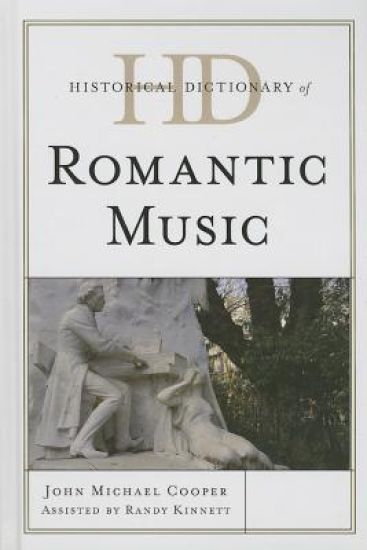
Historical Dictionary of Romantic Music

Historical Dictionary of Romantic Music

John Michael Cooper

Scarecrow Press
2013
sidottu
This Historical Dictionary of Romantic Music provides detailed and authoritative articles for the most important composers, concepts, genres, music educators, performers, theorists, writings, and works of cultivated music in Europe and the Americas during the period 1789-1914. The roster of biographical entries includes not only canonical composers such as Beethoven, Berlioz, Brahms, Chopin, Fauré, Grieg, Liszt, Mahler, Mendelssohn, Mussorgsky, Rossini, Schubert, Robert Schumann, Sibelius, Strauss, Tchaikovsky, Verdi, Wagner, and Wolf, but also less-well-known distinguished contemporaries of those composers (among them George Whitefield Chadwick, Cécile Chaminade, Ernesto Elorduy, Chiquinha Gonzaga, Fanny Hensel, C. H. Parry, and Clara Schumann, to name but a few). Significant literary and cultural topics such as Goethe’s Faust and Wagner’s theoretical writings of the 1850s, as well as entries on other cultural luminaries who significantly influenced music’s Romanticisms – among them J. S. Bach, Goethe, Haydn, Handel, Heine, Mozart, Schiller, and Shakespeare – are also included. Entries on important institutions (conservatory, orphéon, Männerchor), concepts (biographical fallacy, copyright, exoticism, feminism, nationalism, performance practice), and political caesurae and movements (First and Second French Empire, First, Second, and Third French Republic, Franco-Prussian War, Revolutions of 1848, Risorgimento) round out the dictionary section. Like other volumes in this series, this book's more than 500 entries are preceded by an introductory essay that explains the essential concepts necessary for understanding and exploring further the vast and complex musical landscape of Romanticism, plus a detailed Chronology. Concluding the volume is an extensive bibliography that lists the most important source-critical series of editions of Romantic music, important general writings on the period and its music, and composer-by-composer bibliographies.
Margaret Bonds: The Montgomery Variations and Du Bois Credo

Margaret Bonds: The Montgomery Variations and Du Bois Credo

John Michael Cooper

Cambridge University Press
2023
pokkari
In her lifetime, African American composer Margaret Bonds was classical music's most intrepid social-justice activist. Furthermore, her Montgomery Variations (1964) and setting of W.E.B. Du Bois's iconic Civil Rights Credo (1965-67) were the musical summits of her activism. These works fell into obscurity after Bonds's death, but were recovered and published in 2020. Since widely performed, they are finally gaining a recognition long denied. This incisive book situates The Montgomery Variations and Credo in their political and biographical contexts, providing an interdisciplinary exploration that brings notables including Harry Burleigh, W.E.B. and Shirley Graham Du Bois, Martin Luther King, Jr., Abbie Mitchell, Ned Rorem, and – especially – Langston Hughes into the works' collective ambit. The resulting brief, but instructive, appraisal introduces readers to two masterworks whose recovery is a modern musical milestone – and reveals their message to be one that, though born in the mid-twentieth century, speaks directly to our own time.
Margaret Bonds: The Montgomery Variations and Du Bois Credo

Margaret Bonds: The Montgomery Variations and Du Bois Credo

John Michael Cooper

Cambridge University Press
2023
sidottu
In her lifetime, African American composer Margaret Bonds was classical music's most intrepid social-justice activist. Furthermore, her Montgomery Variations (1964) and setting of W.E.B. Du Bois's iconic Civil Rights Credo (1965-67) were the musical summits of her activism. These works fell into obscurity after Bonds's death, but were recovered and published in 2020. Since widely performed, they are finally gaining a recognition long denied. This incisive book situates The Montgomery Variations and Credo in their political and biographical contexts, providing an interdisciplinary exploration that brings notables including Harry Burleigh, W.E.B. and Shirley Graham Du Bois, Martin Luther King, Jr., Abbie Mitchell, Ned Rorem, and – especially – Langston Hughes into the works' collective ambit. The resulting brief, but instructive, appraisal introduces readers to two masterworks whose recovery is a modern musical milestone – and reveals their message to be one that, though born in the mid-twentieth century, speaks directly to our own time.
Historical Dictionary of Romantic Music

Historical Dictionary of Romantic Music

John Michael Cooper

BLOOMSBURY PUBLISHING PLC
2024
sidottu
Historical Dictionary of Romantic Music, Second Edition covers the persons, ideas, practices, and works that made up the worlds of Western music during the long 19th century (ca. 1780-1918). It’s the first book to recognize that Romantic music was very nearly a global phenomenon, it includes more women, more Black musicians and other musicians of color, and more exponents of musical Romanticism from Central and South America as well as Central and Eastern Europe than any other single-volume study of Romantic music – thus challenging the conventional hegemony of musical Romanticisms by men and by Western European nations. It includes entries on topics including anti-Semitism, sexism, and racism that were pervasive and defining to the worlds of musical Romanticism but are rarely addressed in general studies of that subject. It includes Romantic musicians who were not primarily composers, as well as topics such as the Haitian Revolution, spirituals, and ragtime that were more important for music in the long 19th century than is generally acknowledged. The result is an expansive, inclusive, diverse and more richly textured portrayal of “Romantic music” than is elsewhere available.Historical Dictionary of Romantic Music, Second Edition contains a chronology, an introduction, and an extensive bibliography. The dictionary section has more than 600 cross-referenced entries on traditions, famous pieces, persons, places, technical terms, and institutions of Romantic music. This book is an excellent resource for students, researchers, and anyone wanting to know more about romantic music.
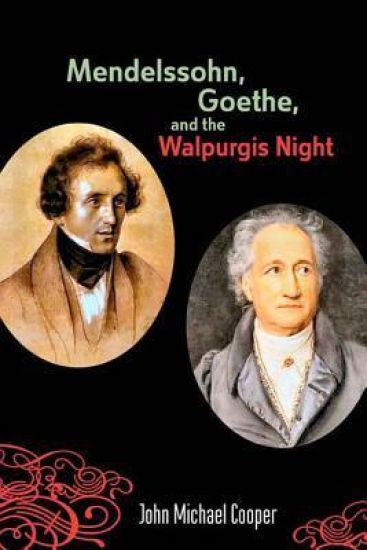
Mendelssohn, Goethe, and the Walpurgis Night

Mendelssohn, Goethe, and the Walpurgis Night

John Michael Cooper

University of Rochester Press
2010
pokkari
The first in-depth study of Mendelssohn's two settings of Goethe's Die erste Walpurgisnacht, in the context of scenes from Goethe's Faust and other works. This paperback edition of Mendelssohn, Goethe, and the Walpurgis Night addresses tolerance and acceptance in the face of cultural, political, and religious strife. Its point of departure is the Walpurgis Night. The Night, also known as Beltane or May Eve, was supposedly an annual witches' Sabbath that centered around the Brocken, the highest peak of the Harz Mountains. After exploring how a notoriously pagan celebration came to be named after the Christian missionary St. Walpurgis (ca. 710-79), John Michael Cooper discusses the Night's treatments in several closely interwoven works by Goethe and Mendelssohn. His book situates those works in their immediate personal andprofessional contexts, as well as among treatments by a wide array of other artists, philosophers, and political thinkers, including Voltaire, Lessing, Shelley, Heine, Delacroix, and Berlioz. In an age of decisive political and religious conflict, Walpurgis Night became a heathen muse: a source of spiritual inspiration that was neither specifically Christian, nor Jewish, nor Muslim. And Mendelssohn's and Goethe's engagements with it offer new insightsinto its role in European cultural history, as well as into issues of political, religious, and social identity -- and the relations between cultural groups -- in today's world. John Michael Cooper is Professor of Music at Southwestern University and author of Mendelssohn's "Italian" Symphony (Oxford University Press).