Kirjojen hintavertailu. Mukana 12 390 323 kirjaa ja 12 kauppaa.

Kirjahaku

Etsi kirjoja tekijän nimen, kirjan nimen tai ISBN:n perusteella.

9 kirjaa tekijältä John P. D'Angelo

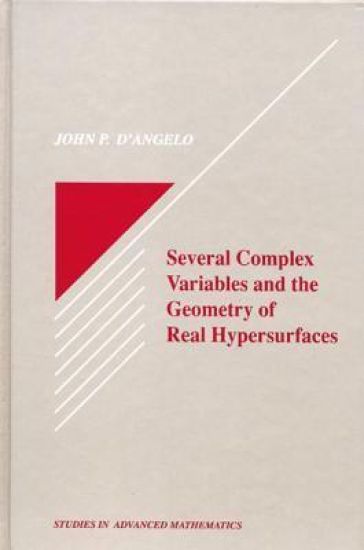
Several Complex Variables and the Geometry of Real Hypersurfaces
Several Complex Variables and the Geometry of Real Hypersurfaces covers a wide range of information from basic facts about holomorphic functions of several complex variables through deep results such as subelliptic estimates for the ?-Neumann problem on pseudoconvex domains with a real analytic boundary. The book focuses on describing the geometry of a real hypersurface in a complex vector space by understanding its relationship with ambient complex analytic varieties. You will learn how to decide whether a real hypersurface contains complex varieties, how closely such varieties can contact the hypersurface, and why it's important. The book concludes with two sets of problems: routine problems and difficult problems (many of which are unsolved). Principal prerequisites for using this book include a thorough understanding of advanced calculus and standard knowledge of complex analysis in one variable. Several Complex Variables and the Geometry of Real Hypersurfaces will be a useful text for advanced graduate students and professionals working in complex analysis.
An Introduction to Complex Analysis and Geometry

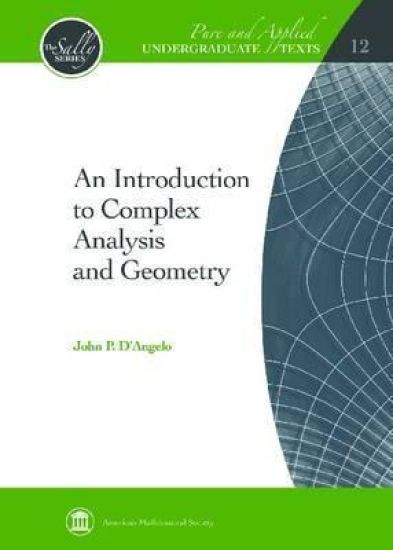
An Introduction to Complex Analysis and Geometry

John P. D'Angelo

American Mathematical Society
2011
sidottu
An Introduction to Complex Analysis and Geometry provides the reader with a deep appreciation of complex analysis and how this subject fits into mathematics. The book developed from courses given in the Campus Honors Program at the University of Illinois Urbana-Champaign. These courses aimed to share with students the way many mathematics and physics problems magically simplify when viewed from the perspective of complex analysis. The book begins at an elementary level but also contains advanced material.The first four chapters provide an introduction to complex analysis with many elementary and unusual applications. Chapters 5 through 7 develop the Cauchy theory and include some striking applications to calculus. Chapter 8 glimpses several appealing topics, simultaneously unifying the book and opening the door to further study.The 280 exercises range from simple computations to difficult problems. Their variety makes the book especially attractive.A reader of the first four chapters will be able to apply complex numbers in many elementary contexts. A reader of the full book will know basic one complex variable theory and will have seen it integrated into mathematics as a whole. Research mathematicians will discover several novel perspectives.
Several Complex Variables and the Geometry of Real Hypersurfaces
Several Complex Variables and the Geometry of Real Hypersurfaces covers a wide range of information from basic facts about holomorphic functions of several complex variables through deep results such as subelliptic estimates for the ?-Neumann problem on pseudoconvex domains with a real analytic boundary. The book focuses on describing the geometry of a real hypersurface in a complex vector space by understanding its relationship with ambient complex analytic varieties. You will learn how to decide whether a real hypersurface contains complex varieties, how closely such varieties can contact the hypersurface, and why it's important. The book concludes with two sets of problems: routine problems and difficult problems (many of which are unsolved). Principal prerequisites for using this book include a thorough understanding of advanced calculus and standard knowledge of complex analysis in one variable. Several Complex Variables and the Geometry of Real Hypersurfaces will be a useful text for advanced graduate students and professionals working in complex analysis.
Inequalities from Complex Analysis

Inequalities from Complex Analysis

John P. D'Angelo

Mathematical Association of America
2002
sidottu
Inequalities from Complex Analysis is a careful, friendly exposition of some rather interesting mathematics. The author begins by defining the complex number field; he gives a novel presentation of some standard mathematical analysis in the early chapters. The development culminates with some results from recent research literature. The book provides complete yet comprehensible proofs as well as some surprising consequences of the results. One unifying theme is a complex variables analogue of Hilbert's seventeenth problem. Numerous examples, exercises and discussions of geometric reasoning aid the reader. The book is accessible to undergraduate mathematicians, as well as physicists and engineers.
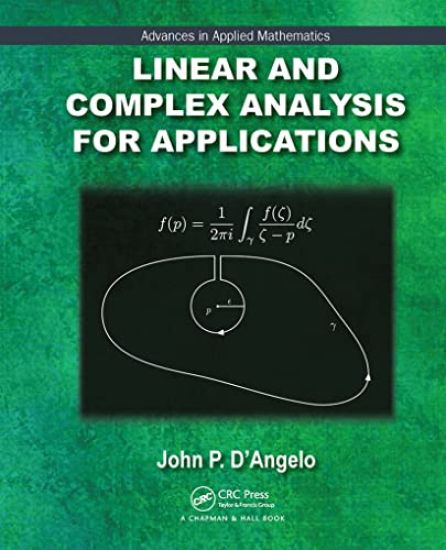
Linear and Complex Analysis for Applications

Linear and Complex Analysis for Applications

John P. D'Angelo

TAYLOR FRANCIS LTD
2023
nidottu
Linear and Complex Analysis for Applications aims to unify various parts of mathematical analysis in an engaging manner and to provide a diverse and unusual collection of applications, both to other fields of mathematics and to physics and engineering. The book evolved from several of the author’s teaching experiences, his research in complex analysis in several variables, and many conversations with friends and colleagues. It has three primary goals: to develop enough linear analysis and complex variable theory to prepare students in engineering or applied mathematics for advanced work, to unify many distinct and seemingly isolated topics, to show mathematics as both interesting and useful, especially via the juxtaposition of examples and theorems. The book realizes these goals by beginning with reviews of Linear Algebra, Complex Numbers, and topics from Calculus III. As the topics are being reviewed, new material is inserted to help the student develop skill in both computation and theory. The material on linear algebra includes infinite-dimensional examples arising from elementary calculus and differential equations. Line and surface integrals are computed both in the language of classical vector analysis and by using differential forms. Connections among the topics and applications appear throughout the book.The text weaves abstract mathematics, routine computational problems, and applications into a coherent whole, whose unifying theme is linear systems. It includes many unusual examples and contains more than 450 exercises.
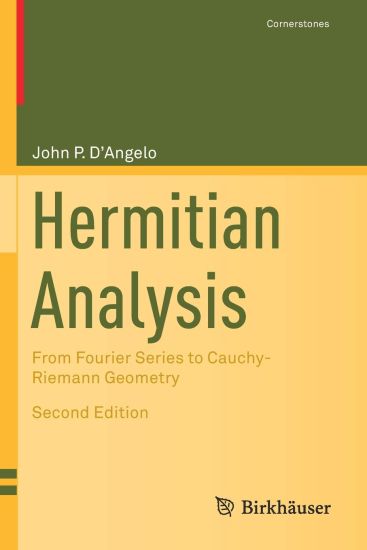
Hermitian Analysis

Hermitian Analysis

John P. D'Angelo

Birkhauser Boston Inc
2016
nidottu
??Hermitian Analysis: From Fourier Series to Cauchy-Riemann Geometry provides a coherent, integrated look at various topics from undergraduate analysis. It begins with Fourier series, continues with Hilbert spaces, discusses the Fourier transform on the real line, and then turns to the heart of the book, geometric considerations. This chapter includes complex differential forms, geometric inequalities from one and several complex variables, and includes some of the author's results. The concept of orthogonality weaves the material into a coherent whole. This textbook will be a useful resource for upper-undergraduate students who intend to continue with mathematics, graduate students interested in analysis, and researchers interested in some basic aspects of CR Geometry. The inclusion of several hundred exercises makes this book suitable for a capstone undergraduate Honors class.?
Linear and Complex Analysis for Applications

Linear and Complex Analysis for Applications

John P. D'Angelo

Productivity Press
2016
sidottu
Linear and Complex Analysis for Applications aims to unify various parts of mathematical analysis in an engaging manner and to provide a diverse and unusual collection of applications, both to other fields of mathematics and to physics and engineering. The book evolved from several of the author’s teaching experiences, his research in complex analysis in several variables, and many conversations with friends and colleagues. It has three primary goals: to develop enough linear analysis and complex variable theory to prepare students in engineering or applied mathematics for advanced work, to unify many distinct and seemingly isolated topics, to show mathematics as both interesting and useful, especially via the juxtaposition of examples and theorems.The book realizes these goals by beginning with reviews of Linear Algebra, Complex Numbers, and topics from Calculus III. As the topics are being reviewed, new material is inserted to help the student develop skill in both computation and theory. The material on linear algebra includes infinite-dimensional examples arising from elementary calculus and differential equations. Line and surface integrals are computed both in the language of classical vector analysis and by using differential forms. Connections among the topics and applications appear throughout the book.The text weaves abstract mathematics, routine computational problems, and applications into a coherent whole, whose unifying theme is linear systems. It includes many unusual examples and contains more than 450 exercises.
Hermitian Analysis

Hermitian Analysis

John P. D'Angelo

Springer Nature Switzerland AG
2019
sidottu
This textbook provides a coherent, integrated look at various topics from undergraduate analysis. It begins with Fourier series, continues with Hilbert spaces, discusses the Fourier transform on the real line, and then turns to the heart of the book, geometric considerations. This chapter includes complex differential forms, geometric inequalities from one and several complex variables, and includes some of the author's original results. The concept of orthogonality weaves the material into a coherent whole. This textbook will be a useful resource for upper-undergraduate students who intend to continue with mathematics, graduate students interested in analysis, and researchers interested in some basic aspects of Cauchy-Riemann (CR) geometry. The inclusion of several hundred exercises makes this book suitable for a capstone undergraduate Honors class.?This second edition contains a significant amount of new material, including a new chapter dedicated to the CR geometry of the unit sphere. This chapter builds upon the first edition by presenting recent results about groups associated with CR sphere maps. From reviews of the first edition:The present book developed from the teaching experiences of the author in several honors courses. …. All the topics are motivated very nicely, and there are many exercises, which make the book ideal for a first-year graduate course on the subject. …. The style is concise, always very neat, and proofs are given with full details. Hence, I certainly suggest this nice textbook to anyone interested in the subject, even for self-study. Fabio Nicola, Politecnico di Torino, Mathematical ReviewsD’Angelo has written an eminently readable book, including excellent explanations of pretty nasty stuff for even the more gifted upper division players .... It certainly succeeds in hooking the present browser: I like this booka great deal. Michael Berg, Loyola Marymount University, Mathematical Association of America
Hermitian Analysis

Hermitian Analysis

John P. D'Angelo

Springer Nature Switzerland AG
2020
nidottu
This textbook provides a coherent, integrated look at various topics from undergraduate analysis. It begins with Fourier series, continues with Hilbert spaces, discusses the Fourier transform on the real line, and then turns to the heart of the book, geometric considerations. This chapter includes complex differential forms, geometric inequalities from one and several complex variables, and includes some of the author's original results. The concept of orthogonality weaves the material into a coherent whole. This textbook will be a useful resource for upper-undergraduate students who intend to continue with mathematics, graduate students interested in analysis, and researchers interested in some basic aspects of Cauchy-Riemann (CR) geometry. The inclusion of several hundred exercises makes this book suitable for a capstone undergraduate Honors class.?This second edition contains a significant amount of new material, including a new chapter dedicated to the CR geometry of the unit sphere. This chapter builds upon the first edition by presenting recent results about groups associated with CR sphere maps. From reviews of the first edition:The present book developed from the teaching experiences of the author in several honors courses. …. All the topics are motivated very nicely, and there are many exercises, which make the book ideal for a first-year graduate course on the subject. …. The style is concise, always very neat, and proofs are given with full details. Hence, I certainly suggest this nice textbook to anyone interested in the subject, even for self-study. Fabio Nicola, Politecnico di Torino, Mathematical ReviewsD’Angelo has written an eminently readable book, including excellent explanations of pretty nasty stuff for even the more gifted upper division players .... It certainly succeeds in hooking the present browser: I like this booka great deal. Michael Berg, Loyola Marymount University, Mathematical Association of America