Kirjojen hintavertailu. Mukana 12 390 323 kirjaa ja 12 kauppaa.

Kirjahaku

Etsi kirjoja tekijän nimen, kirjan nimen tai ISBN:n perusteella.

30 kirjaa tekijältä John R. Anderson

John R. Anderson Explored

John R. Anderson Explored

73 Art Agency; John R. Anderson

Spring Cedars LLC
2020
nidottu
John R. Anderson Explored is a catalogue that presents the second large-scale exhibition and sale of work by artist John R. Anderson. Offering fresh insights into Anderson's unique art and creative development, this oeuvre is an exceptional source for research and public delight. This selection of 51 abstract acrylic paintings by 73 Art Agency, explores Anderson's artistic process and technique, featuring works from across the artist's career, including two early paintings from the 1960s, eight from the 1990s, and sixteen completed recently in 2018.
John R. Anderson Expanded

John R. Anderson Expanded

73 Art Agency; John R. Anderson

Spring Cedars LLC
2025
nidottu
John R. Anderson Expanded is a catalogue that presents the third large-scale exhibition and sale of work by artist John R. Anderson. This collection showcases 41 newly discovered paintings retrieved from the artist's studio in Yankton, South Dakota-each a testament to his lifelong commitment to exploration and reinvention. It not only highlights the latest chapter of Anderson's artistic journey but also pays tribute to the visionary spirit that defined his career. With Expanded, we celebrate an artist who never ceased to push the boundaries of Lyrical Abstraction, an artist who saw creativity as an ever-unfolding process.
How Can the Human Mind Occur in the Physical Universe?

How Can the Human Mind Occur in the Physical Universe?

John R. Anderson

Oxford University Press Inc
2007
sidottu
"The question for me is how can the human mind occur in the physical universe? We now know that the world is governed by physics. We now understand the way biology nestles comfortably within that. The issue is how will the mind do that as well?" Alan Newell, 4 December 1991, Carnegie Mellon University The argument John Anderson gives in this book was inspired by the passage above, from the last lecture by one of the pioneers of cognitive science. Alan Newell describes what, for him, is the pivotal question of scientific inquiry, and Anderson gives an answer that is emerging from the study of brain and behaviour. Humans share the same basic cognitive architecture with all primates, but they have evolved abilities to exercise abstract control over cognition and process more complex relational patterns. The human cognitive architecture consists of a set of largely independent modules associated with different brain regions. This book discusses in detail how these various modules can combine to produce behaviors as varied as driving a car and solving an algebraic equation, but focuses principally on two of the modules: the declarative and procedural. The declarative module involves a memory system that, moment by moment, attempts to give each person the most appropriate possible window into his or her past. The procedural module involves a central system that strives to develop a set of productions that will enable the most adaptive response from any state of the modules. Newell argued that the answer to his question must take the form of a cognitive architecture, and Anderson organizes his answer around the ACT-R architecture, but broadens it by bringing in research from all areas of cognitive science, including how recent work in brain imaging maps onto the cognitive architecture.
How Can the Human Mind Occur in the Physical Universe?

How Can the Human Mind Occur in the Physical Universe?

John R. Anderson

Oxford University Press Inc
2009
nidottu
'The question for me is how can the human mind occur in the physical universe. We now know that the world is governed by physics. We now understand the way biology nestles comfortably within that. The issue is how will the mind do that as well.' --Alan Newell, December 4, 1991, Carnegie Mellon University The argument John Anderson gives in this book was inspired by the passage above, from the last lecture by one of the pioneers of cognitive science. Newell describes what, for him, is the pivotal question of scientific inquiry, and Anderson gives an answer that is emerging from the study of brain and behavior. Humans share the same basic cognitive architecture with all primates, but they have evolved abilities to exercise abstract control over cognition and process more complex relational patterns. The human cognitive architecture consists of a set of largely independent modules associated with different brain regions. In this book, Anderson discusses in detail how these various modules can combine to produce behaviors as varied as driving a car and solving an algebraic equation, but focuses principally on two of the modules: the declarative and procedural. The declarative module involves a memory system that, moment by moment, attempts to give each person the most appropriate possible window into his or her past. The procedural module involves a central system that strives to develop a set of productions that will enable the most adaptive response from any state of the modules. Newell argued that the answer to his question must take the form of a cognitive architecture, and Anderson organizes his answer around the ACT-R architecture, but broadens it by bringing in research from all areas of cognitive science, including how recent work in brain imaging maps onto the cogntive architecture.
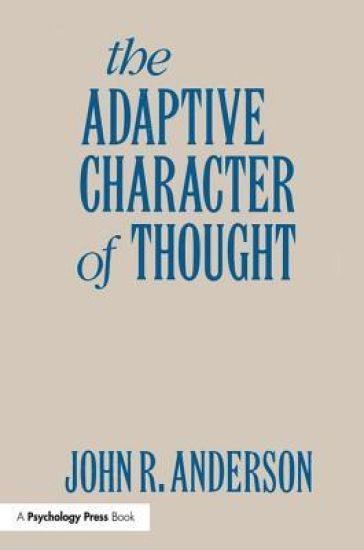
The Adaptive Character of Thought

The Adaptive Character of Thought

John R. Anderson

Psychology Press
1990
sidottu
This important volume examines the phenomena of cognition from an adaptive perspective. Rather than adhering to the typical practice in cognitive psychology of trying to predict behavior from a model of cognitive mechanisms, this book develops a number of models that successfully predict behavior from the structure of the environment to which cognition is adapted. The methodology -- called rational analysis -- involves specifying the information-processing goals of the system, the structure of the environment, and the computational constraints on the system, allowing predictions about behavior to be made by determining what behavior would be optimal under these assumptions. The Adaptive Character of Thought applies this methodology in great detail to four cognitive phenomena: memory, categorization, causal inference, and problem solving.
Rules of the Mind

Rules of the Mind

John R. Anderson

Psychology Press
1993
sidottu
Related to the earlier well-known ACT production system theory, this book's basic goal is to present evidence for the psychological reality of a production system model of mind. Distinguished from the original theory in three ways, this volume uses the rational analyses of Anderson (1990) to improve upon that theory and extend its scope. It also relates the theory to a great deal of new data on the performance and acquisition of cognitive skills. The new theory -- ACT-R -- involves a neurally plausible implementation of a production system architecture. Rational analysis is used to structure and parameterize the system to yield optimal information processing. The theory is applicable to a wide variety of research disciplines, including memory, problem solving, and skill acquisition. Using intelligent tutors, much of the data is concerned with the acquisition of cognitive skills. The book provides analyses of data sets describing the extended course of the acquisition of mathematical and computer programming skills.
Rules of the Mind

Rules of the Mind

John R. Anderson

Psychology Press
1993
nidottu
Related to the earlier well-known ACT production system theory, this book's basic goal is to present evidence for the psychological reality of a production system model of mind. Distinguished from the original theory in three ways, this volume uses the rational analyses of Anderson (1990) to improve upon that theory and extend its scope. It also relates the theory to a great deal of new data on the performance and acquisition of cognitive skills. The new theory -- ACT-R -- involves a neurally plausible implementation of a production system architecture. Rational analysis is used to structure and parameterize the system to yield optimal information processing. The theory is applicable to a wide variety of research disciplines, including memory, problem solving, and skill acquisition. Using intelligent tutors, much of the data is concerned with the acquisition of cognitive skills. The book provides analyses of data sets describing the extended course of the acquisition of mathematical and computer programming skills.
The Architecture of Cognition

The Architecture of Cognition

John R. Anderson

Psychology Press
1995
nidottu
Now available in paper, The Architecture of Cognition is a classic work that remains relevant to theory and research in cognitive science. The new version of Anderson's theory of cognitive architecture -- Adaptive Control of Thought (ACT*) -- is a theory of the basic principles of operation built into the cognitive system and is the main focus of the book.
Language, Memory, and Thought

Language, Memory, and Thought

John R. Anderson

Lawrence Erlbaum Associates Inc
1976
sidottu
Published in 1976, Language, Memory, and thought is a valuable contribution to the field of Cognitive Psychology. This book presents a theory about human cognitive functioning, a set of experiments testing that theory, and a review of some of the literature relevant to the theory. The theory is embodied in a computer simulation model called ACT.
The Architecture of Cognition

The Architecture of Cognition

John R. Anderson

Psychology Press Ltd
2016
sidottu
Now available in paper, The Architecture of Cognition is a classic work that remains relevant to theory and research in cognitive science. The new version of Anderson's theory of cognitive architecture -- Adaptive Control of Thought (ACT*) -- is a theory of the basic principles of operation built into the cognitive system and is the main focus of the book.
The Adaptive Character of Thought

The Adaptive Character of Thought

John R. Anderson

Psychology Press Ltd
2015
nidottu
This important volume examines the phenomena of cognition from an adaptive perspective. Rather than adhering to the typical practice in cognitive psychology of trying to predict behavior from a model of cognitive mechanisms, this book develops a number of models that successfully predict behavior from the structure of the environment to which cognition is adapted. The methodology -- called rational analysis -- involves specifying the information-processing goals of the system, the structure of the environment, and the computational constraints on the system, allowing predictions about behavior to be made by determining what behavior would be optimal under these assumptions. The Adaptive Character of Thought applies this methodology in great detail to four cognitive phenomena: memory, categorization, causal inference, and problem solving.
Cognitive Psychology and Its Implications
As always, Anderson makes his discussions of higher mental processes concrete and accessible with fascinating examples and clear explanations of the underlying research. The book can also be purchased with the breakthrough online resource, LaunchPad, which offers innovative media content, curated and organised for easy assignability.
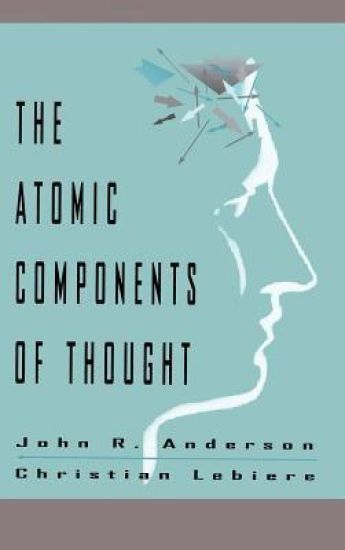
The Atomic Components of Thought

The Atomic Components of Thought

John R. Anderson; Christian J. Lebiere

Psychology Press
1998
sidottu
This book achieves a goal that was set 25 years ago when the HAM theory of human memory was published. This theory reflected one of a number of then-current efforts to create a theory of human cognition that met the twin goals of precision and complexity. Up until then the standard for precision had been the mathematical theories of the 1950s and 1960s. These theories took the form of precise models of specific experiments along with some informal, verbally-stated understanding of how they could be extended to new experiments. They seemed to fall far short of capturing the breadth and power of human cognition that was being demonstrated by the new experimental work in human cognition. The next 10 years saw two major efforts to address the problems of scope. In 1976, the ACT theory was first described and included a production rule system of procedural memory to complement HAM's declarative memory. This provided a computationally adequate system which was indeed capable of accounting for all sorts of cognition. In 1993, a new version of ACT--ACT-R--was published. This was an effort to summarize the theoretical progress made on skill acquisition in the intervening 10 years and to tune the subsymbolic level of ACT-R with the insights of the rational analysis of cognition. Although the appearance of generally-available, full-function code set off a series of events which was hardly planned, it resulted in this book. The catalyst for this was the emergence of a user community. Lebiere insisted that assembling a critical mass of users was essential to the ultimate success of the theory and that a physical gathering was the only way to achieve that goal. This resulted in the First Annual ACT-R Summer School and Workshop, held in 1994. In writing the book, the authors became seized by an aspiration that went beyond just describing the theory correctly. They decided to try to display what the theory could do by collecting together and describing some of its in-house applications. This book reflects decades of work in ACT-R accumulated by many researchers. The chapters are authored by the people that did that particular work. No doubt the reader will be impressed by the scope of the research and the quality of the individual work. Less apparent, but no less important, was the effort that everyone put into achieving the overall consistency and technical integrity of the book. This is the first work in cognitive science to precisely model such a wide range of phenomena with a single theory.
The Atomic Components of Thought

The Atomic Components of Thought

John R. Anderson; Christian J. Lebiere

Psychology Press
1998
nidottu
This book achieves a goal that was set 25 years ago when the HAM theory of human memory was published. This theory reflected one of a number of then-current efforts to create a theory of human cognition that met the twin goals of precision and complexity. Up until then the standard for precision had been the mathematical theories of the 1950s and 1960s. These theories took the form of precise models of specific experiments along with some informal, verbally-stated understanding of how they could be extended to new experiments. They seemed to fall far short of capturing the breadth and power of human cognition that was being demonstrated by the new experimental work in human cognition. The next 10 years saw two major efforts to address the problems of scope. In 1976, the ACT theory was first described and included a production rule system of procedural memory to complement HAM's declarative memory. This provided a computationally adequate system which was indeed capable of accounting for all sorts of cognition. In 1993, a new version of ACT--ACT-R--was published. This was an effort to summarize the theoretical progress made on skill acquisition in the intervening 10 years and to tune the subsymbolic level of ACT-R with the insights of the rational analysis of cognition. Although the appearance of generally-available, full-function code set off a series of events which was hardly planned, it resulted in this book. The catalyst for this was the emergence of a user community. Lebiere insisted that assembling a critical mass of users was essential to the ultimate success of the theory and that a physical gathering was the only way to achieve that goal. This resulted in the First Annual ACT-R Summer School and Workshop, held in 1994. In writing the book, the authors became seized by an aspiration that went beyond just describing the theory correctly. They decided to try to display what the theory could do by collecting together and describing some of its in-house applications. This book reflects decades of work in ACT-R accumulated by many researchers. The chapters are authored by the people that did that particular work. No doubt the reader will be impressed by the scope of the research and the quality of the individual work. Less apparent, but no less important, was the effort that everyone put into achieving the overall consistency and technical integrity of the book. This is the first work in cognitive science to precisely model such a wide range of phenomena with a single theory.
Human Associative Memory

Human Associative Memory

John R. Anderson; G. H. Bower

Lawrence Erlbaum Associates Inc
1973
sidottu
First published in 1973. This book proposes and tests a theory about human memory, about how a person encodes, retains, and retrieves information from memory. The book is especially concerned with memory for sentential materials. We propose a theoretical framework which is adequate for describing comprehension of linguistic materials, for exhibiting the internal representation of propositional materials, for characterizing the interpretative processes which encode this information into memory and make use of it for remembering, for answering questions, recognizing instances of known categories, drawing inferences, and making deductions.
Catalysis

Catalysis

John R. Anderson; Michel Boudart

Springer-Verlag Berlin and Heidelberg GmbH Co. K
2011
nidottu
NMR methods have for a considerable time been standard processes for the analysis of molecular structure: so much so that they are now universally regarded as indispensable for this purpose. Nevertheless, with the passage of time, NMR methodology has been elaborated to levels of ever increasing complexity and analytical sophistication so that the non­ specialist may now be readily excused for the belief that for anything beyond relatively elementary methods one would be well advised to work in collaboration with the specialist experts. The application of NMR methods to the field of catalysis occurred, in the main, relatively late in the day, mainly be­ cause those catalysts of greatest industrial importance, that is heterogeneous catalysts, are solids and so require special NMR methods if usefully narrow NMR lines are to be ob­ servable. Even so, magic-angle spinning NMR methodology is now thoroughly well established and is finding increasing use in the study of catalyst structure. Of course, conventional NMR methods have been used for a considerable time for the analysis of the products of catalytic reactions. Chapter 1 of the present volume by Professor Jacques Fraissard and his collaborators is designed to give an account of the application of NMR methods to the field of catalysis, but not including the conventional use of NMR for reaction product analysis, since this is already well covered in the existing NMR literature.
Catalysis

Catalysis

John R. Anderson; Michel Boudart

Springer-Verlag Berlin and Heidelberg GmbH Co. K
2011
nidottu
Hydrotreating processes in petroleum refining were introduced more than 50 years ago for the removal of sulfur and nitrogen. The sulfided cobalt-molybdenum catalyst, together with its near relatives, is still widely used. Two oil crises made it clear that pretroleum reserves are not inexhaustible and we shall be compelled to exploid less satisfactory sources with high sulfur and nitrogen making hydrotreating even more important. This review is particularly timely for the reason that only recently has a detailed understanding of process chemistry and catalyst structure been obtained. The authors concentrate on the catalytic chemistry of the processes, dealing in some detail with the structure of the most important types of catalysts and the relationship of structure to activity.