Kirjojen hintavertailu. Mukana 12 390 323 kirjaa ja 12 kauppaa.

Kirjahaku

Etsi kirjoja tekijän nimen, kirjan nimen tai ISBN:n perusteella.

14 kirjaa tekijältä John Schad

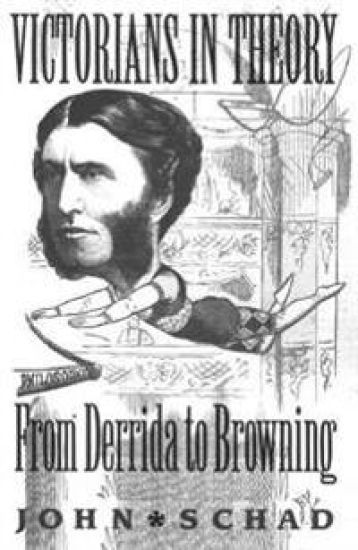
Victorians in Theory

Victorians in Theory

John Schad

Manchester University Press
2009
nidottu
"Each century," wrote Charles Dickens "[is] more amazed by the century following it than by all the centuries before." Victorians in theory explores the startling conceit that nineteenth-century poetry is amazed by twentieth-century literary theory. In a daring and exciting departure from critical convention, Schad re-reads postructuralist theory through Victorian poetry. Each chapter pairs a poet with a theorist: Robert Browning meets Jacques Derrida; Christina Rossetti encounters Luce Irigaray; Matthew Arnold is after Michel Foucault; Gerald Manley Hopkins dreams with Jacques Lacan; and Elizabeth Barrett Browning haunts Hélène Cixous. Reading both across and between these writers, Schad opens up a radically intertextual space; he wanders, in Matthew Arnold's words, "between two worlds." Across this no-man's land appear a host of unlikely specters, among them T. S. Eliot, Martin Luther, Friedrich Nietzsche, Lewis Carroll's Alice, Walter Benjamin's "angel of history," and the woman taken in adultery.This book will fascinate anyone interested in the Victorians or theory; at once rigorous and readable, it will appeal to both the scholar and the student.
Arthur Hugh Clough

Arthur Hugh Clough

John Schad

Liverpool University Press
2005
nidottu
Swinburne called him a bad poet, Tennyson called him dull, Saintsbury called him thin. John Schad celebrates Clough the anti-poet, a loving laureate of the extraordinary dull, who is so thin we can see through, or beyond him. Clough, argues Schad, never gets in the way of the world, or worlds, of which he writes. And these worlds are many: ranging from the orthodox world of the Anglican Oxford that Clough famously abandons, through the turbulent worlds of Paris and Rome that Clough visits in the wake of the revolutionary events of 1848, to the quietly desperate world of Clough’s final years. For Schad, though, Clough’s defining world is the very strange world of continental thought, a world which makes him a most un-Victorian Victorian.
The Late Walter Benjamin

The Late Walter Benjamin

John Schad

Continuum Publishing Corporation
2012
sidottu
This fully-annotated documentary novel explores the life and thought of Walter Benjamin, imaginatively examining its implications in the political context of a post-War London estate. A startling critical-creative examination of one of the 20th Century's leading thinkers, "The Late Walter Benjamin" is a documentary novel that juxtaposes the life and death of Walter Benjamin with the days, hours and minutes of a working-class council estate on the edge of London in post-war Austerity England. The novel centres on one particular tenant who claims to be Walter Benjamin, and only ever uses words written by Benjamin, apparently oblivious that the real Benjamin committed suicide 20 years earlier whilst fleeing the Nazis. Initially set in the sixties, the text slips back to the early years of the estate and to Benjamin's last days, as he moves across Europe seeking ever-more desperately to escape the Third Reich. Through this fictional narrative, John Schad explores not only the emergence of Benjamin's thinking from a politicised Jewish theology forced to confront the rise of Nazism but also the implications of his utopian Marxism, forged in exile, for the very different context of a displaced working class community in post-war Britain. This series aims to showcase new work at the forefront of religion and literature through short studies written by leading and rising scholars in the field. Books will pursue a variety of theoretical approaches as they engage with writing from different religious and literary traditions. Collectively, the series will offer a timely critical intervention to the interdisciplinary crossover between religion and literature, speaking to wider contemporary interests and mapping out new directions for the field in the early twenty-first century.
The Late Walter Benjamin

The Late Walter Benjamin

John Schad

Continuum Publishing Corporation
2012
nidottu
This fully-annotated documentary novel explores the life and thought of Walter Benjamin, imaginatively examining its implications in the political context of a post-War London estate. A startling critical-creative examination of one of the 20th Century's leading thinkers, "The Late Walter Benjamin" is a documentary novel that juxtaposes the life and death of Walter Benjamin with the days, hours and minutes of a working-class council estate on the edge of London in post-war Austerity England. The novel centres on one particular tenant who claims to be Walter Benjamin, and only ever uses words written by Benjamin, apparently oblivious that the real Benjamin committed suicide 20 years earlier whilst fleeing the Nazis. Initially set in the sixties, the text slips back to the early years of the estate and to Benjamin's last days, as he moves across Europe seeking ever-more desperately to escape the Third Reich. Through this fictional narrative, John Schad explores not only the emergence of Benjamin's thinking from a politicised Jewish theology forced to confront the rise of Nazism but also the implications of his utopian Marxism, forged in exile, for the very different context of a displaced working class community in post-war Britain. This series aims to showcase new work at the forefront of religion and literature through short studies written by leading and rising scholars in the field. Books will pursue a variety of theoretical approaches as they engage with writing from different religious and literary traditions. Collectively, the series will offer a timely critical intervention to the interdisciplinary crossover between religion and literature, speaking to wider contemporary interests and mapping out new directions for the field in the early twenty-first century.
Someone Called Derrida

Someone Called Derrida

John Schad

Sussex Academic Press
2007
sidottu
Someone called Jacques Derrida, someone called him on the phone, someone who was dead -- this was August 22nd 1979. A mystery, he thought; but it is a mystery that began more than ten years earlier, in 1968, when Derrida, a philosopher, visits Oxford and there, before the very eyes of the Philosophy Sub-Faculty, he dies, several times. Murder, he thought. And so I shall investigate, and begin with a sign that the philosopher says he left within a book from the thirteenth century, a strange fortune-telling book that he had found in the oldest part of Oxford's Bodleian Library. In the book are a host of cryptic questions, but the philosopher directs us to one in particular, a peculiar question about a boy, and the question is this: Does the boy live? The philosopher will not, though, give the answer; he requires, instead, that we go to Oxford to open the book for ourselves.
Someone Called Derrida

Someone Called Derrida

John Schad

Sussex Academic Press
2007
nidottu
Someone called Jacques Derrida, someone called him on the phone, someone who was dead -- this was August 22nd 1979. A mystery, he thought; but it is a mystery that began more than ten years earlier, in 1968, when Derrida, a philosopher, visits Oxford and there, before the very eyes of the Philosophy Sub-Faculty, he dies, several times. Murder, he thought. And so I shall investigate, and begin with a sign that the philosopher says he left within a book from the thirteenth century, a strange fortune-telling book that he had found in the oldest part of Oxford's Bodleian Library. In the book are a host of cryptic questions, but the philosopher directs us to one in particular, a peculiar question about a boy, and the question is this: Does the boy live? The philosopher will not, though, give the answer; he requires, instead, that we go to Oxford to open the book for ourselves.
Hostage of the Word

Hostage of the Word

John Schad

Sussex Academic Press
2012
sidottu
This book brings together a number of John Schad's very best uncollected essays, interleaved with a selection of autobiographical poems and a striking new work that brings together both critical and creative modes of writing. Turns thus plots the intriguing trajectory of Schad's very distinctive work over the last twenty years -- a trajectory that moves from a series of essays that juggle Christian, Marxist and Derridean intuitions, through a radically literary engagement with Deconstruction, to a daringly critical-creative mode of writing. In this exciting new field, as in the more established world of literature and religion, Schad is an idiosyncratic and sometimes audacious pioneer. The book is to be published simultaneously in hardback and paperback to accommodate adoption on critical-creative courses at both undergraduate and postgraduate levels.
Hostage of the Word

Hostage of the Word

John Schad

Sussex Academic Press
2012
nidottu
This book brings together a number of John Schad's very best uncollected essays, interleaved with a selection of autobiographical poems and a striking new work that brings together both critical and creative modes of writing. Turns thus plots the intriguing trajectory of Schad's very distinctive work over the last twenty years -- a trajectory that moves from a series of essays that juggle Christian, Marxist and Derridean intuitions, through a radically literary engagement with Deconstruction, to a daringly critical-creative mode of writing. In this exciting new field, as in the more established world of literature and religion, Schad is an idiosyncratic and sometimes audacious pioneer. The book is to be published simultaneously in hardback and paperback to accommodate adoption on critical-creative courses at both undergraduate and postgraduate levels.
Queer Fish

Queer Fish

John Schad

Sussex Academic Press
2004
sidottu
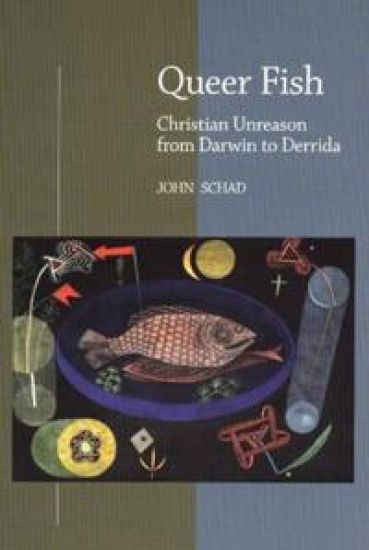
At some point in the nineteenth century, God died, the world grew secular, and Christianity became oppositional, irrational, odd, even queer -- or so the story goes. To explore this narrative, John Schad offers a suitably odd or 'unreasonable' history of what Michel Foucault once called 'Christian unreason'. This proves, in part, to be an unlikely, or uncanny history of Christian involvement in such radical movements and developments as Anarchism, Surrealism, the Absurd, deconstruction, and even quantum physics. It also proves to be a dark and guilty history of Christian involvement in such terrible things and events as slavery, forced conversion, Fenian bombs, the Great War, the Holocaust, and even Hiroshima. The book begins with Matthew Arnold's 'Dover Beach' and its withdrawing 'sea of faith' as time and again Schad finds the figure of the Christian to be beached, a fish out of water -- a queer fish, in fact. This, then, is a book that is all at sea -- beginning with Charles Darwin's voyage to the 'extreme point of Christendom' that was South America, and ending with James Joyce and Jacques Derrida in 'the same boat', the same ruined, but sea-going, boat that is the twentieth-century Western Church. In between: Karl Marx is to be found in 1848 watching 'the waves of revolution' withdraw in Berlin; Sigmund Freud stands incredulous by the shore of Loch Ness; Oscar Wilde is laughed at in the rain at Clapham Junction; and Charles Dickens visits a church for the drowned, a church for ship-wrecked corpses. Revisiting 'Dover Beach' is often an appalling event, an event of death; often it is comic or even absurd. Sometimes it is both at once. With chapters devoted to Darwin, Marx, Freud, Dickens, Wilde, Joyce, and Derrida, Queer Fish has plenty for students not only of literature and philosophy but also theology and Jewish studies.
Queer Fish

Queer Fish

John Schad

Sussex Academic Press
2021
nidottu
At some point in the nineteenth century, God died, the world grew secular, and Christianity became oppositional, irrational, odd, even queer -- or so the story goes. To explore this narrative, John Schad offers a suitably odd or 'unreasonable' history of what Michel Foucault once called 'Christian unreason'. This proves, in part, to be an unlikely, or uncanny history of Christian involvement in such radical movements and developments as Anarchism, Surrealism, the Absurd, deconstruction, and even quantum physics. It also proves to be a dark and guilty history of Christian involvement in such terrible things and events as slavery, forced conversion, Fenian bombs, the Great War, the Holocaust, and even Hiroshima. The book begins with Matthew Arnold's 'Dover Beach' and its withdrawing 'sea of faith' as time and again Schad finds the figure of the Christian to be beached, a fish out of water -- a queer fish, in fact. This, then, is a book that is all at sea -- beginning with Charles Darwin's voyage to the 'extreme point of Christendom' that was South America, and ending with James Joyce and Jacques Derrida in 'the same boat', the same ruined, but sea-going, boat that is the twentieth-century Western Church. In between: Karl Marx is to be found in 1848 watching 'the waves of revolution' withdraw in Berlin; Sigmund Freud stands incredulous by the shore of Loch Ness; Oscar Wilde is laughed at in the rain at Clapham Junction; and Charles Dickens visits a church for the drowned, a church for ship-wrecked corpses. Revisiting 'Dover Beach' is often an appalling event, an event of death; often it is comic or even absurd. Sometimes it is both at once. With chapters devoted to Darwin, Marx, Freud, Dickens, Wilde, Joyce, and Derrida, Queer Fish has plenty for students not only of literature and philosophy but also theology and Jewish studies.
Derrida | Benjamin

Derrida | Benjamin

John Schad; Fred Dalmasso

Springer Nature Switzerland AG
2021
sidottu
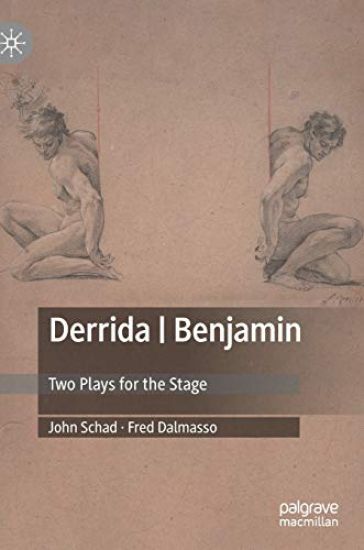
Within the work of both Jacques Derrida and Walter Benjamin there is a buried theatricality, a theatre to-come. And in the last fifteen years there has been a growing awareness of this theatricality. To date, though, there has not been a published stage play about either Derrida or BenjaminCue Derrida| Benjamin, a volume that brings together two tragi-comic plays which mirror each other in a host of ways – above all, in the way that the central philosophical figure is displaced, or not quite where or when we would expect to find them. In Derrida’s case, it is Oxford in 1968; in Benjamin’s case, it is somewhere (or nowhere) near London in 1948. These, then, are plays in which the philosopher is exiled, or elsewhere – not quite himself. This a volume for anyone with an eye or ear for where theatre or performance meets philosophy – students, scholars, readers, actors.
Derrida | Benjamin

Derrida | Benjamin

John Schad; Fred Dalmasso

Springer Nature Switzerland AG
2022
nidottu
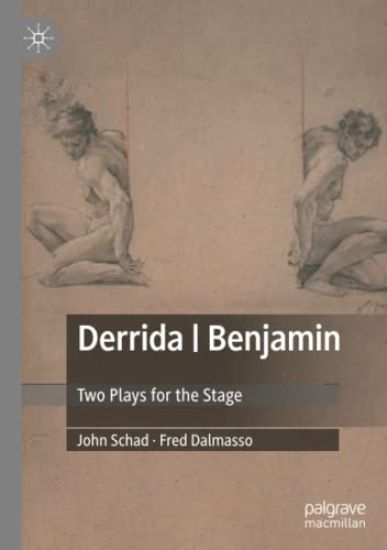
Within the work of both Jacques Derrida and Walter Benjamin there is a buried theatricality, a theatre to-come. And in the last fifteen years there has been a growing awareness of this theatricality. To date, though, there has not been a published stage play about either Derrida or BenjaminCue Derrida| Benjamin, a volume that brings together two tragi-comic plays which mirror each other in a host of ways – above all, in the way that the central philosophical figure is displaced, or not quite where or when we would expect to find them. In Derrida’s case, it is Oxford in 1968; in Benjamin’s case, it is somewhere (or nowhere) near London in 1948. These, then, are plays in which the philosopher is exiled, or elsewhere – not quite himself. This a volume for anyone with an eye or ear for where theatre or performance meets philosophy – students, scholars, readers, actors.