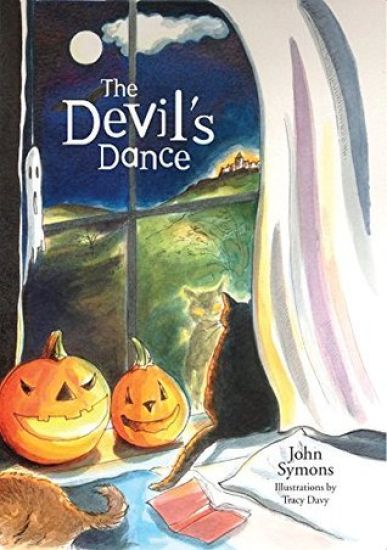
The Devil's Dance transcends categories. It is an exciting, original story, full of menace and very moving. The story is told in turn by two teenagers, Jake and Samuel. It begins with a dream, like a musical overture, which contains the themes to be developed in the rest of the work and describes events that took place two or three hundred years
This book tells the story of two people, born in poverty, who found each other and married in a world at war. They brought up and educated a family, but while their two sons were still very young, the father, a strong man who had served for twenty-five years in the army in India, developed the symptoms of Huntington’s disease. This cast a deep shadow over the family as his condition deteriorated over the next twenty-five years, but their faithful experience of God's love and their deep love for each other gave them the strength and sense of purpose that brought them safe to the end, a meaning expressed in the words of Mother Julian of Norwich: “Do you want to know what our Lord meant in all this? Love is his meaning. In this love our life is everlasting. All this we shall see in God without end.” Love is His Meaning recreates in a new way and as one book, as the author always wished, the story first presented in Stranger on the Shore and This Life of Grace, both of which captivated readers. This new book has allowed the author to draw together the separate stories of his parents and of their families, before they were married, the story of their marriage and of his mother's long life after his father's death. This treatment, of parallel lives, gives a picture of life in our country over the whole of the twentieth century, allowing the reader to grasp what life was like for many ordinary families in those days when the power of the Christian Faith was more influential and widely experienced.
The controversy surrounding the publication of the Zinoviev letter in The Daily Mail in October 1924 has close parallels with events today: Was it leaked by British officials or fake news to influence the outcome of the forthcoming election? On the basis of compelling evidence this book overturns the generally accepted view about the authenticity of the Zinoviev letter, proving it was genuine. The minority Labour government under Ramsay MacDonald had called an election for November. In the last days of the election campaign the press broke the news of a letter purporting to have been sent from Moscow by Grigory Zinoviev, Chairman of the Soviet-controlled Communist International, to the Communist Party of Great Britain. The letter urged members of the Party to increase their efforts to gain power by manipulating the Labour Party, which was hostile to Communist aims, so as to move the Labour Party to a revolutionary position, and by recruiting disenchanted military personnel to form the basis of a British `Red Army'. The Zinoviev letter had reached the Foreign Office via the Secret Service. It caused a storm, with accusations that it was a fabrication by White Russians or by British elements hostile to Ramsay MacDonald's Labour Government, and possibly lost Labour the election. It has never been established whether it was leaked to the Daily Mail by British officials or by someone from the British Communist Party. The author reveals that Zinoviev's letter, sent to British Communists by the Comintern, was not a fabrication, as has been widely believed for almost a hundred years. The evidence to show that this is so has been publicly available since 1930. The book ends with the question, was it overlooked or deliberately concealed by those with an allegiance to the Soviet Union? That is the new and real mystery of the Zinoviev letter.
In late 2019 the Corona virus emerged and spread quickly around the world. With it went the invisible virus of fear. No one knew how many of those who caught it would die, but the fear of death was in the air. Most of the world was locked down. No public figure asked or tried to answer the questions, at one time so deeply felt: 'Is death the end?' 'Is there an afterlife?' Perhaps they assumed the answers 'Yes' and 'No' respectively but, the author argues, those answers are not to be taken for granted. Unasked questions cause untold psychological trouble. The author tackles these questions in a direct, open way of interest to believers and non-believers alike. In fact he asks 'If you do not believe, do you wish there were an afterlife?' He acknowledges that he feels great sympathy with and respect for those who do not believe in the life of the world to come, and admits that he was once one such. In the book he explains frankly what he now believes and why. He argues that it is the most important question that any of us faces: Are we or are we not created by God to live forever, first in this world and then in His nearer presence in the life of the world to come? It is not a comfortable question to face, but which answer is true?
Title: Kingstoniana: being historical gleanings and personal recollections by ... J. Symons.Publisher: British Library, Historical Print EditionsThe British Library is the national library of the United Kingdom. It is one of the world's largest research libraries holding over 150 million items in all known languages and formats: books, journals, newspapers, sound recordings, patents, maps, stamps, prints and much more. Its collections include around 14 million books, along with substantial additional collections of manuscripts and historical items dating back as far as 300 BC.The HISTORY OF BRITAIN & IRELAND collection includes books from the British Library digitised by Microsoft. As well as historical works, this collection includes geographies, travelogues, and titles covering periods of competition and cooperation among the people of Great Britain and Ireland. Works also explore the countries' relations with France, Germany, the Low Countries, Denmark, and Scandinavia. ++++The below data was compiled from various identification fields in the bibliographic record of this title. This data is provided as an additional tool in helping to insure edition identification: ++++ British Library Symons, John; 1889. 140 p.; 4 . 10358.k.7.
Reprint of the original, first published in 1872. The publishing house Anatiposi publishes historical books as reprints. Due to their age, these books may have missing pages or inferior quality. Our aim is to preserve these books and make them available to the public so that they do not get lost.
Reprint of the original, first published in 1872. The publishing house Anatiposi publishes historical books as reprints. Due to their age, these books may have missing pages or inferior quality. Our aim is to preserve these books and make them available to the public so that they do not get lost.
Over the past forty years the visual system has been the most important battleground for competing general theories of brain function. In their most interesting form, theories of brain function are directed towards answering basic philosophical questions concerning the nature of mind. A large part of this monograph involves a presentation and analysis of David Marr's computational theory of vision, focusing especially on his tripartition of computational, algorithmic and implementational levels of analysis. This historical analysis is intended to provide the motivation for a reevaluation of the central methodological presuppositions in the study of the visual system. Ultimately, this book demonstrates that the dream of being able to distinguish psychological functions without attending to neuroscientific detail has come to an end.