Kirjojen hintavertailu. Mukana 11 627 067 kirjaa ja 12 kauppaa.

Kirjahaku

Etsi kirjoja tekijän nimen, kirjan nimen tai ISBN:n perusteella.

6 kirjaa tekijältä Jon Balserak

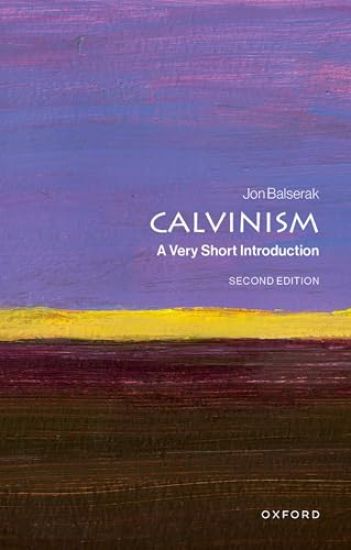
Calvinism

Calvinism

Jon Balserak

Oxford University Press
2026
nidottu
Very Short Introductions: Brilliant, Sharp, Inspiring Since its beginnings during the Protestant Reformation, Calvinism has spread throughout Europe and America and eventually to Africa and Asia. Today it is one of the largest schools of thought in Protestantism. In this Very Short Introduction, Jon Balserak explores how Calvinist ideas and practices arose, spread, and took root. Considering its influence on modern thought on everything from theology to money, politics, and the arts, Balserak also combats some of the common misconceptions about Calvinism, and outlines the Calvinist understanding of God, the world, humankind, and the meaning of life. He also addresses Calvinism in a twenty-first century context and considers the challenges it faces today. ABOUT THE SERIES: The Very Short Introductions series from Oxford University Press contains hundreds of titles in almost every subject area. These pocket-sized books are the perfect way to get ahead in a new subject quickly. Our expert authors combine facts, analysis, perspective, new ideas, and enthusiasm to make interesting and challenging topics highly readable.
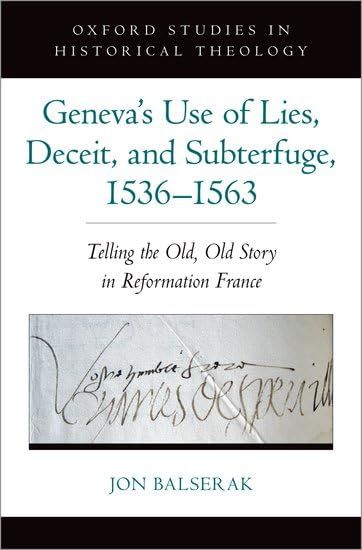
Geneva's Use of Lies, Deceit, and Subterfuge, 1536-1563

Geneva's Use of Lies, Deceit, and Subterfuge, 1536-1563

Jon Balserak

OXFORD UNIVERSITY PRESS INC
2024
sidottu
Geneva was hated and loved in sixteenth-century France. Representing those who hated them were the French Catholic government, who tried desperately to eradicate Genevan Calvinism from its borders--for good reason, as it was growing significantly within France between 1540 and 1563. This book presents a new reading of the battle that raged between the Genevan ministers and the French government during this period. It argues that Calvin, after fleeing France in 1534, began during his wanderings to devise plans to establish Christ's kingdom in his homeland, rescuing it from the "idolatrous" Catholicism imposed on the French people by their monarchs. It shows that Calvin's plans entailed the systematic use of lying and deception which were necessary in order to evade detection from the French authorities. These mendacious means were employed by the Genevans to hide their support of the French Reformed congregations, to conceal political maneuvering among the French nobility who could open France to reform, and to cloak their assisting of the Huguenots during the first French civil war. Jon Balserak sets out the character of Calvin's plans and argues that even the formation of the Genevan company of pastors and the Bourse française were, in part, designed to assist Calvin with his proselytizing goals. The last third of this volume examines the ways in which Calvin adapted Geneva's missionary efforts to deal with three unexpected circumstances that arose between 1559 and 1563: the rise to the throne of Francis II, the assuming of the regency government by Catherine de Medici, and the beginning of war. Though they continued their clandestine operations in support of the Reformed faith in France, these challenges called forth from the Genevans' new efforts, which Balserak analyzes. Calvin's call to the Huguenots to cease fighting and humble themselves before God following Louis of Condé's disastrous signing of the 1563 Peace of Amboise brilliantly illustrates the complex godliness that characterized this entire operation.
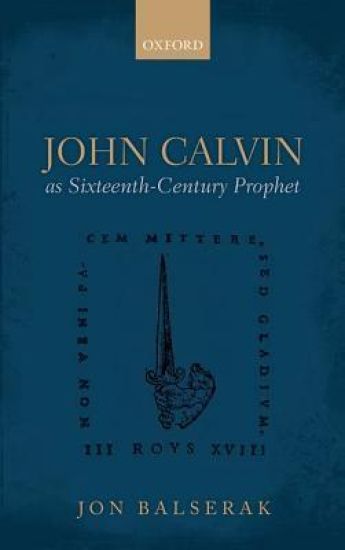
John Calvin as Sixteenth-Century Prophet

John Calvin as Sixteenth-Century Prophet

Jon Balserak

Oxford University Press
2014
sidottu
John Calvin as Sixteenth-Century Prophet examines Calvin's sense of vocation. Jon Balserak argues that Calvin believed himself to be a prophet "placed over nations and kingdoms to tear down and destroy, to build and to plant" (Jer 1: 10). With this authority, Calvin pursued an expansionist agenda which blended the religious, political, and social towards making France, upon which he turned his attentions especially after 1555, Protestant. Beginning with an analysis of the two trajectories of thought existing within Christian discourse on prophecy from the patristic to the Early Modern era, this study goes on to locate Calvin within a non-mystical, non-apocalyptic prophetic tradition that focused on scriptural interpretation. Balserak demonstrates how Calvin developed a plan to win France for the gospel; a plan which included the possibility of armed conflict. To pursue his designs, Calvin trained "prophets" who were sent into France to labor intensely to undermine the king's authority on the grounds that he supported idolatry, convince the French Reformed congregations that they were already in a war with him, and prepare them for a possible military uprising. An additional part of this plan saw Calvin search for a French noble willing to support the evangelical religion, even if it meant initiating a coup. Calvin began ruminating over these ideas in the 1550s or possibly earlier. In this analysis, the war which commenced in 1562 represents the culmination of Calvin's years of preparation.
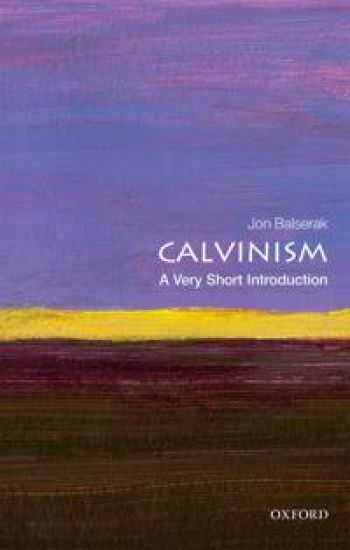
Calvinism

Calvinism

Jon Balserak

Oxford University Press
2016
nidottu
In this Very Short Introduction, Jon Balserak explores major ideas associated with the Calvinist system of thought. Beginning during the Protestant Reformation in cities like Zurich, Geneva, and Basel, Calvinismâalso known as Reformed Theologyâspread rapidly throughout Europe and the New World, eventually making its way to the African Continent and the East. Balserak examines how Calvinist thought and practice spread and took root, helping shape church and society. Much of contemporary thought, especially western thought, on everything from theology to civil government, economics, the arts, work and leisure, education, and the family has been influenced by Calvinism. Balserak explores this influence. He also examines common misconceptions and objections to Calvinism, and sets forth a Calvinist understanding of God, the world, humankind, and the meaning of life. ABOUT THE SERIES: The Very Short Introductions series from Oxford University Press contains hundreds of titles in almost every subject area. These pocket-sized books are the perfect way to get ahead in a new subject quickly. Our expert authors combine facts, analysis, perspective, new ideas, and enthusiasm to make interesting and challenging topics highly readable.
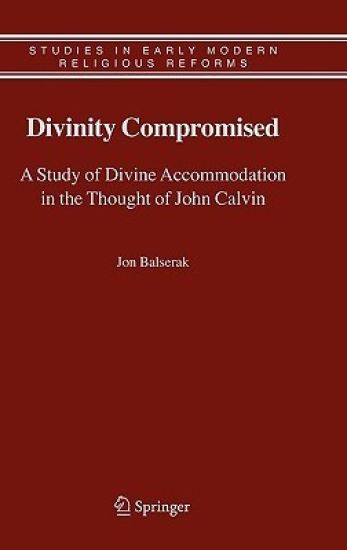
Divinity Compromised

Divinity Compromised

Jon Balserak

Springer-Verlag New York Inc.
2006
sidottu
Divine accommodation in John Calvin’s thought has yet to receive the attention it deserves. To date it has not been the subject of a monograph-length treatment in any language (this study is the first) and the number of journal articles and book chapters devoted solely to it is small. The present work will, it is hoped, help to fill this lacuna in research on the topic, but additional research is undoubtedly still needed. Its title probably deserves a comment. The use of the word compromised is intended to raise the question of the extent of accommodation’s penetration into Calvin’s doctrine of God. It aims to suggest the idea that Calvin’s thinking on accommodation might possess qualities which push against traditional thinking on the divine attributes. The idea was first suggested by E. David Willis. The present study will aim to expand upon it. This monograph owes much to the efforts of Emeritus Professor of Patristic and Reformed Christianity, David F. Wright, who, as supervisor, colleague and friend, has offered assistance to me on innumerable occasions and has also demonstrated a level of scholarly excellence in his own work that has been enormously instructive and encouraging. Thanks are also due to a host of others. Thanks must be expressed to Professor Tony Lane, who offered very helpful criticisms of two earlier versions of this work and whose kindness has not gone unnoticed or unappreciated.
Divinity Compromised

Divinity Compromised

Jon Balserak

Springer
2011
nidottu
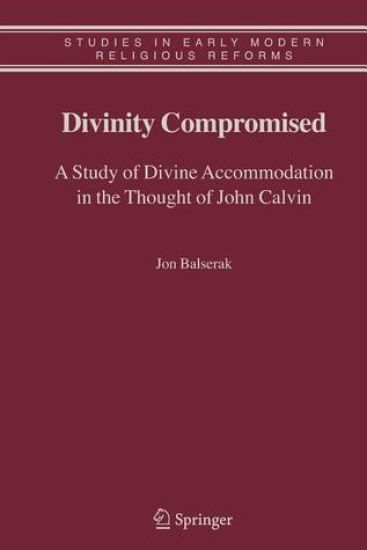
Divine accommodation in John Calvin’s thought has yet to receive the attention it deserves. To date it has not been the subject of a monograph-length treatment in any language (this study is the first) and the number of journal articles and book chapters devoted solely to it is small. The present work will, it is hoped, help to fill this lacuna in research on the topic, but additional research is undoubtedly still needed. Its title probably deserves a comment. The use of the word compromised is intended to raise the question of the extent of accommodation’s penetration into Calvin’s doctrine of God. It aims to suggest the idea that Calvin’s thinking on accommodation might possess qualities which push against traditional thinking on the divine attributes. The idea was first suggested by E. David Willis. The present study will aim to expand upon it. This monograph owes much to the efforts of Emeritus Professor of Patristic and Reformed Christianity, David F. Wright, who, as supervisor, colleague and friend, has offered assistance to me on innumerable occasions and has also demonstrated a level of scholarly excellence in his own work that has been enormously instructive and encouraging. Thanks are also due to a host of others. Thanks must be expressed to Professor Tony Lane, who offered very helpful criticisms of two earlier versions of this work and whose kindness has not gone unnoticed or unappreciated.