Kirjojen hintavertailu. Mukana 11 627 064 kirjaa ja 12 kauppaa.

Kirjahaku

Etsi kirjoja tekijän nimen, kirjan nimen tai ISBN:n perusteella.

4 kirjaa tekijältä Jon Kofas

Intervention and Underdevelopment

Intervention and Underdevelopment

Jon Kofas

Pennsylvania State University Press
1989
pokkari
. . . this ground-breaking study by Jon Kofas . . . provides an insightful analysis of the American aid program that determined the political and economic configuration of postwar Greece. Kofa's analysis, however, is equally significant for United States history because it was on Greek soil that American counterinsurgency, pacification, and containment tactics were evolved, tested, and later applied elsewhere in the Third World. Those who seek meaningful reappraisal rather than beguiling rationalization might well begin with this study, solidly grounded on all available sources. It presents a revisionist perspective regarding both the economic and the political development of Greece under American tutelage. The declared objective of the economic aid was to avoid restructuring of the Greek economy, and to preserve Greece as an exporter of raw materials and an importer of manufactured goods. Kofas asserts that an alternative program similar to that of the northern Balkan countries was feasible, and that failure to undertake such a program is vulnerable of today's Greek economy. Likewise in the political realm, Kofas rejects the Washington dogma that Greece has to be in either the Soviet or the American camp, and therefore must be in the latter. Kofas proposes as a "plausible alternative" a social-demographic regime that, in addition to socioeconomic reforms at home, could have pursued abroad a pro-Greek rather than a pro-Soviet or pro-American course. The victory of the American-supported forces in Greece obscured this alternative vision for decades. Yet it was persistently propounded, in the face of discouraging odds, by a variety of centrist and leftist leaders. With the coming to office of Andreas Papandreou, this vision has become official policy in Athens. Furthermore, assorted versions of this alternative strategy are cropping up globally, which is the underlying reason why the Third World today is out of control. And also why superpower doctrines and projects not recognizing this indisputable and irreversible fact are experiencing difficulties as embarrassing as they are predictable. Hence the broad significance of this thoughtful and thought provoking study. —From the Foreword by L. S. Stavrianos

The Sword of Damocles

The Sword of Damocles

Jon Kofas

Praeger Publishers Inc
2002
sidottu
Focusing on Chile and Colombia during the 1950s and 1960s, Kofas examines the impact of IMF, World Bank, and U.S. foreign policy on the economies and social and political institutions of Latin America. Far from fostering democracy and social justice, foreign loans and aid were major impediments to these ideals. Symptomatic of systematic underdevelopment, cyclical Third World foreign borrowing and debt crises have been responsible for maintaining the debtor nations integrated into the global market economy, perpetuating their dependency, and maintaining low living standards. Comparing Colombia and Chile, the book examines the complex factors of domestic and international forces that account for structural underdevelopment in the Third World.A study on the historical antecedents of globalism and its impact on the Third World, this book analyzes the interplay between IMF, World Bank, and U.S. foreign policy in shaping the economies of the Third World through loans that are the catalyst to global integration. Through its in-depth look at a complex topic, this book will prove provocative and valuable reading to students of globalization, inter-American relations, international finance, Latin American History, and U.S. diplomatic history.
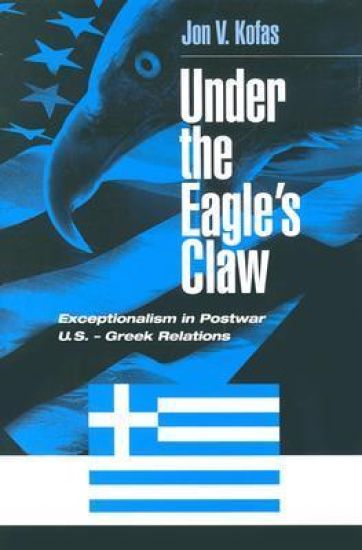
Under the Eagle's Claw

Under the Eagle's Claw

Jon Kofas

Praeger Publishers Inc
2003
sidottu
The record shows that the United States often acts as if it has license to disregard the sovereign rights of other peoples and nations. Kofas argues the United States has used Greece as a means of satisfying its own interests for the past half-century, and that Greece has suffered mightily at the hands of its protector. The United States has deemed this strategically situated nation too important to its own geopolitical ambitions to allow it to realize the democratic freedoms so often espoused.Because of U.S. pressure, Greeks have been subjected to authoritarian regimes and have carried huge military budgets that have significantly weakened social programs. Kofas shows that Greece's own domestic and international interests were consistently subordinated to America's.
Links on a Chain

Links on a Chain

Jon Kofas

Lulu.com
2022
pokkari
A third generation Norwegian, Freddie with a gambling addiction and nostalgic for the sixties counterculture, inherits the low-budget motel on the city's outskirts. As Freddie struggles with his own problems after leaving the motel maid pregnant, he is caught up in the lives of transients; a white supremacist, a black ex-con, a former mental patient and an unstable Vietnam veteran, among others. Against the background of the moral majority movement of the 1980s, Freddie faces not only a moral dilemma, but an existential one. The unraveling of his own life, and the lives of motel guests, force him to reexamines his own middle class values in a society that equates immorality with the marginalized souls like those staying at the Strassen Inn.