Kirjojen hintavertailu. Mukana 11 244 527 kirjaa ja 12 kauppaa.

Kirjahaku

Etsi kirjoja tekijän nimen, kirjan nimen tai ISBN:n perusteella.

10 kirjaa tekijältä Jon Peddie

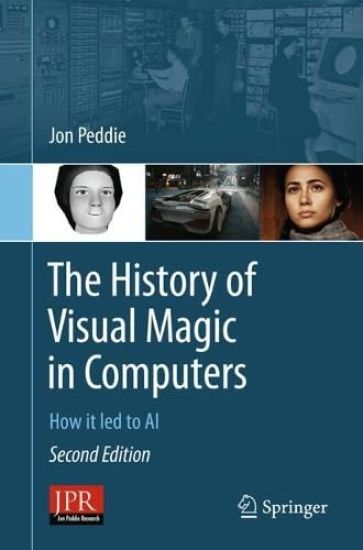
The History of Visual Magic in Computers

The History of Visual Magic in Computers

Jon Peddie

SPRINGER LONDON LTD
2025
nidottu
Have you ever watched a captivating adventure or science fiction movie, played an intricate and immersive computer game, or seen a TV commercial where objects like cars, gas pumps, or biscuits act like people and wondered, "How do they do that?" If so, then you've witnessed the magic of 3D worlds created by computers. It's a captivating field that blends artistry and technology to bring fictional worlds to life and this 2nd edition adds the unique combination of artistry, technology, and AI that goes into creating 3D worlds—real and imaginary. The roots of 3D graphics in computers lie in practical applications, like representing automotive designs and illustrating the structure of molecules. Over time, these techniques evolved, expanding to visualize simulated data and create artistic representations of imaginary worlds. The goal was, and still is, to create images that feel real, overcoming the visual cues that might make a viewer question the authenticity of what they're seeing. To achieve realism, developers had to find ways to work around the limitations of early computers. They exploited the characteristics of the human eye and brain, developing clever visual techniques to simulate reality. This involved harnessing the way people perceive depth and movement and using tricks to create a convincing sense of three dimensions. In this fully revised version, The History of Visual Magic in Computers traces how in the 2020s AI-enabled real-time ray tracing became common and an expected capability.The journey of 3D graphics is a long and collaborative effort. Thousands of individuals, over thousands of years, have made crucial discoveries in mathematics and science, laying the groundwork for these immersive 3D experiences. The story of 3D graphics is a testament to the collective efforts of these individuals, pushing the boundaries of what is possible and today there is a new partner in the process—AI. It traces back to the earliest understanding of three-dimensional space, followed by the development of foundational mathematical concepts to explain and construct 3D worlds. This history spans from the days of mechanical computers to the modern age of tablets and smartphones and ending up with AI enhancements. There have been periods where breakthroughs in computer graphics seemed to happen all at once, leading to exciting developments in algorithms and techniques. As our understanding of how to draw lines and create realistic images improved, 3D controllers for display hardware emerged, paving the way for immersive technologies like stereovision, virtual reality and enhanced image processing using AI.
Ray Tracing: A Tool for All

Ray Tracing: A Tool for All

Jon Peddie

Springer Nature Switzerland AG
2019
sidottu
This is the first book to offer a comprehensive overview for anyone wanting to understand the benefits and opportunities of ray tracing, as well as some of the challenges, without having to learn how to program or be an optics scientist.It demystifies ray tracing and brings forward the need and benefit of using ray tracing throughout the development of a film, product, or building — from pitch to prototype to marketing.Ray Tracing and Rendering clarifies the difference between conventional faked rendering and physically correct, photo-realistic ray traced rendering, and explains how programmer’s time, and backend compositing time are saved while producing more accurate representations with 3D models that move.Often considered an esoteric subject the author takes ray tracing out of the confines of the programmer’s lair and shows how all levels of users from concept to construction and sales can benefit without being forced to be a practitioner. It treats both theoretical and practical aspects of the subject as well as giving insights into all the major ray tracing programs and how many of them came about.It will enrich the readers’ understanding of what a difference an accurate high-fidelity image can make to the viewer — our eyes are incredibly sensitive to flaws and distortions and we quickly disregard things that look phony or unreal. Such dismissal by a potential user or customer can spell disaster for a supplier, producer, or developer. If it looks real it will sell, even if it is a fantasy animation. Ray tracing is now within reach of every producer and marketeer, and at prices one can afford, and with production times that meet the demands of today’s fast world.
Ray Tracing: A Tool for All

Ray Tracing: A Tool for All

Jon Peddie

Springer Nature Switzerland AG
2020
nidottu
This is the first book to offer a comprehensive overview for anyone wanting to understand the benefits and opportunities of ray tracing, as well as some of the challenges, without having to learn how to program or be an optics scientist.It demystifies ray tracing and brings forward the need and benefit of using ray tracing throughout the development of a film, product, or building — from pitch to prototype to marketing.Ray Tracing and Rendering clarifies the difference between conventional faked rendering and physically correct, photo-realistic ray traced rendering, and explains how programmer’s time, and backend compositing time are saved while producing more accurate representations with 3D models that move.Often considered an esoteric subject the author takes ray tracing out of the confines of the programmer’s lair and shows how all levels of users from concept to construction and sales can benefit without being forced to be a practitioner. It treats both theoretical and practical aspects of the subject as well as giving insights into all the major ray tracing programs and how many of them came about.It will enrich the readers’ understanding of what a difference an accurate high-fidelity image can make to the viewer — our eyes are incredibly sensitive to flaws and distortions and we quickly disregard things that look phony or unreal. Such dismissal by a potential user or customer can spell disaster for a supplier, producer, or developer. If it looks real it will sell, even if it is a fantasy animation. Ray tracing is now within reach of every producer and marketeer, and at prices one can afford, and with production times that meet the demands of today’s fast world.
The History of the GPU - Steps to Invention

The History of the GPU - Steps to Invention

Jon Peddie

Springer International Publishing AG
2023
nidottu
This is the first book in a three-part series that traces the development of the GPU. Initially developed for games the GPU can now be found in cars, supercomputers, watches, game consoles and more. GPU concepts go back to the 1970s when computer graphics was developed for computer-aided design of automobiles and airplanes. Early computer graphics systems were adopted by the film industry and simulators for airplanes and high energy physics—exploding nuclear bombs in computers instead of the atmosphere. A GPU has an integrated transform and lighting engine, but these were not available until the end of the 1990s. Heroic and historic companies expanded the development and capabilities of the graphics controller in pursuit of the ultimate device, a fully integrated self-contained GPU. Fifteen companies worked on building the first fully integrated GPU, some succeeded in the console, and Northbridge segments, and Nvidia was the first to offer a fully integrated GPU for the PC. Today the GPU can be found in every platform that involves a computer and a user interface.
The History of the GPU - Eras and Environment

The History of the GPU - Eras and Environment

Jon Peddie

Springer International Publishing AG
2023
nidottu
This is the second book in a three-part series that traces the development of the GPU, which is defined as a single chip with an integrated transform and lighting (T&L) capability. This feature previously was found in workstations as a stand-alone chip that only performed geometry functions. Enabled by Moore’s law, the first era of GPUs began in the late 1990s.Silicon Graphics (SGI) introduced T&L first in 1996 with the Nintendo 64 chipset with integrated T&L but didn’t follow through. ArtX developed a chipset with integrated T&L but didn’t bring it to market until November 1999.The need to integrate the transform and lighting functions in the graphics controller was well understood and strongly desired by dozens of companies. Nvidia was the first to produce a PC consumer level single chip with T&L in October 1999. All in all, fifteen companies came close, they had designs and experience, but one thing or another got in their way to prevent them succeeding.All the forces and technology were converging; the GPU was ready to emerge. Several of the companies involved did produce an integrated GPU, but not until early 2000. This is the account of those companies, the GPU and the environment needed to support it. The GPU has become ubiquitous and can be found in every platform that involves a computer and a user interface.
The History of the GPU - New Developments

The History of the GPU - New Developments

Jon Peddie

Springer International Publishing AG
2023
nidottu
This third book in the three-part series on the History of the GPU covers the second to sixth eras of the GPU, which can be found in anything that has a display or screen. The GPU is now part of supercomputers, PCs, Smartphones and tablets, wearables, game consoles and handhelds, TVs, and every type of vehicle including boats and planes. In the early 2000s the number of GPU suppliers consolidated to three whereas now, the number has expanded to almost 20. In 2022 the GPU market was worth over $250 billion with over 2.2 billion GPUs being sold just in PCs, and more than 10 billion in smartphones. Understanding the power and history of these devices is not only a fascinating tale, but one that will aid your understanding of some of the developments in consumer electronics, computers, new automobiles, and your fitness watch.
Augmented Reality

Augmented Reality

Jon Peddie

Springer International Publishing AG
2023
sidottu
This book provides an in-depth exploration of the field of augmented reality (AR) in its entirety and sets out to distinguish AR from other inter-related technologies like virtual reality (VR), mixed reality (MR) and extended reality (XR). The author presents AR from its initial philosophies and early developments, and in this updated 2nd edition discusses the latest advances and the ramifications they bring and the impact they have on modern society. He examines the new companies that have entered the field and those that have failed or were acquired giving a complete history of AR progress. He explores the possible future developments providing readers with the tools to understand issues relating to defining, building, and using their perception of what is represented in their perceived reality, and ultimately how we assimilate and react to this information. In Augmented Reality: Where We Will All Live 2nd Edition, JonPeddie has amassed and integrated a corpus of material that is finally in one place. It will serve as a comprehensive guide and provide valuable insights for technologists, marketers, business managers, educators and academics who are interested in the field of augmented reality, its concepts, history, practices, and the science behind this rapidly advancing field of research and development.
Augmented Reality

Augmented Reality

Jon Peddie

Springer International Publishing AG
2018
nidottu
This book provides an in-depth exploration of the field of augmented reality (AR) in its entirety and sets out to distinguish AR from other inter-related technologies like virtual reality (VR) and mixed reality (MR). The author presents AR from its initial philosophies and early developments, to its current technologies and its impact on our modern society, to its possible future developments; providing readers with the tools to understand issues relating to defining, building, and using our perception of what is represented in our perceived reality, and ultimately how we assimilate and react to this information. Augmented Reality: Where We Will All Live can be used as a comprehensive guide to the field of AR and provides valuable insights for technologists, marketers, business managers, educators and academics who are interested in the field of augmented reality; its concepts, history, practices and the science behind this rapidly advancing field of research and development.
The History of Visual Magic in Computers

The History of Visual Magic in Computers

Jon Peddie

Springer London Ltd
2013
nidottu
If you have ever looked at a fantastic adventure or science fiction movie, or an amazingly complex and rich computer game, or a TV commercial where cars or gas pumps or biscuits behaved liked people and wondered, “How do they do that?”, then you’ve experienced the magic of 3D worlds generated by a computer. 3D in computers began as a way to represent automotive designs and illustrate the construction of molecules. 3D graphics use evolved to visualizations of simulated data and artistic representations of imaginary worlds. In order to overcome the processing limitations of the computer, graphics had to exploit the characteristics of the eye and brain, and develop visual tricks to simulate realism. The goal is to create graphics images that will overcome the visual cues that cause disbelief and tell the viewer this is not real. Thousands of people over thousands of years have developed the building blocks and made the discoveries in mathematics and science to make such 3D magic possible, and The History of Visual Magic in Computers is dedicated to all of them and tells a little of their story. It traces the earliest understanding of 3D and then foundational mathematics to explain and construct 3D; from mechanical computers up to today’s tablets. Several of the amazing computer graphics algorithms and tricks came of periods where eruptions of new ideas and techniques seem to occur all at once. Applications emerged as the fundamentals of how to draw lines and create realistic images were better understood, leading to hardware 3D controllers that drive the display all the way to stereovision and virtual reality.
Augmented Reality

Augmented Reality

Jon Peddie

Springer International Publishing AG
2024
nidottu
This book provides an in-depth exploration of the field of augmented reality (AR) in its entirety and sets out to distinguish AR from other inter-related technologies like virtual reality (VR), mixed reality (MR) and extended reality (XR). The author presents AR from its initial philosophies and early developments, and in this updated 2nd edition discusses the latest advances and the ramifications they bring and the impact they have on modern society. He examines the new companies that have entered the field and those that have failed or were acquired giving a complete history of AR progress. He explores the possible future developments providing readers with the tools to understand issues relating to defining, building, and using their perception of what is represented in their perceived reality, and ultimately how we assimilate and react to this information. In Augmented Reality: Where We Will All Live 2nd Edition, JonPeddie has amassed and integrated a corpus of material that is finally in one place. It will serve as a comprehensive guide and provide valuable insights for technologists, marketers, business managers, educators and academics who are interested in the field of augmented reality, its concepts, history, practices, and the science behind this rapidly advancing field of research and development.