Kirjojen hintavertailu. Mukana 11 244 527 kirjaa ja 12 kauppaa.

Kirjahaku

Etsi kirjoja tekijän nimen, kirjan nimen tai ISBN:n perusteella.

5 kirjaa tekijältä Jon Wiener

Gimme Some Truth

Gimme Some Truth

Jon Wiener

University of California Press
2000
pokkari
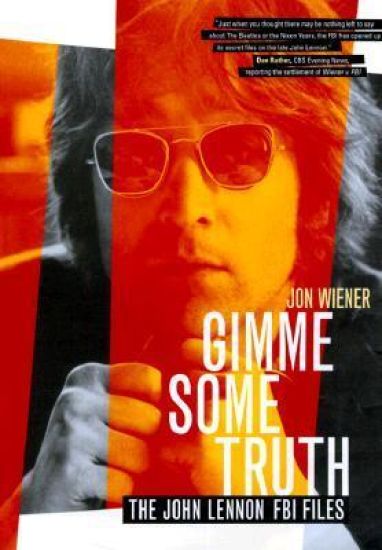
When FBI Director J. Edgar Hoover reported to the Nixon White House in 1972 about the Bureau's surveillance of John Lennon, he began by explaining that Lennon was a 'former member of the Beatles singing group'. When a copy of this letter arrived in response to Jon Wiener's 1981 Freedom of Information request, the entire text was withheld - along with almost 200 other pages - on the grounds that releasing it would endanger national security. This book tells the story of the author's remarkable fourteen-year court battle to win release of the Lennon files under the Freedom of Information Act in a case that went all the way to the Supreme Court. With the publication of "Gimme Some Truth", 100 key pages of the Lennon FBI file are available - complete and unexpurgated, fully annotated and presented in a 'before and after' format. Lennon's file was compiled in 1972, when the war in Vietnam was at its peak, when Nixon was facing re-election, and when the 'clever Beatle' was living in New York and joining up with the New Left and the anti-war movement. The Nixon administration's efforts to 'neutralize' Lennon are the subject of Lennon's file. The documents are reproduced in facsimile so that readers can see all the classification stamps, marginal notes, blacked out passages and - in some cases - the initials of J. Edgar Hoover. The file includes lengthy reports by confidential informants detailing the daily lives of anti-war activists, memos to the White House, transcripts of TV shows on which Lennon appeared, and a proposal that Lennon be arrested by local police on drug charges. Fascinating, engrossing, at points hilarious and absurd, "Gimme Some Truth" documents an era when rock music seemed to have real political force and when youth culture challenged the status quo in Washington. It also delineates the ways the Reagan, Bush, and Clinton administrations fought to preserve government secrecy, and highlights the legal strategies adopted by those who have challenged it.
How We Forgot the Cold War

How We Forgot the Cold War

Jon Wiener

University of California Press
2012
sidottu
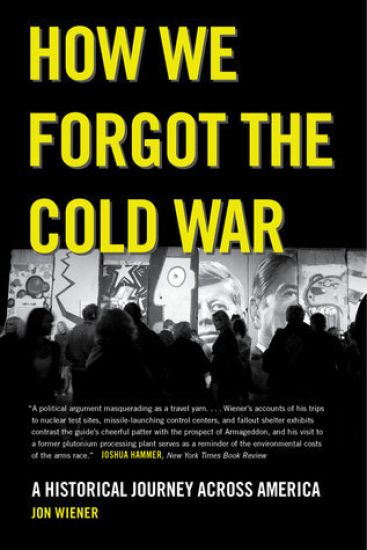
Hours after the USSR collapsed in 1991, Congress began making plans to establish the official memory of the Cold War. Conservatives dominated the proceedings, spending millions to portray the conflict as a triumph of good over evil and a defeat of totalitarianism equal in significance to World War II. In this provocative book, historian Jon Wiener visits Cold War monuments, museums, and memorials across the United States to find out how the era is being remembered. The author's journey provides a history of the Cold War, one that turns many conventional notions on their heads. In an engaging travelogue that takes readers to sites such as the life-size recreation of Berlin's "Checkpoint Charlie" at the Reagan Library, the fallout shelter display at the Smithsonian, and exhibits about "Sgt. Elvis," America's most famous Cold War veteran, Wiener discovers that the Cold War isn't being remembered. It's being forgotten. Despite an immense effort, the conservatives' monuments weren't built, their historic sites have few visitors, and many of their museums have now shifted focus to other topics. Proponents of the notion of a heroic "Cold War victory" failed; the public didn't buy the official story. Lively, readable, and well-informed, this book expands current discussions about memory and history, and raises intriguing questions about popular skepticism toward official ideology.
How We Forgot the Cold War

How We Forgot the Cold War

Jon Wiener

University of California Press
2014
pokkari
Hours after the USSR collapsed in 1991, Congress began making plans to establish the official memory of the Cold War. Conservatives dominated the proceedings, spending millions to portray the conflict as a triumph of good over evil and a defeat of totalitarianism equal in significance to World War II. In this provocative book, historian Jon Wiener visits Cold War monuments, museums, and memorials across the United States to find out how the era is being remembered. The author's journey provides a history of the Cold War, one that turns many conventional notions on their heads. In an engaging travelogue that takes readers to sites such as the life-size recreation of Berlin's "Checkpoint Charlie" at the Reagan Library, the fallout shelter display at the Smithsonian, and exhibits about "Sgt. Elvis," America's most famous Cold War veteran, Wiener discovers that the Cold War isn't being remembered. It's being forgotten. Despite an immense effort, the conservatives' monuments weren't built, their historic sites have few visitors, and many of their museums have now shifted focus to other topics. Proponents of the notion of a heroic "Cold War victory" failed; the public didn't buy the official story. Lively, readable, and well-informed, this book expands current discussions about memory and history, and raises intriguing questions about popular skepticism toward official ideology.
Professors, Politics and Pop

Professors, Politics and Pop

Jon Wiener

Verso Books
1994
nidottu
"It is frightening to think the [Jon Wiener] teaches history at a university..." - Jacques Derrida "Wiener takes the modern university as his beat, and covers it like a police reporter ...Wiener's mean streets are the think tank, the scholarly symposium, and the faculty lounge. And when he's had enough of this academic low life, he listens to Elvis, Springsteen and the Beatles. He even listens to Frank Sinatra." - John Leonard "In this book, Jon Wiener demonstrates his great skill as guerrilla sharpshooter in the forty-year war that the National Security State has been conducting against the American people. These reports from the field - the resistance - illuminate Nixon and Watergate as never before, reveal in fascinating detail the turbulence within Academe, invoke pity if not awe for that unexpected victim of state, Frank Sinatra." - Gore Vidal "Wiener is good at spotting, and blasting, paranoid fantasy and incompetence in high (and low) places and his range of targets is impressively wide ...[his] surveys are lucid, trenchant and brief." - Observer
Historians In Trouble

Historians In Trouble

Jon Wiener

The New Press
2007
nidottu
A revealing look at headline-grabbing controversies revolving around charges of plagiarism and fraud in the profession of history. Focusing on 12 key controversies on both sides of teh political spectrum, Wiener seeks to understand why some cases make the healdines and end carers while others do not. He looks at the case of Michael Bellesiles, teh historian of gun culture accused of research fraud; accused plagiarists and celebrity historians Stephen Ambrose and Doris Kearns Goodwin; and Pulitzer Prize winner Joseph J Ellis.