Kirjojen hintavertailu. Mukana 11 244 527 kirjaa ja 12 kauppaa.

Kirjahaku

Etsi kirjoja tekijän nimen, kirjan nimen tai ISBN:n perusteella.

7 kirjaa tekijältä Jonathan B. Imber

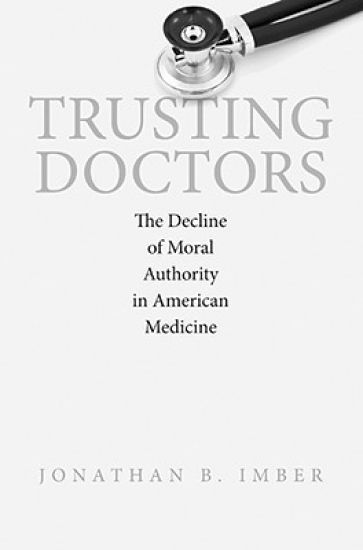
Trusting Doctors

Trusting Doctors

Jonathan B. Imber

Princeton University Press
2008
sidottu
For more than a century, the American medical profession insisted that doctors be rigorously trained in medical science and dedicated to professional ethics. Patients revered their doctors as representatives of a sacred vocation. Do we still trust doctors with the same conviction? In Trusting Doctors, Jonathan Imber attributes the development of patients' faith in doctors to the inspiration and influence of Protestant and Catholic clergymen during the nineteenth and early twentieth centuries. He explains that as the influence of clergymen waned, and as reliance on medical technology increased, patients' trust in doctors steadily declined. Trusting Doctors discusses the emphasis that Protestant clergymen placed on the physician's vocation; the focus that Catholic moralists put on specific dilemmas faced in daily medical practice; and the loss of unchallenged authority experienced by doctors after World War II, when practitioners became valued for their technical competence rather than their personal integrity. Imber shows how the clergy gradually lost their impact in defining the physician's moral character, and how vocal critics of medicine contributed to a decline in patient confidence. The author argues that as modern medicine becomes defined by specialization, rapid medical advance, profit-driven industry, and ever more anxious patients, the future for a renewed trust in doctors will be confronted by even greater challenges. Trusting Doctors provides valuable insights into the religious underpinnings of the doctor-patient relationship and raises critical questions about the ultimate place of the medical profession in American life and culture.
Trusting Doctors

Trusting Doctors

Jonathan B. Imber

Princeton University Press
2015
pokkari
For more than a century, the American medical profession insisted that doctors be rigorously trained in medical science and dedicated to professional ethics. Patients revered their doctors as representatives of a sacred vocation. Do we still trust doctors with the same conviction? In Trusting Doctors, Jonathan Imber attributes the development of patients' faith in doctors to the inspiration and influence of Protestant and Catholic clergymen during the nineteenth and early twentieth centuries. He explains that as the influence of clergymen waned, and as reliance on medical technology increased, patients' trust in doctors steadily declined. Trusting Doctors discusses the emphasis that Protestant clergymen placed on the physician's vocation; the focus that Catholic moralists put on specific dilemmas faced in daily medical practice; and the loss of unchallenged authority experienced by doctors after World War II, when practitioners became valued for their technical competence rather than their personal integrity. Imber shows how the clergy gradually lost their impact in defining the physician's moral character, and how vocal critics of medicine contributed to a decline in patient confidence. The author argues that as modern medicine becomes defined by specialization, rapid medical advance, profit-driven industry, and ever more anxious patients, the future for a renewed trust in doctors will be confronted by even greater challenges. Trusting Doctors provides valuable insights into the religious underpinnings of the doctor-patient relationship and raises critical questions about the ultimate place of the medical profession in American life and culture.

Searching for Science Policy

Searching for Science Policy

Jonathan B. Imber

Transaction Publishers
2002
sidottu
The findings of scientific research often provide an important baseline to the formation of public policy. However, effective communication to the larger public about what scientists do and know is a problem inherent to all democratic societies. It is the prerogative of democratic societies to determine what kind of scientific research will be funded. Searching for Science Policy offers innovative ways of thinking about how the rhetoric and practice of science operates in various institutional contexts.The book is divided into two parts. Part 1, "Policy Uses and Misuses of Science," explores the various ways in which scientific claims are inevitably mediated by how they are used. Joel Best, draws on statistics involving missing children, violence against women, and attendance figures at political demonstrations to demonstrate how the motivations to use inaccurate and misleading numbers stems directly from the ideological and organizational interests of those using them. Judith Kleinfeld analyzes recruitment policies for women scientists at MIT, showing how hiring practices that may be justifiable on extra-scientific factors are carried out based on pseudo-scientific studies not subject to public scrutiny. Robert MacCoun addresses the journalistic misuse of drug and drug abuse statistics and shows how this profoundly distorts policy implications drawn from them. And Allan Mazur examines the role scientific evidence has come to play in the law, pointing out the pitfalls of its intrinsic quality and how such evidence may be interpreted or misinterpreted by judges and juries.Part 2, "Searching for Science Policy," extends discussion of the role of science to specific ideas about how public policy-making might be improved in matters of law, family, environment, drug use, and health. Mark Kleiman weighs the sometimes conflicting claims of science and social order in formulating drug policy. Norval Glenn calls for closer cooperation between professional associations, the media, and researchers in reporting provisional social science findings to the public. Stanley Rothman and S. Robert Lichter examine the dynamic by which environmental organizations shape public perceptions of risk and harm. And in the concluding chapter, Sheila Jasanoff looks closely at differences between the provisional nature of science as normally practiced and the more contentious sphere of litigation that demands ultimate resolution.In a time when scientists find themselves subject to more public scrutiny than ever before, the well-informed citizen is no longer a moral ideal but rather a social imperative. Searching for Science Policy helps to clarify the grounds and the circumstances of more effective use of science in public discourse.
Searching for Science Policy

Searching for Science Policy

Jonathan B. Imber

Routledge
2018
nidottu
The findings of scientific research often provide an important baseline to the formation of public policy. However, effective communication to the larger public about what scientists do and know is a problem inherent to all democratic societies. It is the prerogative of democratic societies to determine what kind of scientific research will be funded. Searching for Science Policy offers innovative ways of thinking about how the rhetoric and practice of science operates in various institutional contexts.The book is divided into two parts. Part 1, "Policy Uses and Misuses of Science," explores the various ways in which scientific claims are inevitably mediated by how they are used. Joel Best, draws on statistics involving missing children, violence against women, and attendance figures at political demonstrations to demonstrate how the motivations to use inaccurate and misleading numbers stems directly from the ideological and organizational interests of those using them. Judith Kleinfeld analyzes recruitment policies for women scientists at MIT, showing how hiring practices that may be justifiable on extra-scientific factors are carried out based on pseudo-scientific studies not subject to public scrutiny. Robert MacCoun addresses the journalistic misuse of drug and drug abuse statistics and shows how this profoundly distorts policy implications drawn from them. And Allan Mazur examines the role scientific evidence has come to play in the law, pointing out the pitfalls of its intrinsic quality and how such evidence may be interpreted or misinterpreted by judges and juries.Part 2, "Searching for Science Policy," extends discussion of the role of science to specific ideas about how public policy-making might be improved in matters of law, family, environment, drug use, and health. Mark Kleiman weighs the sometimes conflicting claims of science and social order in formulating drug policy. Norval Glenn calls for closer cooperation between professional associations, the media, and researchers in reporting provisional social science findings to the public. Stanley Rothman and S. Robert Lichter examine the dynamic by which environmental organizations shape public perceptions of risk and harm. And in the concluding chapter, Sheila Jasanoff looks closely at differences between the provisional nature of science as normally practiced and the more contentious sphere of litigation that demands ultimate resolution.In a time when scientists find themselves subject to more public scrutiny than ever before, the well-informed citizen is no longer a moral ideal but rather a social imperative. Searching for Science Policy helps to clarify the grounds and the circumstances of more effective use of science in public discourse.
Abortion and the Private Practice of Medicine
Originally published in 1986, Abortion and the Private Practice of Medicine was the first book to look at abortion from the perspective of physicians in private practice. Jonathan B. Imber spent two years observing and interviewing all twenty-six of the obstetrician-gynecologists in “Daleton,” a city that did not have an abortion clinic. The decision as to whether, when, and how to perform abortions was therefore essentially up to the individual doctor. Imber begins the volume with a historical survey of medical views on abortion and the medical profession’s response to the legalization of abortion in the United States. Quoting extensively from his interviews, he looks at various characteristics of doctors that may affect their professional opinion on abortion: their age, gender, religious background, and length of residence in the community; the nature of their training and prior experience; and the setting of the practice (whether group or solo). Imber found that the physicians’ reasons for agreeing or refusing to perform abortions revealed considerable differences of opinion about how they construe their responsibilities.
Therapeutic Culture

Therapeutic Culture

Jonathan B. Imber

Routledge
2017
sidottu
For nearly half a century, social scientists have made claims that there is a "therapeutic ethos" with extensive influence upon numerous aspects of American society. In Therapeutic Culture, twelve authors address the implications of this ethos and its effects on a wide range of social institutions, extending from the family to schools, and operating in religious behavior and within the legal system. Has there been, as the sociological theorist Philip Rieff argued in 1966, a "triumph of the therapeutic?" If so, in what kinds of institutions has it been most pervasive? At the same time, what aspects of modern culture has it replaced or defeated? Therapeutic Culture addresses these questions, and raises others. Part 1 of this volume examines the emergence of the idea of "authenticity" as it defines the manipulation of emotions and behavior both in the United States and Great Britain. Contributors include Elisabeth Lasch-Quinn, Frank Furedi, Jonathan B. Imber, and Alan Woolfolk. Part 2 illustrates specific cases of the effects of therapeutic culture within institutions, including courts, schools, religious communities, and the "virtual community" of the Internet. Contributors include James L. Nolan, Jr., John Steadman Rice, Felicia Wu Song, and James Tucker. Part 3 extends the analyses of specific social institutions to the broader consequences that have resulted as a therapeutic ethos has taken root in contemporary life. Contributors include Digby Anderson, Ellen Herman, and James Davison Hunter. Part 4 is devoted to a previously unpublished essay by Philip Rieff whose significant influence can be seen in many of the contributions. Rieff revisits the highly controversial confirmation hearings of Supreme Court Associate Justice Clarence Thomas in 1991 and offers ample evidence of the therapeutic uses of politics as well as the political manipulations available within a therapeutic culture to provide a fitting conclusion. This volume establishes a benchmark for further theoretical reflection and empirical research on the nature of therapeutic culture. It will be of interest to sociologists, psychologists, political scientists, and cultural studies specialists.
Abortion and the Private Practice of Medicine

Abortion and the Private Practice of Medicine

Jonathan B. Imber

AldineTransaction
2017
nidottu
Originally published in 1986, Abortion and the Private Practice of Medicine was the first book to look at abortion from the perspective of physicians in private practice. Jonathan B. Imber spent two years observing and interviewing all twenty-six of the obstetrician-gynecologists in “Daleton,” a city that did not have an abortion clinic. The decision as to whether, when, and how to perform abortions was therefore essentially up to the individual doctor. Imber begins the volume with a historical survey of medical views on abortion and the medical profession’s response to the legalization of abortion in the United States. Quoting extensively from his interviews, he looks at various characteristics of doctors that may affect their professional opinion on abortion: their age, gender, religious background, and length of residence in the community; the nature of their training and prior experience; and the setting of the practice (whether group or solo). Imber found that the physicians’ reasons for agreeing or refusing to perform abortions revealed considerable differences of opinion about how they construe their responsibilities.