Kirjojen hintavertailu. Mukana 11 244 527 kirjaa ja 12 kauppaa.

Kirjahaku

Etsi kirjoja tekijän nimen, kirjan nimen tai ISBN:n perusteella.

40 kirjaa tekijältä Jonathan Barnes

The Somnambulist

The Somnambulist

Jonathan Barnes

William Morrow Company
2009
nidottu
Once the toast of good society in Victoria's England, the extraordinary conjurer Edward Moon no longer commands the respect that he did in earlier times. Still, each night he returns to the stage of his theater to amaze his devoted, albeit dwindling, audience, aided by his partner, the Somnambulist--a silent, hairless, hulking giant who, when stabbed, does not bleed. But these are strange, strange times in England, with the oddest of sorts prowling London's dank underbelly. And the very bizarre death of a disreputable actor has compelled a baffled police constabulary to turn once again to Edward Moon for help--inevitably setting in motion events that will shatter his increasingly tenuous grasp on reality.

The Domino Men

The Domino Men

Jonathan Barnes

William Morrow Company
2010
nidottu
In an earlier century, Queen Victoria made a Faustian bargain, signing London and all its souls away to a nefarious, inhuman entity. Now, generations later, the bill has finally come due. . . . An amiable, unambitious London file clerk, Henry Lamb leads an unremarkable life--until the day he learns he's expected to assume the covert responsibilities of his universally despised, now comatose grandfather. London is at war, and a shadowy organization known (to a very few) as the Directorate wishes to recruit Henry to the cause. All he has to do is find "the girl," save the world from the monster Leviathan, and defeat the unspeakable evil lurking in the cellar of 10 Downing Street: the serial-slaying schoolboy twins known as the Domino Men.
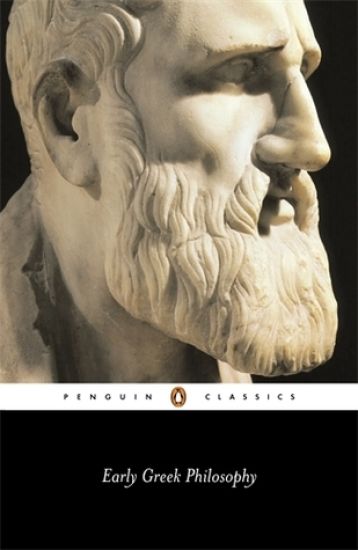
Early Greek Philosophy

Early Greek Philosophy

Jonathan Barnes

Penguin Classics
2002
pokkari
The works collected in this volume form the true foundation of Western philosophy - the base upon which Plato and Aristotle and their successors would eventually build. Yet the importance of the Pre-Socratics thinkers lies less in their influence - great though that was - than in their astonishing intellectual ambition and imaginative reach. Zeno's dizzying 'proofs' that motion is impossible; the extraordinary atomic theories of Democritus; the haunting and enigmatic epigrams of Heraclitus; and the maxims of Alcmaeon: fragmentary as they often are, the thoughts of these philosophers seem strikingly modern in their concern to forge a truly scientific vocabulary and way of reasoning.
Aristotle

Aristotle

Jonathan Barnes

Oxford University Press
2000
nidottu
The influence of Aristotle, the prince of philosophers, on the intellectual history of the West is second to none. In this book Jonathan Barnes examines Aristotle's scientific researches, his discoveries in logic and his metaphysical theories, his work in psychology and in ethics and politics, and his ideas about art and poetry, placing his teachings in their historical context. ABOUT THE SERIES: The Very Short Introductions series from Oxford University Press contains hundreds of titles in almost every subject area. These pocket-sized books are the perfect way to get ahead in a new subject quickly. Our expert authors combine facts, analysis, perspective, new ideas, and enthusiasm to make interesting and challenging topics highly readable.
Mantissa

Mantissa

Jonathan Barnes

Oxford University Press
2015
sidottu
This is the fourth (and last) volume of Jonathan Barnes' collected essays on ancient philosophy. As its title suggests, the twenty-three papers which it contains cover a wide range of topics. The first paper discusses the size of the sun, and the last looks at Plato and Aristotle in Victorian Oxford. In between come pieces on--inter alia--the theory of just war and the definition of comedy, the nature of the soul according to Plato and Aristotle and Zeno and Tertullian, atheism of Protagoras, Timaeus the Sophist (and his Platonic Lexicon) and the early history of Aristotle's writings, Nietzsche on Diogenes Laertius, the first Christian novel ... One of the pieces is new. The others have all been retouched, and some of them revised. Half a dozen were written in French and have been translated into English. The volume is kitted out with a bibliography and with two rather good indexes. The papers are, in parts at least, well written, and some of them are mildly diverting: no-one with a nose for ancient philosophy will sniff at them.
Method and Metaphysics

Method and Metaphysics

Jonathan Barnes

Oxford University Press
2015
nidottu
Method and Metaphysics presents twenty-six essays in ancient philosophy by Jonathan Barnes, one of the most admired and influential scholars of his generation. The essays span four decades of his career, and are drawn from a wide variety of sources: many of them will be relatively unknown even to specialists in ancient philosophy. Several essays are now translated from the original French and made available in English for the first time; others have been substantially revised for republication. The volume opens with eight essays about the interpretation of ancient philosophical texts, and about the relationship between philosophy and its history. The next five essays examine the methods of ancient philosophers. The third section comprises thirteen essays about metaphysical topics, from the Presocratics to the late Platonists. This collection will be a rich feast for students and scholars of ancient philosophy.
Truth, etc.

Truth, etc.

Jonathan Barnes

Clarendon Press
2007
sidottu
Truth, etc. is a wide-ranging study of ancient logic based upon the John Locke lectures given by the eminent philosopher Jonathan Barnes in Oxford. Its six chapters discuss, first, certain ancient ideas about truth; secondly, the Aristotelian conception of predication; thirdly, various ideas about connectors which were developed by the ancient logicians and grammarians; fourthly, the notion of logical form, insofar as it may be discovered in the ancient texts; fifthly, the question of the 'justification of deduction'; and sixthly, the attitude which has been called logical utilitarianism and which restricts the scope of logic to those forms of inference which are or might be useful for scientific proofs. In principle, the book presupposes no knowledge of logic and no skill in ancient languages: all ancient texts are cited in English translation; and logical symbols and logical jargon are avoided so far as possible. There is no scholarly apparatus of footnotes, and no bibliography. It can be read in an armchair. Anyone interested in ancient philosophy, or in logic and its history, will find it interesting.
Truth, etc.

Truth, etc.

Jonathan Barnes

Oxford University Press
2009
nidottu
Truth, etc. is a wide-ranging study of ancient logic based upon the John Locke lectures given by the eminent philosopher Jonathan Barnes in Oxford. Its six chapters discuss, first, certain ancient ideas about truth; secondly, the Aristotelian conception of predication; thirdly, various ideas about connectors which were developed by the ancient logicians and grammarians; fourthly, the notion of logical form, insofar as it may be discovered in the ancient texts; fifthly, the question of the 'justification of deduction'; and sixthly, the attitude which has been called logical utilitarianism and which restricts the scope of logic to those forms of inference which are or might be useful for scientific proofs. In principle, the book presupposes no knowledge of logic and no skill in ancient languages: all ancient texts are cited in English translation; and logical symbols and logical jargon are avoided so far as possible. There is no scholarly apparatus of footnotes, and no bibliography. It can be read in an armchair. Anyone interested in ancient philosophy, or in logic and its history, will find it interesting.
Method and Metaphysics

Method and Metaphysics

Jonathan Barnes

Oxford University Press
2011
sidottu
Method and Metaphysics presents twenty-six essays in ancient philosophy by Jonathan Barnes, one of the most admired and influential scholars of his generation. The essays span four decades of his career, and are drawn from a wide variety of sources: many of them will be relatively unknown even to specialists in ancient philosophy. Several essays are now translated from the original French and made available in English for the first time; others have been substantially revised for republication here. The volume opens with eight essays about the interpretation of ancient philosophical texts, and about the relationship between philosophy and its history. The next five essays examine the methods of ancient philosophers. The third section comprises thirteen essays about metaphysical topics, from the Presocratics to the late Platonists. This collection will be a rich feast for students and scholars of ancient philosophy.
Logical Matters

Logical Matters

Jonathan Barnes

Oxford University Press
2012
sidottu
The second volume of Jonathan Barnes' papers on ancient philosophy contains twenty-seven pieces under the broad heading of Logic. The essays were written over a period of some forty years. Some of them were published in obscure places (and two or three of them in a foreign language). The French essays have been done into English; and all the essays have been retouched, and a few of them substantially revised. The first three essays in the volume are of a general nature, being concerned with ancient views on the status of logic--and with the distinction between formal and material inferences. The next nine items deal with different aspects of Aristotelian logic--the copula, negation, the categories, homonymy, and the principle of contradiction. Then come three papers about the connection (or lack of connection) between Aristotelian logic and Stoic logic. Two of the pieces discuss Theophrastus' theory of 'hypothetical' syllogisms. After that, things run more or less chronologically--a short notice on the Dialecticians, three essays on aspects of Stoic logic, a pair of papers on ancient theories of meaning, items on adverbs and connectors, on Philoponus and Boethius, and on an anonymous tract written in the autumn of 1007 AD. All in all, there is matter to divert scholars and students of ancient philosophy.
Proof, Knowledge, and Scepticism

Proof, Knowledge, and Scepticism

Jonathan Barnes

Oxford University Press
2014
sidottu
Proof, Knowledge, and Scepticism is the third volume of Jonathan Barnes' papers on ancient philosophy. It contains twenty-two pieces which turn about epistemological matters. The papers have all been brushed down, and some of them have been revised. One or two of them appear for the first time in English. The first three pieces form a prologue (and link this volume to its predecessor): they deal with certain ancient views about the relation between logic on the one hand and knowledge and science on the other. After that, the book divides into two unequal parts. The first part is concerned with proof, five of its ten chapters discussing Aristotle and three. The second is chiefly occupied with scepticism--more particularly, with the Pyrrhonian version of ancient scepticism. A final piece says something about the Book of Ecclesiastes. The essays in this volume, some of which are less familiar than others, are written with brio: anyone with an interest in ancient philosophy will find them amusing.
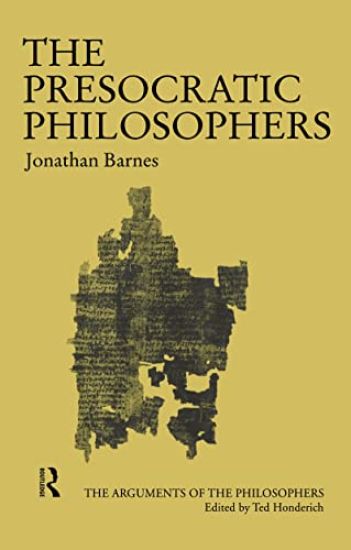
The Presocratic Philosophers

The Presocratic Philosophers

Jonathan Barnes

Routledge
1982
nidottu
The Presocratics were the founding fathers of the Western philosophical tradition, and the first masters of rational thought. This volume provides a comprehensive and precise exposition of their arguments, and offers a rigorous assessment of their contribution to philosophical thought.
Presocratics-Arg Philosophers

Presocratics-Arg Philosophers

Jonathan Barnes

Routledge
1999
sidottu
The purpose of this series is to provide a contemporary assessment and history of the entire course of philosophical thought. Each book constitutes a detailed, critical introduction to the work of a philosopher of major influence and significance.
Presocratics-Arg Philosophers

Presocratics-Arg Philosophers

Jonathan Barnes

Routledge
2012
nidottu
The purpose of this series is to provide a contemporary assessment and history of the entire course of philosophical thought. Each book constitutes a detailed, critical introduction to the work of a philosopher of major influence and significance.
The Toils of Scepticism

The Toils of Scepticism

Jonathan Barnes

Cambridge University Press
2007
pokkari
In the works of Sextus Empiricus, scepticism is presented in its most elaborate and challenging form. This book investigates - both from an exegetical and from a philosophical point of view - the chief argumentative forms which ancient scepticism developed. Thus the particular focus is on the Agrippan aspect of Sextus' Pyrrhonism. Barnes gives a lucid explanation and analysis of these arguments, both individually and as constituent parts of a sceptical system. For, taken together, these forms amount to a formidable and systematic challenge to any claim to knowledge or rational belief. The challenge had a great influence on the history of philosophy. And it has never been met. This study reflects the growing interest in ancient scepticism. Quotations from the ancient sources are all translated and Greek terms are explained. Notes on the ancient authors give a brief guide to the sources, both familiar and unfamiliar.
The Toils of Scepticism

The Toils of Scepticism

Jonathan Barnes

Cambridge University Press
1990
sidottu
In the works of Sextus Empiricus, scepticism is presented in its most elaborate and challenging form. This book investigates - both from an exegetical and from a philosophical point of view - the chief argumentative forms which ancient scepticism developed. Thus the particular focus is on the Agrippan aspect of Sextus’ Pyrrhonism. Barnes gives a lucid explanation and analysis of these arguments, both individually and as constituent parts of a sceptical system. For, taken together, these forms amount to a formidable and systematic challenge to any claim to knowledge or rational belief. The challenge had a great influence on the history of philosophy. And it has never been met. This study reflects the growing interest in ancient scepticism. Quotations from the ancient sources are all translated and Greek terms are explained. Notes on the ancient authors give a brief guide to the sources, both familiar and unfamiliar.
The Somnambulist

The Somnambulist

Jonathan Barnes

Gollancz
2008
pokkari
'Be warned. This book has no literary merit whatsoever. It is a lurid piece of nonsense, convoluted, implausible, peopled by unconvincing characters, written in drearily pedestrian prose, frequently ridiculous and wilfully bizarre. Needless to say, I doubt you'll believe a word of it.'So starts the extraordinary tale of Edward Moon, detective, his silent sidekick the Somnambulist and a devilish plot to recreate the apocalyptic prophecies of William Blake and bring the British Empire crashing down.With a gallery of vividly grotesque characters, a richly evoked setting and a playful highly literate style this is an amazingly readable literary fantasy and a brilliant debut.
The Domino Men

The Domino Men

Jonathan Barnes

Gollancz
2009
pokkari
A young man discovers a manuscript and so begins a bizarre tale that brings together his grandfather, every conspiracy theory you've ever heard about the royal family and the true story about where the power of Number 10 really lies.Readers of The Somnambulist may well recoginise the characters kept within a chalk circle in a cellar beneath Downing Street.With a gallery of vividly grotesque characters, a gleefully satiric take on modern life and a playful and highly literate style, this is an amazingly readable literary fantasy.In his sequel to the crazed Victoriana of The Somnambulist Jonathan Barnes brings his invention, reality, grotesquerie and curiosities bang-up-to-date.
The Presocratic Philosophers

The Presocratic Philosophers

Jonathan Barnes

Routledge
2015
sidottu
The Presocratics were the founding fathers of the Western philosophical tradition, and the first masters of rational thought. This volume provides a comprehensive and precise exposition of their arguments, and offers a rigorous assessment of their contribution to philosophical thought.
Applying Cross-Curricular Approaches Creatively
Applying Cross-Curricular Approaches Creatively explores the relevance and effectiveness of cross-disciplinary and project-based teaching. With a focus on personal reflection and discussion, it offers educators inspiration, guidance and resources to deliver a truly integrated curriculum creatively. Exploring how we can make connections in the classroom through our own lives and those of our children, it supports teachers in becoming more personally involved in decisions about the style of teaching and substance of curriculum in schools. Applying Cross-Curricular Approaches Creatively examines key topics such as: Educationalists with an interest in cross-curricular and creative approaches Planning for and provoking creativity Choosing cross-curricular themes Mind-full approaches to teaching and learning Assessing creative and integrated learning Teachers as researchers in the classroom Applying Cross-Curricular Approaches Creatively is an essential text for those wishing to plan a coherent curriculum with cross-curricular elements. It places the 'basics' of knowledge, genuine motivation, engagement and participation at the core of its arguments for meaningful learning for all children. Filled with autobiographical accounts and case studies, and with ready-to-use ideas for creative lessons, this uplifting book challenges us to return to curriculum breadth and balance and away from a ‘one-size-fits-all’ approach.