Kirjojen hintavertailu. Mukana 11 627 670 kirjaa ja 12 kauppaa.

Kirjahaku

Etsi kirjoja tekijän nimen, kirjan nimen tai ISBN:n perusteella.

9 kirjaa tekijältä Jonathan Dancy

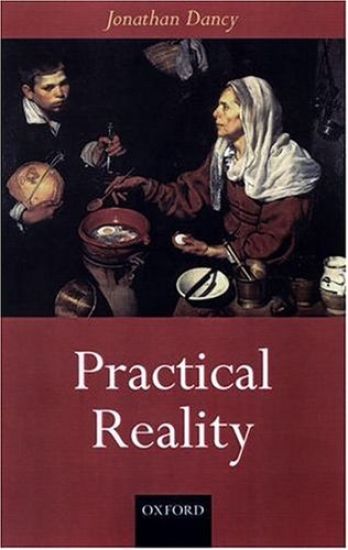
Practical Reality

Practical Reality

Jonathan Dancy

Clarendon Press
2000
sidottu
Practical Reality is about the relation between the reason why we do things and the reasons why we should. It maintains that current philosophical orthodoxy bowdlerises this relation, making it impossible to understand how anyone can act for a good reason. In order to understand this, Dancy claims, we have to abandon current conceptions of the reasons why we act (our motivating reasons) as mental states of ourselves. Belief/desire explanations of action, or purely cognitive accounts in terms of beliefs alone, drive too great a wedge between the normative and the motivational. Instead, we have to understand a motivating reason as the sort of thing that could be a good reason: for instance, that the train is about to leave this, rather than my belief that the train is about to leave, must be my reason for running. Most contemporary philosophers think that this view cannot be true. Dancy aims to demonstrate that things can be as he thinks they must be. By giving a fresh account of values and reasons, he finds a place for normativity in philosophy of mind and action, and strengthens the connection between these areas and ethics.
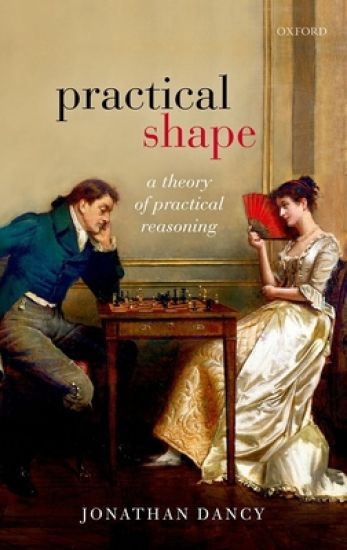
Practical Shape

Practical Shape

Jonathan Dancy

Oxford University Press
2018
sidottu
Everyone allows that we can reason to a new belief from beliefs that we already have. Aristotle thought that we could also reason from beliefs to action. Practical Shape: A Theory of Practical Reasoning establishes this possibility of reasoning to action, in a way that allows also for reasoning to intention, hope, fear, and doubt. While many philosophers have found little sense in Aristotle's claim, Dancy offers a general theory of reasoning that is sensitive to current debates but still Aristotelian in spirit. The text clearly sets out the similarities between reasoning to action and reasoning to belief, which are far more striking than any dissimilarities. Its detailed account of practical reasoning, a topic inadequately covered in current literature, is presented in such a way as to be intelligible to a variety of readers, making it an ideal resource for students of philosophy but also of interest to academics in related disciplines.
Practical Thought

Practical Thought

Jonathan Dancy

Oxford University Press
2021
sidottu
Practical Thought: Essays on Reasons, Intuition, and Action presents a selection of Jonathan Dancy's most important philosophical essays since the late 1970s, focusing on the central themes of his work: metaethics, moral metaphysics, the theory of motivation, and the British Intuitionists. The twenty-four essays in this book chart his intellectual journey.
Practical Reality

Practical Reality

Jonathan Dancy

Oxford University Press
2002
nidottu
'Practical Reality' is a lucid original study of the relation between the reasons why we do things and the reasons why we should. Jonathan Dancy maintains that current philosophical orthodoxy bowdlerizes this relation, making it impossible to understand how anyone can act for a good reason.
Ethics Without Principles

Ethics Without Principles

Jonathan Dancy

Clarendon Press
2004
sidottu
Jonathan Dancy presents a long-awaited exposition and defence of particularism in ethics, a view with which he has been associated for twenty years. He argues that the traditional link between morality and principles, or between being moral and having principles, is little more than a mistake. The possibility of moral thought and judgement does not in any way depend on an adequate supply of principles. Dancy grounds this claim on a form of reasons-holism, holding that what is a reason in one case need not be any reason in another, and maintaining that moral reasons are no different in this respect from others. He puts forward a distinctive form of value-holism to go with the holism of reasons, and he gives a detailed discussion, much needed, of the currently popular topic of 'contributory' reasons. Opposing positions of all sorts are summarized and criticized. Ethics Without Principles is the definitive statement of particularist ethical theory, and will be required reading for all those working on moral philosophy and ethical theory.
Ethics Without Principles

Ethics Without Principles

Jonathan Dancy

Clarendon Press
2006
nidottu
Jonathan Dancy presents a long-awaited exposition and defence of particularism in ethics, a view with which he has been associated for twenty years. He argues that the traditional link between morality and principles, or between being moral and having principles, is little more than a mistake. The possibility of moral thought and judgement does not in any way depend on an adequate supply of principles. Dancy grounds this claim on a form of reasons-holism, holding that what is a reason in one case need not be any reason in another, and maintaining that moral reasons are no different in this respect from others. He puts forward a distinctive form of value-holism to go with the holism of reasons, and he gives a detailed discussion, much needed, of the currently popular topic of 'contributory' reasons. Opposing positions of all sorts are summarized and criticized. Ethics Without Principles is the definitive statement of particularist ethical theory, and will be required reading for all those working on moral philosophy and ethical theory.
Berkeley

Berkeley

Jonathan Dancy

Blackwell Publishers
1987
nidottu
This new introduction to the main themes of Berkeley's philosophy assumes no previous knowlege of philosophy and will be accessible to first-year students and to the interested general reader. It also offers and defends its own interpretation of Berkeley' position. Jonathan Dancy argues that we understand Berkeley's idealism best if we take seriously his claim that realism (the view that material things have an existence independent of the mind) derives from a mistaken use of abstraction. Stress is laid on Berkelye's determination to use idealism to bring his God as close to us as possible. Instances of this are his claims that the world we live in is a collection of ideas in God's mind, and that natural events are divine utterances which science is the attempts to interpret. Dancy also discusses Berkelye's attack on the distinction between primary and secondary qualities, and his views on perception and knowledge. There is an account of his theory of the mind and of the nature of human action, and a final chapter contrasts the interpretation offered here with others. Students who have read this book will be well equipped to understand and assess the frequent references to Berkeley in current literature.
Moral Reasons

Moral Reasons

Jonathan Dancy

JOHN WILEY AND SONS LTD
1992
nidottu
This book attempts to place a realist view of ethics (the claim that there are facts of the matter in ethics as elsewhere) within a broader context. It starts with a discussion of why we should mind about the difference between right and wrong, asks what account we should give of our ability to learn from our moral experience, and looks in some detail at the different sorts of ways in which moral reasons can combine to show us what we should do in the circumstances. The second half of the book uses these results to mount an attack on consequentialism in ethics, arguing that there are more sorts of reasons around than consequentialists can even dream of.