The ineffable character of "Britishness" has been used, often enigmatically, to describe Canada's distinct cultural flavour within North America. This mysterious quality, writes award-winning writer Jonathan Vance, goes back to the early days of Canadian history, and consists of far more than the sum of early migration patterns. It emerges from a long-standing respect for British liberal ideals and an identification with the British empire. Canada's own unique brand of Britishness evolved over a history of shared military endeavor, as Canadians fought alongside others to defend the ideals that the British Empire was deemed to represent. To understand Canada's history of Britishness, Vance looks into the military past of both countries. The fabric of Canadian life in the eighteenth and nineteenth centuries owes a great deal to the presence of British military. And this, observes Vance, is a two-way relationship: he reminds us that during the two World Wars, close to a million Canadians travelled to the United Kingdom. In this form of reverse colonialism, Canadians established modest outposts in Britain, and parts of the country were Canadianized. This new, outside-the-box narrative is Jonathan Vance at his best. Beautifully written, based on original research in the true sense of the word, and illustrated with previously unseen materials, this book reveals a side of Canada often forgotten by historians.
Hockey magnate Conn Smythe, Trudeau cabinet minister Gilles Lamontagne, and the composer and former conductor of the Toronto Symphony Orchestra, Sir Ernest MacMillan, share something other than their fame: they all have the dubious distinction of having been captured by the enemy during Canada's wars of the twentieth century. Like some 15,000 other Canadians, Smythe, Lamontagne, and MacMillan experienced the bewilderment that accompanied the moment of capture, the humiliation of being completely in the captor's power, and the sense of stagnating in a backwater while the rest of the world moved forward.From prison camps in Eire, where POWs were allowed to keep pets and to be members of the local tennis clubs, to camps in Japan, where prisoners were often severely beaten, systematically starved, and overworked, Canadian prisoners of war throughout the twentieth century have faced a variety of conditions and experiences. But they did not fight their war alone and isolated. On the home front, many other people attempted to help them. Against the backdrop of the POW experience, Jonathan Vance provides the first comprehensive account of how the Canadian government and non-governmental organizations such as the Red Cross have dealt with the problems of prisoners of war.Beginning in the nineteenth century, Vance traces the growth of Canadian interest in the plight of POWs. He goes on to examine the measures taken to assist Canadian POWs during the two world wars and the Korean war. The book focuses in particular on the campaigns to ship relief supplies to prison camps and on attempts to secure the prisoners' release.POWs have sometimes been seen as forgotten casualties whose privations were misunderstood during war and whose needs were neglected afterwards. This perception developed out of a tradition in POW memoirs which paid little attention to the efforts of politicians, civil servants, and individuals who devoted considerable time and energy to their cause. Vance argues that this impression is wrong and that, in fact, every effort was made to ameliorate conditions for men and women in captivity. In his book, he outlines the difficulties and confusion that arose from jurisdictional squabbling and lack of clear communication. Ironically, Vance concludes, obstacles were more often created by an overabundance of enthusiasm than by a lack of interest in the prisoners' fate. Canada's wartime bureaucracy, often praised by historians, is revealed as needlessly complex and, in many ways, hopelessly inefficient.In Objects of Concern, Jonathan Vance examines Canada's role in the formation of an important aspect of international law, traces the growth and activities of a number of national and local philanthropic agencies, and recounts the efforts of ex-prisoners to secure compensation for the long-term effects of captivity. In doing so, he reminds Canadians of an aspect of war that has often been overlooked in conventional military history.
Hockey magnate Conn Smythe, Trudeau cabinet minister Gilles Lamontagne, and the composer and former conductor of the Toronto Symphony Orchestra, Sir Ernest MacMillan, share something other than their fame: they all have the dubious distinction of having been captured by the enemy during Canada's wars of the twentieth century. Like some 15,000 other Canadians, Smythe, Lamontagne, and MacMillan experienced the bewilderment that accompanied the moment of capture, the humiliation of being completely in the captor's power, and the sense of stagnating in a backwater while the rest of the world moved forward.From prison camps in Eire, where POWs were allowed to keep pets and to be members of the local tennis clubs, to camps in Japan, where prisoners were often severely beaten, systematically starved, and overworked, Canadian prisoners of war throughout the twentieth century have faced a variety of conditions and experiences. But they did not fight their war alone and isolated. On the home front, many other people attempted to help them. Against the backdrop of the POW experience, Jonathan Vance provides the first comprehensive account of how the Canadian government and non-governmental organizations such as the Red Cross have dealt with the problems of prisoners of war.Beginning in the nineteenth century, Vance traces the growth of Canadian interest in the plight of POWs. He goes on to examine the measures taken to assist Canadian POWs during the two world wars and the Korean war. The book focuses in particular on the campaigns to ship relief supplies to prison camps and on attempts to secure the prisoners' release.POWs have sometimes been seen as forgotten casualties whose privations were misunderstood during war and whose needs were neglected afterwards. This perception developed out of a tradition in POW memoirs which paid little attention to the efforts of politicians, civil servants, and individuals who devoted considerable time and energy to their cause. Vance argues that this impression is wrong and that, in fact, every effort was made to ameliorate conditions for men and women in captivity. In his book, he outlines the difficulties and confusion that arose from jurisdictional squabbling and lack of clear communication. Ironically, Vance concludes, obstacles were more often created by an overabundance of enthusiasm than by a lack of interest in the prisoners' fate. Canada's wartime bureaucracy, often praised by historians, is revealed as needlessly complex and, in many ways, hopelessly inefficient.In Objects of Concern, Jonathan Vance examines Canada's role in the formation of an important aspect of international law, traces the growth and activities of a number of national and local philanthropic agencies, and recounts the efforts of ex-prisoners to secure compensation for the long-term effects of captivity. In doing so, he reminds Canadians of an aspect of war that has often been overlooked in conventional military history.
This book examines Canada's collective memory of the First World War through the 1920s and 1930s beginning with the Armistice in 1918. This book deals with cultural history more than military history and looks at art, music and literature during World War I.Comparable to Modris Eskteins' Rites of Spring and Paul Fussell's The Great War and Modern Memory, the author draws on a broad range of sources, published and unpublished, making this book an original contribution to the growing literature dealing with World War I.Thematically organized into such subjects as the symbolism of the soldier, the implications of war memory for Canadian nationalism and the idea of a just war, the book draws on military records, memoirs, war memorials, newspaper reports, fiction, popular songs, and films. In each case Vance draws a distinction between the objective realities of the war and the way that contemporaries remember it.Death so Noble takes an unorthodox look at the Canadian war experience. It views the Great War as a cultural and philosophical force rather than as a political and military event. It will be of interest to specialists in First World War history and literature as well as a general audience.
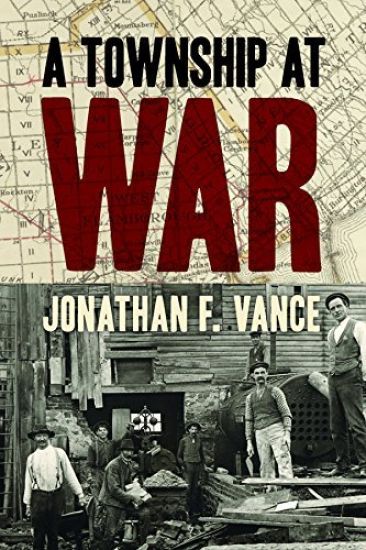
A Township at War takes the reader from rural Canadian field and farm to the slopes of Vimy Ridge and the mud of Passchendaele, and shows how a tightly knit Ontario community was consumed and transformed by the trauma of war. In 1914, the southern Ontario township of East Flamborough was like a thousand other rural townships in Canada, broadly representative in its wartime experience. Author Jonathan Vance draws from rich narrative sources to reveal what rural people were like a century ago - how they saw the world, what they valued, and how they lived their lives. We see them coming to terms with global events that took their loved ones to distant battlefields, and dealing with the prosaic challenges of everyday life. Fall fairs, recruiting meetings, church services, school concerts - all are reimagined to understand how rural Canadians coped with war, modernism, and a world that was changing more quickly than they were.This is a story of resilience and idealism, of violence and small-mindedness, of a world that has long disappeared and one that remains with us to this day.