Kirjojen hintavertailu. Mukana 11 627 354 kirjaa ja 12 kauppaa.

Kirjahaku

Etsi kirjoja tekijän nimen, kirjan nimen tai ISBN:n perusteella.

16 kirjaa tekijältä Jonathan Marks

The Alternative Introduction to Biological Anthropology

The Alternative Introduction to Biological Anthropology

Jonathan Marks

Oxford University Press Inc
2017
nidottu
In The Alternative Introduction to Biological Anthropology, Second Edition, author Jonathan Marks presents an innovative framework for thinking about the major issues in the field with fourteen original essays designed to correlate to the core chapters in standard textbooks. Each chapter draws on and complements--but does not reconstitute (except for the sake of clarity)--the major data and ideas presented in standard texts. Marks explores such topics as how we make sense of data about our origins, where our modern ideas come from, our inability to separate natural facts from cultural facts and values as we try to understand ourselves, and the social and political aspects of science as a culturally situated mental activity.
Human Biodiversity

Human Biodiversity

Jonathan Marks

AldineTransaction
1995
nidottu
Are humans unique? This simple question, at the very heart of the hybrid field of biological anthropology, poses one of the false of dichotomies—with a stereotypical humanist answering in the affirmative and a stereotypical scientist answering in the negative.The study of human biology is different from the study of the biology of other species. In the simplest terms, people's lives and welfare may depend upon it, in a sense that they may not depend on the study of other scientific subjects. Where science is used to validate ideas—four out of five scientists preferring a brand of cigarettes or toothpaste—there is a tendency to accept the judgment as authoritative without asking the kinds of questions we might ask of other citizens' pronouncements.
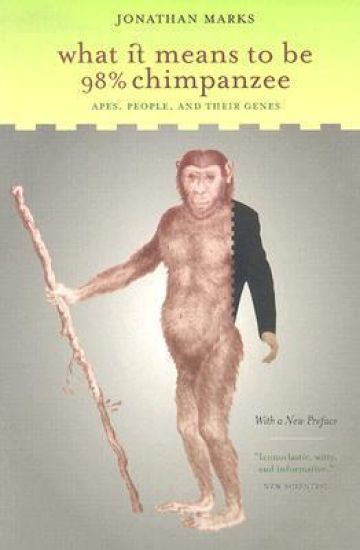
What It Means to Be 98% Chimpanzee

What It Means to Be 98% Chimpanzee

Jonathan Marks

University of California Press
2003
pokkari
Marks presents the field of molecular anthropology - a synthesis of the holistic approach of anthropology with the reductive approach of molecular genetics - as a way of improving our understanding of the science of human evolution. This iconoclastic, witty, and extremely readable book illuminates the deep background of our place in nature and asks us to think critically about what science is, and what passes for it, in modern society.
Why I Am Not a Scientist

Why I Am Not a Scientist

Jonathan Marks

University of California Press
2009
pokkari
This lively and provocative book casts an anthropological eye on the field of science in a wide-ranging and innovative discussion that integrates philosophy, history, sociology, and auto-ethnography. Jonathan Marks examines biological anthropology, the history of the life sciences, and the literature of science studies while upending common understandings of science and culture with a mixture of anthropology, common sense, and disarming humor.Science, Marks argues, is widely accepted to be three things: a method of understanding and a means of establishing facts about the universe, the facts themselves, and a voice of authority or a locus of cultural power. This triple identity creates conflicting roles and tensions within the field of science and leads to its record of instructive successes and failures. Among the topics Marks addresses are the scientific revolution, science as thought and performance, creationism, scientific fraud, and modern scientific racism. Applying his considerable insight, energy, and wit, Marks sheds new light on the evolution of science, its role in modern culture, and its challenges for the twenty-first century.
Tales of the Ex-Apes

Tales of the Ex-Apes

Jonathan Marks

University of California Press
2015
pokkari
What do we think about when we think about human evolution? With his characteristic wit and wisdom, anthropologist Jonathan Marks explores our scientific narrative of human origins-the study of evolution-and examines its cultural elements and theoretical foundations. In the process, he situates human evolution within a general anthropological framework and presents it as a special case of kinship and mythology. Tales of the Ex-Apes argues that human evolution has incorporated the emergence of social relations and cultural histories that are unprecedented in the apes and thus cannot be reduced to purely biological properties and processes. Marks shows that human evolution has involved the transformation from biological to biocultural evolution. Over tens of thousands of years, new social roles-notably spouse, father, in-laws, and grandparents-have co-evolved with new technologies and symbolic meanings to produce the human species, in the absence of significant biological evolution. We are biocultural creatures, Marks argues, fully comprehensible by recourse to neither our real ape ancestry nor our imaginary cultureless biology.
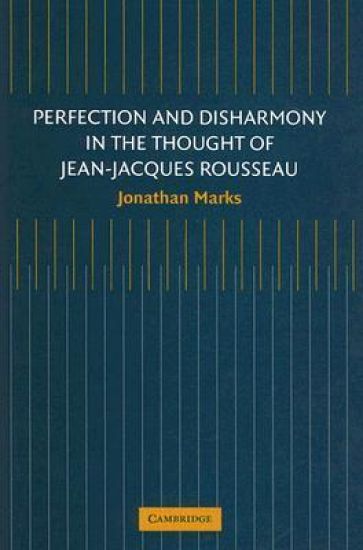
Perfection and Disharmony in the Thought of Jean-Jacques Rousseau
In Perfection and Disharmony in the Thought of Jean-Jacques Rousseau, Jonathan Marks offers an interpretation of the philosopher's thought and its place in the contemporary debate between liberals and communitarians. Against prevailing views, he argues that Rousseau's thought revolves around the natural perfection of a naturally disharmonious being. At the foundation of Rousseau's thought he finds a natural teleology that takes account of and seeks to harmonize conflicting ends. The Rousseau who emerges from this interpretation is a radical critic of liberalism who is nonetheless more cautious about protecting individual freedom than his milder communitarian successors. Marks elaborates on the challenge that Rousseau poses to liberals and communitarians alike by setting up a dialogue between him and Charles Taylor, one of the most distinguished ethical and political theorists at work today.
Perfection and Disharmony in the Thought of Jean-Jacques Rousseau
In Perfection and Disharmony in the Thought of Jean-Jacques Rousseau, Jonathan Marks offers an interpretation of the philosopher's thought and its place in the contemporary debate between liberals and communitarians. Against prevailing views, he argues that Rousseau's thought revolves around the natural perfection of a naturally disharmonious being. At the foundation of Rousseau's thought he finds a natural teleology that takes account of and seeks to harmonize conflicting ends. The Rousseau who emerges from this interpretation is a radical critic of liberalism who is nonetheless more cautious about protecting individual freedom than his milder communitarian successors. Marks elaborates on the challenge that Rousseau poses to liberals and communitarians alike by setting up a dialogue between him and Charles Taylor, one of the most distinguished ethical and political theorists at work today.
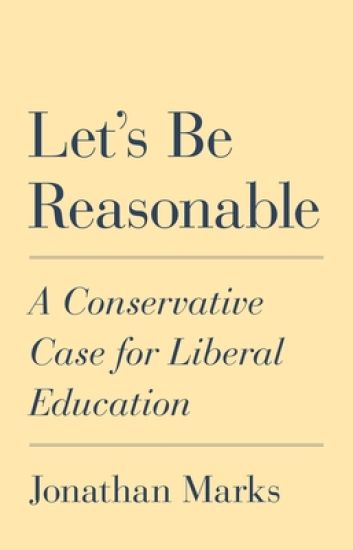
Let's Be Reasonable

Let's Be Reasonable

Jonathan Marks

PRINCETON UNIVERSITY PRESS
2021
sidottu
A conservative college professor's compelling defense of liberal educationNot so long ago, conservative intellectuals such as William F. Buckley Jr. believed universities were worth fighting for. Today, conservatives seem more inclined to burn them down. In Let's Be Reasonable, conservative political theorist and professor Jonathan Marks finds in liberal education an antidote to this despair, arguing that the true purpose of college is to encourage people to be reasonable—and revealing why the health of our democracy is at stake.Drawing on the ideas of John Locke and other thinkers, Marks presents the case for why, now more than ever, conservatives must not give up on higher education. He recognizes that professors and administrators frequently adopt the language and priorities of the left, but he explains why conservative nightmare visions of liberal persecution and indoctrination bear little resemblance to what actually goes on in college classrooms. Marks examines why advocates for liberal education struggle to offer a coherent defense of themselves against their conservative critics, and demonstrates why such a defense must rest on the cultivation of reason and of pride in being reasonable.More than just a campus battlefield guide, Let's Be Reasonable recovers what is truly liberal about liberal education—the ability to reason for oneself and with others—and shows why the liberally educated person considers reason to be more than just a tool for scoring political points.
Let's Be Reasonable

Let's Be Reasonable

Jonathan Marks

PRINCETON UNIVERSITY PRESS
2023
pokkari
A conservative college professor's compelling defense of liberal educationNot so long ago, conservative intellectuals such as William F. Buckley Jr. believed universities were worth fighting for. Today, conservatives seem more inclined to burn them down. In Let's Be Reasonable, conservative political theorist and professor Jonathan Marks finds in liberal education an antidote to this despair, arguing that the true purpose of college is to encourage people to be reasonable—and revealing why the health of our democracy is at stake.Drawing on the ideas of John Locke and other thinkers, Marks presents the case for why, now more than ever, conservatives must not give up on higher education. He recognizes that professors and administrators frequently adopt the language and priorities of the left, but he explains why conservative nightmare visions of liberal persecution and indoctrination bear little resemblance to what actually goes on in college classrooms. Marks examines why advocates for liberal education struggle to offer a coherent defense of themselves against their conservative critics, and demonstrates why such a defense must rest on the cultivation of reason and of pride in being reasonable.More than just a campus battlefield guide, Let's Be Reasonable recovers what is truly liberal about liberal education—the ability to reason for oneself and with others—and shows why the liberally educated person considers reason to be more than just a tool for scoring political points.
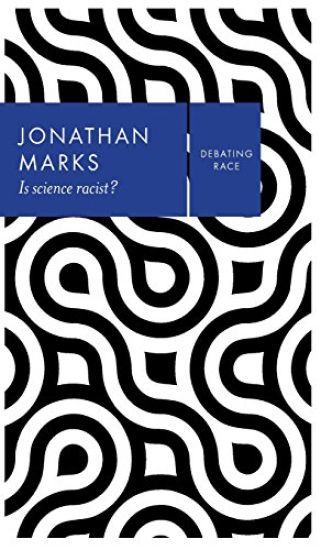
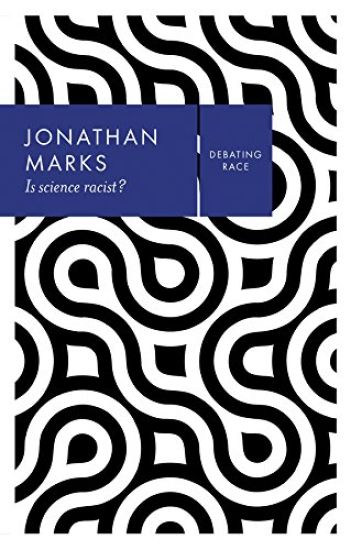
Is Science Racist?

Is Science Racist?

Jonathan Marks

Polity Press
2017
sidottu
Every arena of science has its own flash-point issues—chemistry and poison gas, physics and the atom bomb—and genetics has had a troubled history with race. As Jonathan Marks reveals, this dangerous relationship rumbles on to this day, still leaving plenty of leeway for a belief in the basic natural inequality of races.The eugenic science of the early twentieth century and the commodified genomic science of today are unified by the mistaken belief that human races are naturalistic categories. Yet their boundaries are founded neither in biology nor in genetics and, not being a formal scientific concept, race is largely not accessible to the scientist. As Marks argues, race can only be grasped through the humanities: historically, experientially, politically. This wise, witty essay explores the persistence and legacy of scientific racism, which misappropriates the authority of science and undermines it by converting it into a social weapon.
Is Science Racist?

Is Science Racist?

Jonathan Marks

Polity Press
2017
nidottu
Every arena of science has its own flash-point issues—chemistry and poison gas, physics and the atom bomb—and genetics has had a troubled history with race. As Jonathan Marks reveals, this dangerous relationship rumbles on to this day, still leaving plenty of leeway for a belief in the basic natural inequality of races.The eugenic science of the early twentieth century and the commodified genomic science of today are unified by the mistaken belief that human races are naturalistic categories. Yet their boundaries are founded neither in biology nor in genetics and, not being a formal scientific concept, race is largely not accessible to the scientist. As Marks argues, race can only be grasped through the humanities: historically, experientially, politically. This wise, witty essay explores the persistence and legacy of scientific racism, which misappropriates the authority of science and undermines it by converting it into a social weapon.
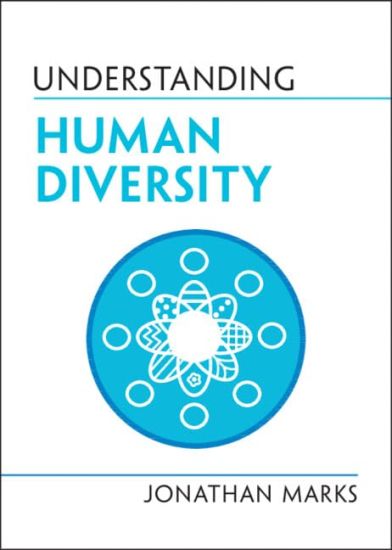
Understanding Human Diversity

Understanding Human Diversity

Jonathan Marks

Cambridge University Press
2024
pokkari
No two people are the same, and no two groups of people are the same. But what kinds of differences are there, and what do they mean? What does our DNA say about race, gender, equality, or ancestry? Drawing on the latest discoveries in anthropology and human genetics, Understanding Human Diversity looks at scientific realities and pseudoscientific myths about the patterns of diversity in our species, challenging common misconceptions about genetics, race, and evolution and their role in shaping human life today. By examining nine counterexamples drawn from popular scientific ideas, that is to say, examinations of what we are not, this book leads the reader to an appreciation of what we are. We are hybrids with often inseparable natural and cultural aspects, formed of natural and cultural histories, and evolved from remote ape and recent human ancestors. This book is a must for anyone curious about human genetics, human evolution, and human diversity.
English Pronunciation in Use Elementary Book with Answers and Downloadable Audio
Understand and be understood in English with the best-selling English Pronunciation in Use. This book, with over five hours of free downloadable audio, includes 50 units of explanations, examples, practice exercises and answers for elementary level (A2) learners of English. You will become confident with all areas of English pronunciation, including individual sounds, word stress, connected speech and intonation, and can practise with simple 'listen and repeat' activities, modelled with a single British English accent. Inside the book is a code for the free audio, along with clear instructions for downloading from the cambridge.org website. Perfect for both self-study and classroom activities.
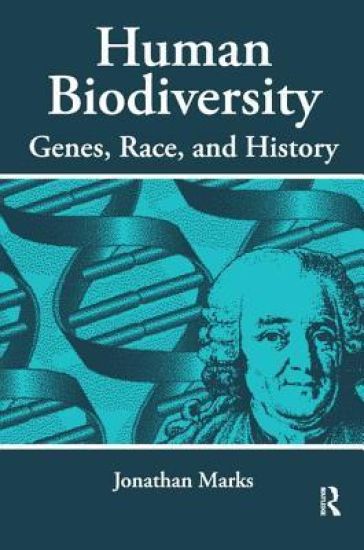
Human Biodiversity

Human Biodiversity

Jonathan Marks

Routledge
2017
sidottu
Are humans unique? This simple question, at the very heart of the hybrid field of biological anthropology, poses one of the false of dichotomies with a stereotypical humanist answering in the affirmative and a stereotypical scientist answering in the negative.The study of human biology is different from the study of the biology of other species. In the simplest terms, people's lives and welfare may depend upon it, in a sense that they may not depend on the study of other scientific subjects. Where science is used to validate ideas four out of five scientists preferring a brand of cigarettes or toothpaste there is a tendency to accept the judgment as authoritative without asking the kinds of questions we might ask of other citizens' pronouncements.In Human Biodiversity, Marks has attempted to distill from a centuries-long debate what has been learned and remains to be learned about the biological differences within and among human groups. His is the first such attempt by an anthropologist in years, for genetics has undermined the fundamental assumptions of racial taxonomy. The history of those assumptions from Linnaeus to the recent past the history of other, more useful assumptions that derive from Buffon and have reemerged to account for genetic variation are the poles of Marks's exploration.
Why Are There Still Creationists?

Why Are There Still Creationists?

Jonathan Marks

Polity Press
2021
sidottu
The evidence for the ancestry of the human species among the apes is overwhelming. But the facts are never “just” facts. Human evolution has always been a value-laden scientific theory and, as anthropology makes clear, the ancestors are always sacred. They may be ghosts, or corpses, or fossils, or a naked couple in a garden, but the idea that you are part of a lineage is a powerful and universal one. Meaning and morals are at play, which most certainly transcend science and its quest for maximum accuracy. With clarity and wit, Jonathan Marks shows that the creation/evolution debate is not science versus religion. After all, modern anti-evolutionists reject humanistic scholarship about the Bible even more fundamentally than they reject the science of our simian ancestry. Widening horizons on both sides of the debate, Marks makes clear that creationism is a theological, not a scientific, debate and that thinking perceptively about values and meanings should not be an alternative to thinking about science – it should be a key part of it.
Why Are There Still Creationists?

Why Are There Still Creationists?

Jonathan Marks

Polity Press
2021
nidottu
The evidence for the ancestry of the human species among the apes is overwhelming. But the facts are never “just” facts. Human evolution has always been a value-laden scientific theory and, as anthropology makes clear, the ancestors are always sacred. They may be ghosts, or corpses, or fossils, or a naked couple in a garden, but the idea that you are part of a lineage is a powerful and universal one. Meaning and morals are at play, which most certainly transcend science and its quest for maximum accuracy. With clarity and wit, Jonathan Marks shows that the creation/evolution debate is not science versus religion. After all, modern anti-evolutionists reject humanistic scholarship about the Bible even more fundamentally than they reject the science of our simian ancestry. Widening horizons on both sides of the debate, Marks makes clear that creationism is a theological, not a scientific, debate and that thinking perceptively about values and meanings should not be an alternative to thinking about science – it should be a key part of it.