Kirjojen hintavertailu. Mukana 12 390 323 kirjaa ja 12 kauppaa.

Kirjahaku

Etsi kirjoja tekijän nimen, kirjan nimen tai ISBN:n perusteella.

4 kirjaa tekijältä Jonathan P. A. Sell

Shakespeare's Sublime Pathos

Shakespeare's Sublime Pathos

Jonathan P. A. Sell

Taylor Francis Ltd
2021
sidottu
Winner of the AEDEAN "Enrique García Díez" Literature Research Award 2023Winner of the European Society for the Study of English Book Award 2024Shakespeare’s Sublime Pathos: Person, Audience, Language breaks new ground in providing a sustained, demystifying treatment of its subject and looking for answers to basic questions regarding the creation, experience, aesthetics and philosophy of Shakespearean sublimity. More specifically, it explores how Shakespeare generates experiences of sublime pathos, for which audiences have been prepared by the sublime ethos described in the companion volume, Shakespeare’s Sublime Ethos. To do so, it examines Shakespeare’s model of mutualistic character, in which "entangled" language brokers a psychic communion between fictive persons and real-life audiences and readers. In the process, Sublime Critical platitudes regarding Shakespeare’s liberating ambiguity and invention of the human are challenged, while the sympathetic imagination is reinstated as the linchpin of the playwright’s sublime effects. As the argument develops, the Shakespearean sublime emerges as an emotional state of vulnerable exhilaration leading to an ethically uplifting openness towards others and an epistemologically bracing awareness of human unknowability. Taken together, Shakespeare’s Sublime Pathos and Shakespeare’s Sublime Ethos show how Shakespearean drama integrates matter and spirit on hierarchical planes of cognition and argue that, ultimately, his is an immanent sublimity of the here-and-now enfolding a transcendence which may be imagined, simulated or evoked, but never achieved.
Shakespeare's Sublime Pathos

Shakespeare's Sublime Pathos

Jonathan P. A. Sell

TAYLOR FRANCIS LTD
2023
nidottu
Winner of the AEDEAN "Enrique García Díez" Literature Research Award 2023Winner of the European Society for the Study of English Book Award 2024Shakespeare’s Sublime Pathos: Person, Audience, Language breaks new ground in providing a sustained, demystifying treatment of its subject and looking for answers to basic questions regarding the creation, experience, aesthetics and philosophy of Shakespearean sublimity. More specifically, it explores how Shakespeare generates experiences of sublime pathos, for which audiences have been prepared by the sublime ethos described in the companion volume, Shakespeare’s Sublime Ethos. To do so, it examines Shakespeare’s model of mutualistic character, in which "entangled" language brokers a psychic communion between fictive persons and real-life audiences and readers. In the process, Sublime Critical platitudes regarding Shakespeare’s liberating ambiguity and invention of the human are challenged, while the sympathetic imagination is reinstated as the linchpin of the playwright’s sublime effects. As the argument develops, the Shakespearean sublime emerges as an emotional state of vulnerable exhilaration leading to an ethically uplifting openness towards others and an epistemologically bracing awareness of human unknowability. Taken together, Shakespeare’s Sublime Pathos and Shakespeare’s Sublime Ethos show how Shakespearean drama integrates matter and spirit on hierarchical planes of cognition and argue that, ultimately, his is an immanent sublimity of the here-and-now enfolding a transcendence which may be imagined, simulated or evoked, but never achieved.
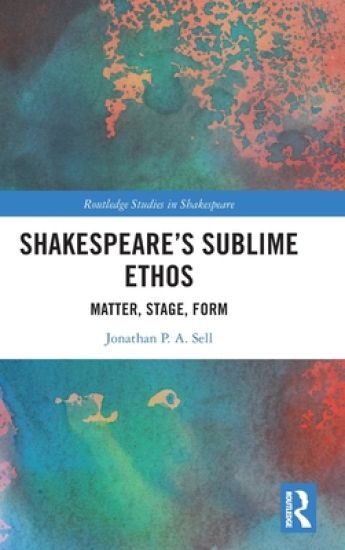
Shakespeare's Sublime Ethos

Shakespeare's Sublime Ethos

Jonathan P. A. Sell

Taylor Francis Ltd
2021
sidottu
Winner of the AEDEAN "Enrique García Díez" Literature Research Award 2023Winner of the European Society for the Study of English Book Award 2024Shakespeare’s Sublime Ethos: Matter, Stage, Form breaks new ground in providing a sustained, demystifying treatment of its subject and looking for answers to basic questions regarding the creation, experience, aesthetics and philosophy of Shakespearean sublimity. More specifically, it explores how Shakespeare generates a sublime mood or ethos which predisposes audiences intellectually and emotionally for the full experience of sublime pathos, explored in the companion volume, Shakespeare’s Sublime Pathos. To do so, it examines Shakespeare’s invention of sublime matter, his exploitation of the special characteristics of the Elizabethan stage, and his dramaturgical and formal simulacra of absolute space and time. In the process, it considers Shakespeare’s conception of the universe and man’s place in it and uncovers the epistemological and existential implications of key aspects of his art. As the argument unfolds, a case is made for a transhistorically baroque Shakespeare whose "bastard art" enables the dramatic restoration of an original innocence where ignorance really is bliss. Taken together, Shakespeare’s Sublime Ethos and Shakespeare’s Sublime Pathos show how Shakespearean drama integrates matter and spirit on hierarchical planes of cognition and argue that, ultimately, his is an immanent sublimity of the here-and-now enfolding a transcendence which may be imagined, simulated or evoked, but never achieved.
Shakespeare's Sublime Ethos

Shakespeare's Sublime Ethos

Jonathan P. A. Sell

TAYLOR FRANCIS LTD
2023
nidottu
Winner of the AEDEAN "Enrique García Díez" Literature Research Award 2023Winner of the European Society for the Study of English Book Award 2024Shakespeare’s Sublime Ethos: Matter, Stage, Form breaks new ground in providing a sustained, demystifying treatment of its subject and looking for answers to basic questions regarding the creation, experience, aesthetics and philosophy of Shakespearean sublimity. More specifically, it explores how Shakespeare generates a sublime mood or ethos which predisposes audiences intellectually and emotionally for the full experience of sublime pathos, explored in the companion volume, Shakespeare’s Sublime Pathos. To do so, it examines Shakespeare’s invention of sublime matter, his exploitation of the special characteristics of the Elizabethan stage, and his dramaturgical and formal simulacra of absolute space and time. In the process, it considers Shakespeare’s conception of the universe and man’s place in it and uncovers the epistemological and existential implications of key aspects of his art. As the argument unfolds, a case is made for a transhistorically baroque Shakespeare whose "bastard art" enables the dramatic restoration of an original innocence where ignorance really is bliss. Taken together, Shakespeare’s Sublime Ethos and Shakespeare’s Sublime Pathos show how Shakespearean drama integrates matter and spirit on hierarchical planes of cognition and argue that, ultimately, his is an immanent sublimity of the here-and-now enfolding a transcendence which may be imagined, simulated or evoked, but never achieved.