Kirjojen hintavertailu. Mukana 11 342 296 kirjaa ja 12 kauppaa.

Kirjahaku

Etsi kirjoja tekijän nimen, kirjan nimen tai ISBN:n perusteella.

4 kirjaa tekijältä Jonna Perrillo

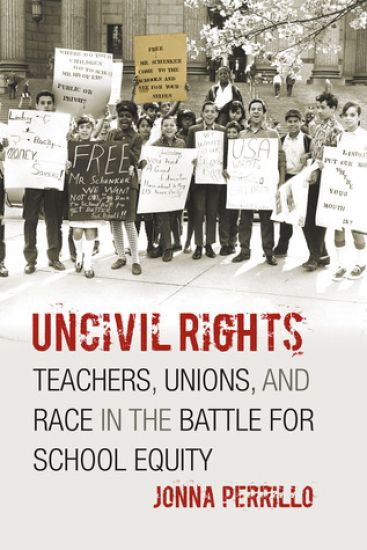
Uncivil Rights

Uncivil Rights

Jonna Perrillo

University of Chicago Press
2012
sidottu
Almost fifty years after Brown v. Board of Education, a wealth of research shows that minority students continue to receive an unequal education. At the heart of this inequality is a complex and often conflicted relationship between teachers and civil rights activists, examined fully for the first time in Jonna Perrillo's "Uncivil Rights", which traces the tensions between the two groups in New York City from the Great Depression to the present. While movements for teachers' rights and civil rights were not always in conflict, Perrillo uncovers the ways they have become so, brought about both by teachers who have come to see civil rights efforts as detracting from or competing with their own goals and by civil rights activists whose aims have deprofessionalized the role of the educator. Focusing in particular on unionized teachers, Perrillo finds a new vantage point from which to examine the relationship between school and community, showing how in this struggle, educators, activists, and especially our students have lost out.
Uncivil Rights

Uncivil Rights

Jonna Perrillo

University of Chicago Press
2012
nidottu
Almost fifty years after Brown v. Board of Education, a wealth of research shows that minority students continue to receive an unequal education. At the heart of this inequality is a complex and often conflicted relationship between teachers and civil rights activists, examined fully for the first time in Jonna Perrillo's "Uncivil Rights", which traces the tensions between the two groups in New York City from the Great Depression to the present. While movements for teachers' rights and civil rights were not always in conflict, Perrillo uncovers the ways they have become so, brought about both by teachers who have come to see civil rights efforts as detracting from or competing with their own goals and by civil rights activists whose aims have deprofessionalized the role of the educator. Focusing in particular on unionized teachers, Perrillo finds a new vantage point from which to examine the relationship between school and community, showing how in this struggle, educators, activists, and especially our students have lost out.
Educating the Enemy

Educating the Enemy

Jonna Perrillo

University of Chicago Press
2022
sidottu
Compares the privileged educational experience offered to the children of relocated Nazi scientists in Texas with the educational disadvantages faced by Mexican American students living in the same city.Educating the Enemy begins with the 144 children of Nazi scientists who moved to El Paso, Texas, in 1946 as part of the military program called Operation Paperclip. These German children were bused daily from a military outpost to four El Paso public schools. Though born into a fascist enemy nation, the German children were quickly integrated into the schools and, by proxy, American society. Their rapid assimilation offered evidence that American public schools played a vital role in ensuring the victory of democracy over fascism. Jonna Perrillo not only tells this fascinating story of Cold War educational policy, but she draws an important contrast with another, much more numerous population of children in the El Paso public schools: Mexican Americans. Like everywhere else in the Southwest, Mexican American children in El Paso were segregated into “Mexican” schools, where the children received a vastly different educational experience. Not only were they penalized for speaking Spanish—the only language all but a few spoke due to segregation—they were tracked for low-wage and low-prestige careers, with limited opportunities for economic success. Educating the Enemy charts what two groups of children—one that might have been considered the enemy, the other that was treated as such—reveal about the ways political assimilation has been treated by schools as an easier, more viable project than racial or ethnic assimilation. Listen to an interview with the author here and read an interview in Time and a piece based on the book in the Boston Review.
Educating the Enemy

Educating the Enemy

Jonna Perrillo

University of Chicago Press
2022
nidottu
Compares the privileged educational experience offered to the children of relocated Nazi scientists in Texas with the educational disadvantages faced by Mexican American students living in the same city.Educating the Enemy begins with the 144 children of Nazi scientists who moved to El Paso, Texas, in 1946 as part of the military program called Operation Paperclip. These German children were bused daily from a military outpost to four El Paso public schools. Though born into a fascist enemy nation, the German children were quickly integrated into the schools and, by proxy, American society. Their rapid assimilation offered evidence that American public schools played a vital role in ensuring the victory of democracy over fascism. Jonna Perrillo not only tells this fascinating story of Cold War educational policy, but she draws an important contrast with another, much more numerous population of children in the El Paso public schools: Mexican Americans. Like everywhere else in the Southwest, Mexican American children in El Paso were segregated into “Mexican” schools, where the children received a vastly different educational experience. Not only were they penalized for speaking Spanish—the only language all but a few spoke due to segregation—they were tracked for low-wage and low-prestige careers, with limited opportunities for economic success. Educating the Enemy charts what two groups of children—one that might have been considered the enemy, the other that was treated as such—reveal about the ways political assimilation has been treated by schools as an easier, more viable project than racial or ethnic assimilation. Listen to an interview with the author here and read an interview in Time and a piece based on the book in the Boston Review.