Kirjojen hintavertailu. Mukana 11 717 486 kirjaa ja 12 kauppaa.

Kirjahaku

Etsi kirjoja tekijän nimen, kirjan nimen tai ISBN:n perusteella.

7 kirjaa tekijältä Jorge Niosi

Technology and National Competitiveness

Technology and National Competitiveness

Jorge Niosi

McGill-Queen's University Press
1991
sidottu
The first part of the collection reassesses and elaborates on Nobel Prize winner Wassily Leontief's input-output model and makes use of Michael V. Posner's technology gap trade theory to examine international trade and import-export factor intensity. The contributors clearly isolate technology as a crucial factor in the foreign commerce of Canada, the US, and other industrial nations. The second part provides the theoretical background, revealing the importance of the industrialized state's ability to affect international trade by implementing technology policy. The third part analyses the role of government strategy in the development of technology in less industrialized nations faced with a fluctuating world economy and rapid technological change. The fourth part re-evaluates Shumpeterian theory, addressing the market determinants of technological change such as market structure, corporate strategy, and the size of corporations. The contributors to this volume are Bernard Bonin, Francois Chesnais, Lester A. Davis, Christian DeBresson, Giovanni Dosi, Faye Duchin, Philippe Faucher, K.E. Hamilton, Thomas Hatzichronoglou, Lynn Krieger Mytelka, Jorge Niosi, Jacques Perrin, and Luc Soete.

Technology and National Competitiveness

Technology and National Competitiveness

Jorge Niosi

McGill-Queen's University Press
1991
nidottu
The first part of the collection reassesses and elaborates on Nobel Prize winner Wassily Leontief's input-output model and makes use of Michael V. Posner's technology gap trade theory to examine international trade and import-export factor intensity. The contributors clearly isolate technology as a crucial factor in the foreign commerce of Canada, the US, and other industrial nations. The second part provides the theoretical background, revealing the importance of the industrialized state's ability to affect international trade by implementing technology policy. The third part analyses the role of government strategy in the development of technology in less industrialized nations faced with a fluctuating world economy and rapid technological change. The fourth part re-evaluates Shumpeterian theory, addressing the market determinants of technological change such as market structure, corporate strategy, and the size of corporations. The contributors to this volume are Bernard Bonin, Francois Chesnais, Lester A. Davis, Christian DeBresson, Giovanni Dosi, Faye Duchin, Philippe Faucher, K.E. Hamilton, Thomas Hatzichronoglou, Lynn Krieger Mytelka, Jorge Niosi, Jacques Perrin, and Luc Soete.

Canada's National System of Innovation

Canada's National System of Innovation

Jorge Niosi

McGill-Queen's University Press
2000
sidottu
Niosi looks at the history of Canada's National System of Innovation (NSI), particularly during the post-war period, illuminating the fact that during and after World War II over 30 research universities, 150 government laboratories, and dozens of government policies aimed at nurturing innovation in private firms, academia, and government organizations were developed. He uses data obtained through questionnaire responses from all the large research and development organizations in Canada to analyse Canada's domestic system of innovation, finding increasing collaboration between universities, government laboratories, and private firms. He concludes that Canada has been quite successful in creating a national system of innovation and that the federal government, through its initiatives and innovative techniques, has been the main factor in the creation of this system.
Canadian Multinationals

Canadian Multinationals

Jorge Niosi

Garamond Press
1985
pokkari
Canada is one of the principal exporters of capital to other countries. It is home to several multinationals which in their respective areas of activity are among the largest in the world. This goundbreaking work, originally published in French, considers the nature and role of over a dozen companies in the manufacturing, mining, and public service sectors, challenging existing theories of multinationals.
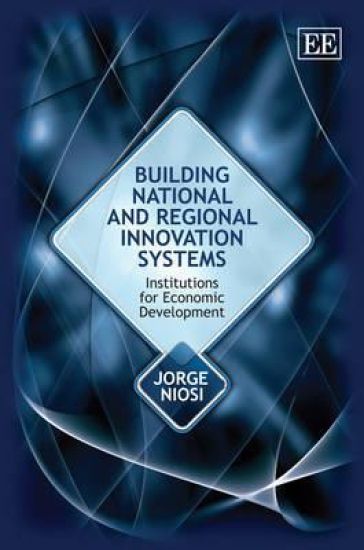
Building National and Regional Innovation Systems

Building National and Regional Innovation Systems

Jorge Niosi

Edward Elgar Publishing Ltd
2010
sidottu
Following the demise of the Washington Consensus, developing countries are looking for new ideas to guide their development. This innovative book suggests taking seriously some of the findings of evolutionary economics and paying specific attention to the institutions that matter for economic development, particularly those related to science, technology and innovation. The author highlights how the institutional framework that will allow countries to grow should include universities, government laboratories and policy incentives for human capital and business research and development. He argues that there are no simple policies and no 'one-size-fits-all' solutions, and that the majority of developing countries have not yet found the right combinations of institutions. The book suggests that building successful national and regional innovation systems requires at least one generation of continuous effort, significant trial and error, and a thorough knowledge of the experiences of the OECD countries that built those institutions in the past. It moves on to demonstrate how certain countries such as Canada, Finland and Singapore have succeeded in catching-up and how several others, for example Argentina, Egypt, Mexico and the Philippines, have failed. It then pinpoints the main industrial, science, technology and innovation policies required by developing countries to achieve their goals. This unique and timely book will appeal to postgraduate students of international economics, international business and development economics, as well as students of science, technology and society.
Building National and Regional Innovation Systems

Building National and Regional Innovation Systems

Jorge Niosi

Edward Elgar Publishing Ltd
2012
nidottu
Following the demise of the Washington Consensus, developing countries are looking for new ideas to guide their development. This innovative book suggests taking seriously some of the findings of evolutionary economics and paying specific attention to the institutions that matter for economic development, particularly those related to science, technology and innovation. The author highlights how the institutional framework that will allow countries to grow should include universities, government laboratories and policy incentives for human capital and business research and development. He argues that there are no simple policies and no 'one-size-fits-all' solutions, and that the majority of developing countries have not yet found the right combinations of institutions. The book suggests that building successful national and regional innovation systems requires at least one generation of continuous effort, significant trial and error, and a thorough knowledge of the experiences of the OECD countries that built those institutions in the past. It moves on to demonstrate how certain countries such as Canada, Finland and Singapore have succeeded in catching-up and how several others, for example Argentina, Egypt, Mexico and the Philippines, have failed. It then pinpoints the main industrial, science, technology and innovation policies required by developing countries to achieve their goals. This unique and timely book will appeal to postgraduate students of international economics, international business and development economics, as well as students of science, technology and society.