Kirjojen hintavertailu. Mukana 11 627 067 kirjaa ja 12 kauppaa.

Kirjahaku

Etsi kirjoja tekijän nimen, kirjan nimen tai ISBN:n perusteella.

7 kirjaa tekijältä Joseph F. Kelly

Responding to Evil

Responding to Evil

Joseph F. Kelly

Liturgical Press
2003
pokkari
In Responding to Evil Joseph Kelly treats evil as a force in our personal lives. He talks about the impact of September 11 on the American consciousness and how that brought the question of evil front and center. Professor Kelly then looks at what evil does to us and how previous generations have dealt with it. By focusing on the sins people commit rather than the questions psychologists tend to focus on, such as murder or theft, or on tragedies that occurred in Rwanda or during the Holocaust, Kelly makes the discussion of evil relevant to readers like us who are not really evil" but who face the problem of our own sinfulness every day. In taking up the intellectual question of how God and evil can coexist Kelly relates the ideas in the book to real-life situations, especially of good and caring people. Finally, he shares how we can respond to evil and looks at how some modern Christians, often ordinary people, have done so. Chapters are *What Evil Does to Us, - *How Can God and Evil Co-Exist? - *Responses to Evil, - and *Some Final Thoughts. Joseph F. Kelly, PhD, chair of the department of religious studies at John Carroll University, is also active in religious education for the Diocese of Cleveland. Of his eight previous books, with Liturgical Press he has published The Problem of Evil in the Western Tradition and The World of the Early Christians. "
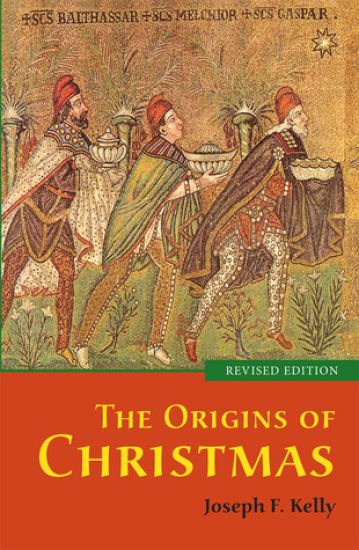
The Origins of Christmas

The Origins of Christmas

Joseph F. Kelly

Liturgical Press
2014
pokkari
When was Christmas first celebrated? How did December 25 become the date for the feast? How did the Bible’s “magi from the East” become three kings named Melchior, Caspar, and Balthasar who rode camels from three different continents to worship the newborn Christ? How did the Feast of the Nativity generate an entire liturgical season from Advent to Candlemas? Why did medieval and Renaissance artists portray Joseph as an old man? When did the first Christmas music appear? And who was the real Saint Nicholas? These and many other questions are answered in this revised and expanded edition of The Origins of Christmas. The story of the origins of Christmas is not well known, but it is a fascinating tale. It begins when the first Christians had little interest in Christ’s Nativity, and it finishes when Christmas had become an integral part of Christian life and Western culture. The Origins of Christmas covers a variety of topics in a concise and accessible style, and is suitable for group discussions.
The Problem of Evil in the Western Tradition

The Problem of Evil in the Western Tradition

Joseph F. Kelly

Liturgical Press
2002
pokkari
The question of evil presents a profound challenge to humanity—why do we do what we know to be wrong? This is especially a challenge to religious believers. Why doesn't an all-good and omnipotent God step in and put an end to evil? The Problem of Evil in the Western Tradition examines how Western thinkers have dealt with the problem of evil, starting in ancient Israel and tracing the question through post-biblical Judaism, Early Christianity (especially in Africa), the Middle Ages, the Renaissance, the Reformation, the Enlightenment, and to the twenty-first century when science has raised new and important issues.Joseph Kelly covers the book of Job, the book of Revelation, Augustine of Hippo, Aquinas, Luther, Marlow, Milton, Voltaire, Hume, Mary Shelley, Darwin, Jung, Flannery O'Connor, Karl Rahner, Teilhard de Chardin, and modern geneticists.Chapters are "Some Perspectives on Evil," "Israel and Evil," "The New Adam," "Out of Africa," "The Broken Cosmos," "The Middle Ages," "Decline and Reform of Humanism," "The Devil's Last Stand," "Rationalizing Evil," "The Attack on Christianity," "Dissident Voices," "Human Evil in the Nineteenth Century," "Science, Evil, and Original Sin," "Modern Literary Approaches to Evil," "Some Scientific Theories of Evil," and "Modern Religious Approaches to Evil."Joseph F. Kelly, Ph.D., is professor of religious studies at John Carroll University in Cleveland, Ohio. He is the author of The World of the Early Christians, published by The Liturgical Press.
An Introduction to the New Testament for Catholics
The title of this book may be a bit puzzling 'a Catholic introduction to the New Testament? The New Testament belongs to all Christians, and the modern study of the New Testament has benefited from the contributions by scholars of all Christian denominations. But there are questions and issues in the New Testament that are specific to Catholics, such as the portrayal of Jesus' mother Mary, the commissioning of Peter, and the Trinity. In this volume, Joseph Kelly provides an introduction to the New Testament for students and deals with the concerns of modern Catholics reading the Bible. It's a book that Catholic teachers can use rather than a book that presents them with problems they have to explain.Kelly helps readers to understand what modern scholars, especially Catholic biblical exegetes, say about the individual books because we cannot understand what role Jesus can play in modern life if we don 't understand what he meant to the earliest Christians.The New Testament tells the story of Jesus, the most remarkable person who ever lived, and of his disciples. It includes some of the most famous narratives in the world and the most memorable words ever spoken. It introduces us to great people who moved history and of those who took the difficult step of leaving the religions of their ancestors and families to become Christians. Kelly shows that in looking at the New Testament we see real people communicating with us 'sharing their beliefs, their fears, and their hopes. Distant yet familiar, challenging yet comprehensible, the New Testament is a precious heritage, and one that Kelly recommends we must make our own.Joseph F. Kelly, PhD, is professor of religious studies at John Carroll University in Cleveland, Ohio. He is the author of The World of the Early Christians, The Problem of Evil in the Western Tradition, Responding to Evil, The Origins of Christmas and The Collegeville Church History Time-Line published by Liturgical Press.
The Ecumenical Councils of the Catholic Church

The Ecumenical Councils of the Catholic Church

Joseph F. Kelly

Liturgical Press
2009
pokkari
There have been twenty-one universal gatherings 'ecumenical councils' of the Catholic Church. The first opened in 325, the last closed in 1965, and the names of many ring out in the history of the church: Nicea, Chalcedon, Trent, Vatican II. Though centuries separate the councils, each occurred when the church faced serious crises, sometimes with doctrinal matters, sometimes with moral or even political matters, and sometimes with discerning the church's relation to the world. The councils determined much of what the Catholic Church is and believes. Additionally, many councils impacted believers in other Christian traditions and even in other faiths. In this accessible, readable, and yet substantial account of the councils Joseph Kelly provides both the historical context for each council as well as an account of its proceedings. Readers will discover how the councils shaped the debate for the following decades and even centuries, and will appreciate the occasional portraits of important conciliar figures from Emperor Constantine to Pope John XXIII.