
Kirjahaku
Etsi kirjoja tekijän nimen, kirjan nimen tai ISBN:n perusteella.
18 kirjaa tekijältä Joseph F. Zimmerman
This volume has been written specifically for students of the U.S. system of government, and for students interested in federalism in practice. Joseph F. Zimmerman traces the development if the U.S. federal system from 1789 to the present day by focussing in the shifting balance of power between the nation and the states. It introduces the important theories of federalism and explains how they can be used to understand the system as it was originally drawn up and as it operates now. All the important trends in national-state relations are examined, with particular attention being given to the preemption by the federal legislature and judiciary of the powers and authority of the states.The U.S. federal system has changed radically since its inception, and continues to increase in complexity. This lucid and accessible account links the system's current practices with its history and looks forward to the future of the most important federal system in operation today.
This volume has been written specifically for students of the U.S. system of government, and for students interested in federalism in practice. Joseph F. Zimmerman traces the development if the U.S. federal system from 1789 to the present day by focussing in the shifting balance of power between the nation and the states. It introduces the important theories of federalism and explains how they can be used to understand the system as it was originally drawn up and as it operates now. All the important trends in national-state relations are examined, with particular attention being given to the preemption by the federal legislature and judiciary of the powers and authority of the states.The U.S. federal system has changed radically since its inception, and continues to increase in complexity. This lucid and accessible account links the system's current practices with its history and looks forward to the future of the most important federal system in operation today.
This is a revision and update of Zimmerman's classic study of relations between state and local government. The first edition, published in 1983, was based on three decades of research into intergovernmental affairs and examined the legal, financial, and structural foundations of state-local relations. This new edition adds a fourth decade of research and brings the work up to date through the early 1990s, adding a chapter on state mandates and local governments, reviewing and analyzing the changes in fortune of state and local governments, and the impact of those changes on their relations between each other and between themselves and the federal government.
This is a revision and update of Zimmerman's classic study of relations between state and local government. The first edition, published in 1983, was based on three decades of research into intergovernmental affairs and examined the legal, financial, and structural foundations of state-local relations. This new edition adds a fourth decade of research and brings the work up to date through the early 1990s, adding a chapter on state mandates and local governments, reviewing and analyzing the changes in fortune of state and local governments, and the impact of those changes on their relations between each other and between themselves and the federal government.
This groundbreaking book examines in detail relations between the states and the roles of United States Congress and Supreme Court in determining the nature of such relations—a distinguishing characteristic of a federal system. The neglect of interstate relations by scholars is surprising in view of the long and ongoing struggle between state power and federal power in the U.S. This new text provides a comprehensive examination of interstate relations, with up-to-date information and analysis relative to interstate suits, full faith and credit, privileges and immunities, tax exportation by states, interstate business competition, and interstate trade barriers. In addition, the work proposes a new model for improving interstate relations in the U.S. This important text will be of interest to scholars and students in American government and politics, state government and politics, and intergovernmental relations.
Zimmerman examines in detail the use of the recall by United States voters to remove elected state and local officials from office. The arguments of recall proponents and opponents are analyzed, and model constitutional and statutory provisions are developed to guide governments considering adoption of the recall or revision of current recall provisions.This book is the first since 1912 devoted to a national evaluation of the recall. The recall currently is authorized by a constitutional or statutory provision in 26 states and by home rule charters in a number of additional states. Zimmerman examines in detail the use of the recall by United States voters to remove elected state and local officials from office. The arguments of recall proponents and opponents are analyzed, and model constitutional and statutory provisions are developed to guide governments considering adoption of the recall or revision of current recall provisions.Recall attempts throughout the United States are reviewed to obtain evidence to evaluate the arguments of recall proponents and opponents. The evidence, Zimmerman suggests, generally supports the proponents. The recall has not produced a new era of public official responsibility, yet the device has not caused extensive disruption of state and local governments as feared by early opponents. In his conclusion, Zimmerman analyzes current constitutional and statutory recall provisions to develop model provisions to guide those considering adoption of the recall or revision of existing provisions. This analysis will be of particular interest to scholars and researchers of state and local government, American constitutional law, and public policy.
In this groundbreaking study, Zimmerman explores the town meeting form of government in all New England states. This comprehensive work relies heavily upon surveys of town officers and citizens, interviews, and mastery of the scattered writing on the subject. Zimmerman finds that the stereotypes of the New England open town meeting advanced by its critics are a serious distortion of reality. He shows that voter superintendence of town affairs has proven to be effective, and there is no empirical evidence that thousands of small towns and cities with elected councils are governed better. Whereas the relatively small voter attendance suggests that interest groups can control town meetings, their influence has been offset effectively by the development of town advisory committees, particularly the finance committee and the planning board, which are effective counterbalances to pressure groups. Zimmerman provides a new conception of town meeting democracy, positing that the meeting is a de facto representative legislative body with two safety valves—open access to all voters and the initiative to add articles to the warrant, and the calling of special meetings to reconsider decisions made at the preceding town meeting. And, as Zimmerman points out, a third safety valve—the protest referendum—can be adopted by a town meeting.
The referendum first became established with voter ratification of the Massachusetts Constitution in 1780. Other types were adopted in the nineteenth century, largely through the efforts of Progressives and Populists seeking to authorize voters to utilize the initiative-referendum and protest referendum. Certain referenda, particularly on adoption or amendment of constitutions and local government charters, are well established and non-controversial. Other referenda, the general initiative-referendum and the protest referendum, have been controversial since their inception. Zimmerman analyzes a number of general initiative and protest referendum campaigns in order to develop conclusions as to their desirability and the need for reform.Experience with the various types of referenda reveal the need for the development of a general theory of their use, combining elements of the theory of representative democracy based on the leadership-feedback model and the theory of direct democracy based upon decision making by assembled voters. Referenda experience also reveals that certain types of referenda would be unnecessary if each state government devolved broad powers to general purpose local government. Zimmerman's analysis of the development of the 16 types of referenda and their attributes and defects will be a major resource for scholars, students, policy makers, and the general public interested in issues of local and state government effectiveness and accountability.
Zimmerman places in perspective the important roles played by interstate compacts and interstate administrative agreements in the governance systems of the United States. Compacts are identified and classified by type. Particular emphasis is placed on federal government promotion of compacts, including the U.S. Congress enactment of federal-state compacts in which the federal government joins member states as partners to achieve stated goals.Formal and informal interstate administrative agreements have increased in number dramatically during the past six decades and relate to both minor and very important issues. Credit for many interstate administrative agreements must be ascribed to associations of state government officers which encourage their members to promote interstate cooperation and also draft model state laws and administrative agreements. Although compacts and agreements have lubricated the functioning of the United States governmental system, as Zimmerman makes clear, the full potential of compacts and agreements has not been achieved to date, and he makes recommendations to improve the level of interstate cooperation. An important resource for scholars and students of American government—federal, state, and local—as well as administrators and policymakers.

This comprehensive work details the special efforts that need to be initiated by governments on a continuing basis to eliminate unethical behavior by public officers and employees. The current conflict-of-interest programs are inadequate to eliminate corruption, and special controls should be installed to detect and deter unethical behavior. The evaluation of different approaches to ethical government and the development of a model ethics program are of special interest.
Electoral Systems in Comparative Perspective
Joseph F. Zimmerman
Praeger Publishers Inc
1994
sidottu
This comparative study of electoral procedures, trends, and key issues is the first to deal with the representation of women and minorities around the world. Wilma Rule and Joseph Zimmerman have brought together an international team of scholars who show why there is gross underrepresentation of women and minorities internationally and who analyze the cultural, socio-economic, and political barriers to their future electoral successes. The scholars describe the current situation in 20 countries in various regions and point to ways for women and minorities to enhance positions politically. This text is intended for courses in comparative politics, political parties and elections, women in politics, and minority politics.
Congress in the latter part of the nineteenth century decided to enact a series of statutes facilitating state enforcement of their respective criminal laws. Subsequently, Congress enacted statutes federalizing what had been solely state crimes, thereby establishing federal court and state court concurrent jurisdiction over these crimes. Federalization of state crimes has been criticized by numerous scholars, U.S. Supreme Court justices, and national organizations. Such federalization has congested the calendars of the U.S. District Court and the U.S. Court of Appeals leading to delays in civil cases because of the Speedy Trial Act that vacates a criminal indictment if a trial is not commenced within a specific number of days, resulted in over-crowded U.S. penitentiaries, and raises the issue of double jeopardy that is prohibited by the Fifth Amendment to the U.S. Constitution and the constitution of each state. This book examines the impact of federalization of state crime and draws conclusions regarding its desirability. It also offers recommendations directed to Congress and the President, one recommendation direct to state legislatures for remedial actions to reduce the undesirable effects of federalized state crimes, and one recommendation that Congress and all states enter into a federal-interstate criminal suppression compact.
An insightful reassessment of the relationship between the U.S. Congress and the states.Reassessing the relationship between the federal government and the states, Congress: Facilitator of State Action examines how the U.S. Congress routinely and necessarily devolves power to the states. A host of congressional statutes reveal the ways in which the U.S. Congress facilitates state action to solve certain problems, including the enforcement of respective criminal laws. Financial and nonfinancial assistance to the states are elucidated and assessed, including technical assistance and the establishment of such programs as the National Driver Register. Comprehensive and timely, this book illuminates a key dynamic in the country's political system and offers a more complex and accurate theory of federalism.Joseph F. Zimmerman is Professor of Political Science at the University at Albany, State University of New York. His many books include Contemporary American Federalism: The Growth of National Power, Second Edition; The Silence of Congress: State Taxation of Interstate Commerce; and The Government and Politics of New York State: Second Edition, all published by SUNY Press.
In-depth study of the recall, the most important popular device allowing voters to remove unresponsive elected officials from office.The recall, or "election in reverse," is meant to allow voters to remove an elected official from office prior to the completion of his/her term in office. In this revised second edition of The Recall, Joseph F. Zimmerman examines the rise of the recall in the United States and its use by American voters. Proponents of the recall believe the threat of removal from office would ensure that elected officials would act in accord with the public's will, while opponents fear their use would disrupt and inhibit public officers in the performance of their duties. Zimmerman provides a detailed analysis of how the recall has functioned in practice and discovers that the recall has seldom been employed against elected state officials. Although used more often against local government officials, the rate is still not exceptionally high when one considers the extremely large number of elected officials. After a century of use in the United States, the recall has not produced a new era of public official responsibility as hoped for by proponents, but neither has it caused extensive disruption of state and local governments, the original concern of early opponents.
In-depth examination of a rarely studied article of the United States Constitution.While there is a vast amount of scholarship on the US Constitution, very little of it addresses Article IV. The article's first section, the Full Faith and Credit Clause, requires that individual states must respect "the public acts, accords, and judicial proceedings of every other state," and the second section, the Privileges and Immunity Clause, prevents one state from treating the citizens of another state in a discriminatory manner. In Unifying the Nation, Joseph F. Zimmerman provides a unique and comprehensive examination of court cases pertaining to both sections. Article IV, he argues, is central to the political and economic union of the individual states that comprise the nation. Many of the court cases cited in the text have tremendous day-to-day relevance and implications for the practice of government, such as same-sex marriage, child adoption, child support, public welfare, health care, and telecommunications.
Innovative Congressional Minimum Standards Preemption Statutes
Joseph F. Zimmerman
State University of New York Press
2017
pokkari
Examines a new type of federal preemption statute popular since 1965 that allows states to retain a certain amount of regulatory discretion, with a focus on environmental statutes.Congress possesses broad regulatory powers, including the power of complete or partial preemption of state and local regulatory powers. Congress rarely enacted preemption statutes before the twentieth century, but since the 1960s such interventions have grown significantly in number, now totaling over seven hundred, and have transformed the nature of the American federal system. In Innovative Congressional Minimum Standards Preemption Statutes, Joseph F. Zimmerman provides the background and history of this critical transformation, classifying the forms these federal interventions have taken, with a focus on statutes dealing with such environmental issues as water and air quality, restoration of surface-mined areas, and still other areas that, collectively, have produced a revolution in relations between Congress and the states. Contrary to public perceptions of preemption being one-sided and heavy-handed, Zimmerman details the many variations present in these statutes that accommodate state and local interests, allowing for administrative and policy flexibility, and a generally cooperative relationship between states and localities and federal administrative agencies.
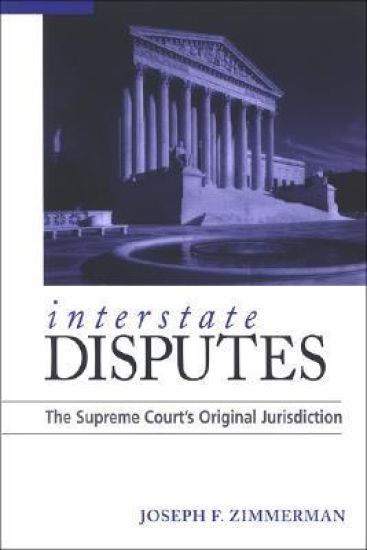
Examines the role of the U.S. Supreme Court in settling disputes between states. With respect to "controversies between two or more states," the U.S. Constitution grants original jurisdiction to the U.S. Supreme Court, and in 1789 Congress made exclusive the Court's jurisdiction over interstate disputes. In this book, Joseph F. Zimmerman examines the role of the Supreme Court in settling disputes between states, the criteria developed by the Court to determine whether its original jurisdiction should be invoked, and the function of special masters, who, as adjuncts to the Court, facilitate negotiated settlements or provide the factual information needed by the Court to render sound decisions. Zimmerman analyzes a wide range of specific disputes, from boundary lines to financial matters to water allocation, diversion, and pollution. To alleviate the Court's exceptionally heavy and critically important appellate workload, the author proposes alternative mechanisms for resolving controversies between sister states, including interstate boundary compacts, interstate regulatory compacts, and several congressional initiatives.