
Kirjojen hintavertailu. Mukana 12 096 659 kirjaa ja 12 kauppaa.

Kirjahaku

Etsi kirjoja tekijän nimen, kirjan nimen tai ISBN:n perusteella.

10 kirjaa tekijältä Josh Lerner

The Architecture of Innovation

The Architecture of Innovation

Josh Lerner

Oxford University Press
2012
sidottu
The developed world is struggling with unsustainable promises and unappealing choices, and sustained economic growth represents one of the few ways out. And over the centuries, growth in advanced economies has been strongly linked to innovation. Despite the vast amounts written about innovation over the years, understanding of its drivers remains surprisingly limited. This book, by top Harvard Business School professor Josh Lerner, seeks to remedy this shortfall. It highlights that while organizational economists have made strides in understanding what combinations of incentives and organization structure can encourage innovative breakthroughs, many of these insights have not yet received the attention they deserve in the real world, or been developed in ways that can easily be applied in real situations. The author focuses on two models for encouraging innovation, the corporate research laboratory and the start-up. Each model, while proven and successful, also faces significant challenges and ambiguities. A central argument is that there remains considerable potential for hybrids between these two approaches. This book draws on important research in economics and reviews different approaches to innovation, combining this with a series of case examples to explore the challenges that face start up firms, large firms, and nations. It is essential reading for anybody faced with the challenge of innovation.
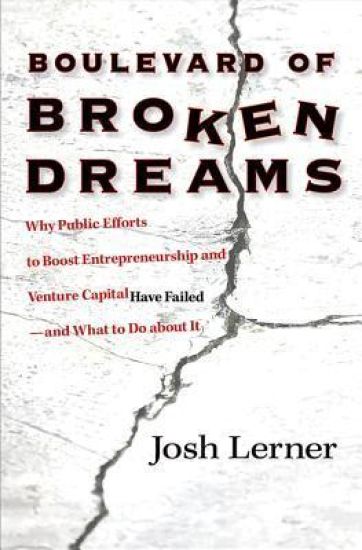
Boulevard of Broken Dreams

Boulevard of Broken Dreams

Josh Lerner

Princeton University Press
2012
pokkari
Silicon Valley, Singapore, Tel Aviv--the global hubs of entrepreneurial activity--all bear the marks of government investment. Yet, for every public intervention that spurs entrepreneurial activity, there are many failed efforts that waste untold billions in taxpayer dollars. When has governmental sponsorship succeeded in boosting growth, and when has it fallen terribly short? Should the government be involved in such undertakings at all? Boulevard of Broken Dreams is the first extensive look at the ways governments have supported entrepreneurs and venture capitalists across decades and continents. Josh Lerner, one of the foremost experts in the field, provides valuable insights into why some public initiatives work while others are hobbled by pitfalls, and he offers suggestions for how public ventures should be implemented in the future. Discussing the complex history of Silicon Valley and other pioneering centers of venture capital, Lerner uncovers the extent of government influence in prompting growth. He examines the public strategies used to advance new ventures, points to the challenges of these endeavors, and reveals the common flaws undermining far too many programs--poor design, a lack of understanding for the entrepreneurial process, and implementation problems. Lerner explains why governments cannot dictate how venture markets evolve, and why they must balance their positions as catalysts with an awareness of their limited ability to stimulate the entrepreneurial sector. As governments worldwide seek to spur economic growth in ever more aggressive ways, Boulevard of Broken Dreams offers an important caution. The book argues for a careful approach to government support of entrepreneurial activities, so that the mistakes of earlier efforts are not repeated.
Everyone Counts

Everyone Counts

Josh Lerner

Cornell Selects
2014
pokkari
The Laurence and Lynne Brown Democracy Medal recognizes outstanding individuals, groups, and organizations that produce exceptional innovations to further democracy in the United States or around the world. The inaugural medal winner, the Participatory Budgeting Project (PBP), is an innovative not-for-profit organization that promotes "participatory budgeting," an inclusive process that empowers community members to make informed decisions about public spending. More than 46,000 people in communities across the United States have decided how to spend $45 million through programs that PBP helped spark over the last five years. In Everyone Counts, PBP co-founder and executive director Josh Lerner provides a concise history of the organization's origins and its vision, highlighting its real-world successes in fostering grassroots budgeting campaigns in such cities as New York, Boston, and Chicago. As more and more communities turn to participatory budgeting as a means of engaging citizens, prioritizing civic projects, and allocating local, state, and federal funding, this cogent volume will offer guidance and inspiration to others who want to transform democracy in the United States and elsewhere. "The Participatory Budgeting Project exemplifies the essential features the award committee was looking for in its inaugural recipient. Political and economic inequality is part of the American national discussion, and participatory budgeting helps empower marginalized groups that do not normally take part in a process that is so critical for democratic life."— John Gastil, Director of the McCourtney Institute for Democracy
Venture Capital and Private Equity

Venture Capital and Private Equity

Josh Lerner; Felda Hardymon; Ann Leamon

John Wiley Sons Inc
2012
sidottu
The 5th edition of Lerner's Venture Capital and Private Equity: A Casebook continues to present the important historical cases of private equity while incorporating a number of new relevant and timely cases from previous best-selling issues. It includes more cases relevant to the texts four main goals: understanding the ways in which private equity firms work, applying the key ideas of corporate finance to the industry, understanding the process of valuation, and critiquing valuation approaches of the past and present- an approach which has proved very successful over the past four editions. This casebook contains cases and notes designed to provide an understanding of the history of the private equity industry's development and the workings of the industry today. By explaining the industry on a case-by-case basis, this text promises to address the critical question of whether gains made in recent years have been sustained and how firms will respond to the current opportunities and challenges.
The Venture Capital Cycle

The Venture Capital Cycle

Paul Gompers; Josh Lerner

MIT Press
2006
pokkari
"This book provides profound and balance insight into what venture capital is all about."In The Venture Capital Cycle, Paul Gompers and Josh Lerner correct widespread misperceptions about the nature and role of the venture capitalist and provide an accessible and comprehensive overview of the venture capital industry. Bringing together fifteen years of ground-breaking research into the form and function of venture capital firms, they examine the fund-raising, investing, and exit stages of venture capitalists. Three major themes run throughout the process: venture investors confront tremendous information and incentive problems; venture capital processes are inherently interrelated, and a complete understanding of the industry requires a full understanding of the venture cycle; and, unlike most financial markets, the venture capital industry adjusts very slowly to shifts in the demand for and the supply of investment capital.This second edition has been thoroughly revised in light of recent research findings, and includes six new chapters. The first part, on fund-raising, now includes a chapter that examines what determines the level of venture capital fund-raising and how tax policy influences the demand for venture capital. Three new chapters in the second part, on investing, examine what kind of distortions are introduced when the venture capital market goes dramatically up, a question prompted by the 1999-2000 market bubble; demonstrate that the venture capital industry does indeed spur innovation, an important determinant of economic growth; and examine whether and under what circumstances governments can be effective venture capitalists. Two new chapters in the third part, on exiting venture capital investments, discuss whether venture capital firms affiliated with investment-banks are prone to conflicts of interest with public offerings and how lockups on initial public offerings are used to limit conflicts of interest.
Patient Capital

Patient Capital

Victoria Ivashina; Josh Lerner

PRINCETON UNIVERSITY PRESS
2019
sidottu
How to overcome barriers to the long-term investments that are essential for solving the world’s biggest problemsThere has never been a greater need for long-term investments to tackle the world’s most difficult problems, such as climate change and decaying infrastructure. And it is increasingly unlikely that the public sector will be willing or able to fill this gap. If these critical needs are to be met, the major pools of long-term, patient capital—including pensions, sovereign wealth funds, university endowments, and wealthy individuals and families—will have to play a large role. In this accessible and authoritative account of long-term capital investment, two leading experts on the subject, Harvard Business School professors Victoria Ivashina and Josh Lerner, highlight the significant hurdles facing long-term investors and propose concrete ways to overcome these difficulties.Presenting the best evidence in an engaging way by using memorable stories and examples, Patient Capital describes how large investors increasingly want and need long-run investments that have the potential to deliver greater returns than those in the public markets. Yet success in such investments has been the exception. Performance has suffered from both the limitations of investors and the internal structure of their fund managers, often resulting in the wrong incentives and a lack of long-term planning.Yet the challenges facing long-term investors can be surmounted and the rewards are potentially large, both for investors and society as a whole. Patient Capital shows how to make long-term investment work better for everyone.
Patient Capital

Patient Capital

Victoria Ivashina; Josh Lerner

Princeton University Press
2021
pokkari
How to overcome barriers to the long-term investments that are essential for solving the world’s biggest problemsThere has never been a greater need for long-term investments to tackle the world’s most difficult problems, such as climate change, human health, and decaying infrastructure. And it is increasingly unlikely that the public sector will be willing or able to fill this gap. If these critical needs are to be met, the major pools of long-term, patient capital—including pensions, sovereign wealth funds, university endowments, and wealthy individuals and families—will have to play a large role. In this accessible and authoritative account of long-term capital investment, two leading experts on the subject, Victoria Ivashina and Josh Lerner, highlight the significant hurdles facing long-term investors and propose concrete ways to overcome these difficulties.
Rethinking Innovation

Rethinking Innovation

Jean Tirole; Josh Lerner

PRINCETON UNIVERSITY PRESS
2026
sidottu
How corporations have increasingly embraced the sharing of knowledge as a competitive strategy Innovation is more important than ever, yet breakthroughs are becoming harder to achieve. Modern technologies, from artificial intelligence and 5G networks to biotech, are so complex that they require collaboration across companies, industries, and countries. Increasingly, firms are discovering that sharing knowledge can be more powerful, and more profitable, than guarding it. In Rethinking Innovation, distinguished economists Josh Lerner and Jean Tirole examine ways that corporations have embraced the sharing of knowledge as a competitive strategy. Open-source software, for example, has seen multibillion-dollar public offerings and shifting business strategies, producing high-profile disputes over what openness actually entails. Across high-tech industries, new forms of knowledge-sharing are transforming how companies develop and exploit new technologies. Lerner and Tirole explore three key organizational structures that make this collaboration possible: patent pools, which bundle essential patents and make them available to firms seeking to license them; standard-setting organizations, where companies agree on common technical templates and commit to making related patents available on fair terms; and open-source communities, in which users share innovations freely with others. Drawing on decades of pioneering research, Lerner and Tirole explain how these institutions emerged, how they work in practice, and how they can both promote innovation and create new challenges for competition and policy. Combining economic insight with vivid case studies—from early efforts to coordinate aircraft patents to contemporary battles over artificial intelligence and global technology standards—Rethinking Innovation reveals how firms collaborate to develop and commercialize complex technologies. Clear and accessible throughout, this book offers a guide to the forces reshaping modern innovation for managers, policymakers, and scholars.
Innovation and Its Discontents

Innovation and Its Discontents

Adam B. Jaffe; Josh Lerner

Princeton University Press
2007
pokkari
The United States patent system has become sand rather than lubricant in the wheels of American progress. Such is the premise behind this provocative and timely book by two of the nation's leading experts on patents and economic innovation. Innovation and Its Discontents tells the story of how recent changes in patenting--an institutional process that was created to nurture innovation--have wreaked havoc on innovators, businesses, and economic productivity. Jaffe and Lerner, who have spent the past two decades studying the patent system, show how legal changes initiated in the 1980s converted the system from a stimulator of innovation to a creator of litigation and uncertainty that threatens the innovation process itself. In one telling vignette, Jaffe and Lerner cite a patent litigation campaign brought by a a semi-conductor chip designer that claims control of an entire category of computer memory chips. The firm's claims are based on a modest 15-year old invention, whose scope and influenced were broadened by secretly manipulating an industry-wide cooperative standard-setting body. Such cases are largely the result of two changes in the patent climate, Jaffe and Lerner contend. First, new laws have made it easier for businesses and inventors to secure patents on products of all kinds, and second, the laws have tilted the table to favor patent holders, no matter how tenuous their claims. After analyzing the economic incentives created by the current policies, Jaffe and Lerner suggest a three-pronged solution for restoring the patent system: create incentives to motivate parties who have information about the novelty of a patent; provide multiple levels of patent review; and replace juries with judges and special masters to preside over certain aspects of infringement cases. Well-argued and engagingly written, Innovation and Its Discontents offers a fresh approach for enhancing both the nation's creativity and its economic growth.