Kirjojen hintavertailu. Mukana 12 390 323 kirjaa ja 12 kauppaa.

Kirjahaku

Etsi kirjoja tekijän nimen, kirjan nimen tai ISBN:n perusteella.

51 kirjaa tekijältä Josiah Tucker

Collected Works of Josiah Tucker

Collected Works of Josiah Tucker

Josiah Tucker

Routledge
1993
sidottu
Josiah Tucker was one of the foremost thinkers of 18th century England in the field of economics, international relations, political theory and imperialism. His publications have been virtually unavailable since their original publications - these six volumes represent his most important writings in economics and social theory in one comprehensive collection.
Josiah Tucker

Josiah Tucker

Josiah Tucker

LIBERTY FUND INC
2021
nidottu
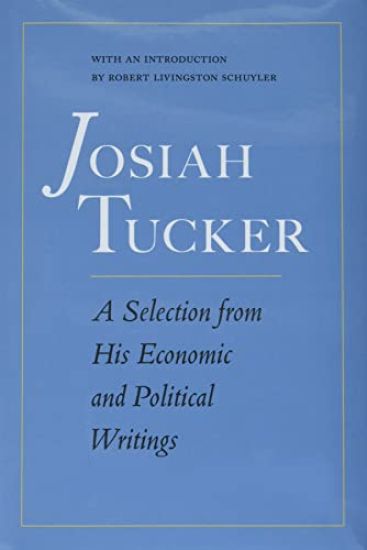
Josiah Tucker (17131799) was one of the foremost thinkers of eighteenth-century England in the fields of economics, international relations, political theory, and imperialism. He shared the opinion, prevalent in his day, that Great Britain was underpopulated and observed with regret the immigration to America, believing that the colonies brought Britain no benefits. He thought instead that colonies were too costly to be beneficial, and, as early as 1749, he asserted that the American colonies would seek independence as soon as they no longer needed Great Britains assistance. He is one of the few men in England who consistently wrote and preached that the separation of the colonies would spell the ruin of England. Born of Welsh peasant stock in Laugharne, Carmarthenshire, Tucker was educated at St. Johns College, Oxford, and became a curate and rector successively at St. Stephens Church in Bristol. This led him to take considerable interest in politics and trade, as Bristol was second only to London in commerce in Great Britain during Tuckers years of residence there. During the greater portion of a long life, he poured out a succession of pamphlets on these matters. He was appointed dean of Gloucester in 1758. He died in 1799 and was buried in Gloucester Cathedral. This edition (originally published by Columbia University Press in 1931) contains seven of Tuckers writings, two of which are of special economic interest: The Elements of Commerce and Theory of Taxes and Instructions for Travelers. In the former selection, Tucker denounces monopoly in all its forms, yet he occupies an intermediate position between the rigid exclusiveness of mercantilism and the freedom of trade of Adam Smith. While he departs from Smith in some ways, it is often said that Tuckers work anticipates the classic doctrines of the Wealth of Nations, which was written twenty years later. Other writings in the volume include a remarkable tract on war, which illustrates progressive, pacifistic thought; and a treatise on civil government, written to refute the contract theory of the state. Tucker disposed of the fallacy that one nation could thrive only at the expense of another and condemned going to war for the sake of trade advantages. The original introduction, by Columbia history professor Robert Livingston Schuyler, places Tuckers writings in their historical and biographical setting and emphasises what seems most significant in his thought as an economist, a pacifist, an anti-imperialist, and a political theorist. Throughout the writings in this book, Tucker reveals with striking clearness the process of internal disintegration of the mercantilist doctrine during the eighteenth century, even before Hume and Smith had provided an acceptable substitute.
Josiah Tucker

Josiah Tucker

Josiah Tucker

LIBERTY FUND INC
2021
sidottu
Josiah Tucker (17131799) was one of the foremost thinkers of eighteenth-century England in the fields of economics, international relations, political theory, and imperialism. He shared the opinion, prevalent in his day, that Great Britain was underpopulated and observed with regret the immigration to America, believing that the colonies brought Britain no benefits. He thought instead that colonies were too costly to be beneficial, and, as early as 1749, he asserted that the American colonies would seek independence as soon as they no longer needed Great Britains assistance. He is one of the few men in England who consistently wrote and preached that the separation of the colonies would spell the ruin of England. Born of Welsh peasant stock in Laugharne, Carmarthenshire, Tucker was educated at St. Johns College, Oxford, and became a curate and rector successively at St. Stephens Church in Bristol. This led him to take considerable interest in politics and trade, as Bristol was second only to London in commerce in Great Britain during Tuckers years of residence there. During the greater portion of a long life, he poured out a succession of pamphlets on these matters. He was appointed dean of Gloucester in 1758. He died in 1799 and was buried in Gloucester Cathedral. This edition (originally published by Columbia University Press in 1931) contains seven of Tuckers writings, two of which are of special economic interest: The Elements of Commerce and Theory of Taxes and Instructions for Travelers. In the former selection, Tucker denounces monopoly in all its forms, yet he occupies an intermediate position between the rigid exclusiveness of mercantilism and the freedom of trade of Adam Smith. While he departs from Smith in some ways, it is often said that Tuckers work anticipates the classic doctrines of the Wealth of Nations, which was written twenty years later. Other writings in the volume include a remarkable tract on war, which illustrates progressive, pacifistic thought; and a treatise on civil government, written to refute the contract theory of the state. Tucker disposed of the fallacy that one nation could thrive only at the expense of another and condemned going to war for the sake of trade advantages. The original introduction, by Columbia history professor Robert Livingston Schuyler, places Tuckers writings in their historical and biographical setting and emphasizes what seems most significant in his thought as an economist, a pacifist, an anti-imperialist, and a political theorist. Throughout the writings in this book, Tucker reveals with striking clearness the process of internal disintegration of the mercantilist doctrine during the eighteenth century, even before Hume and Smith had provided an acceptable substitute.

A Review of Lord Vis. Clare's Conduct as Representative of Bristol. by Josiah Tucker, ...
The 18th century was a wealth of knowledge, exploration and rapidly growing technology and expanding record-keeping made possible by advances in the printing press. In its determination to preserve the century of revolution, Gale initiated a revolution of its own: digitization of epic proportions to preserve these invaluable works in the largest archive of its kind. Now for the first time these high-quality digital copies of original 18th century manuscripts are available in print, making them highly accessible to libraries, undergraduate students, and independent scholars.Delve into what it was like to live during the eighteenth century by reading the first-hand accounts of everyday people, including city dwellers and farmers, businessmen and bankers, artisans and merchants, artists and their patrons, politicians and their constituents. Original texts make the American, French, and Industrial revolutions vividly contemporary.++++The below data was compiled from various identification fields in the bibliographic record of this title. This data is provided as an additional tool in helping to insure edition identification: ++++British LibraryT087991Glocester: printed by R. Raikes; and sold by T. Cadell, in London; and T. Cadell, in Bristol, 1775?] 2],34p.; 12
A Review of Lord Vis. Clare's Conduct as Representative of Bristol. By Josiah Tucker,
The 18th century was a wealth of knowledge, exploration and rapidly growing technology and expanding record-keeping made possible by advances in the printing press. In its determination to preserve the century of revolution, Gale initiated a revolution of its own: digitization of epic proportions to preserve these invaluable works in the largest archive of its kind. Now for the first time these high-quality digital copies of original 18th century manuscripts are available in print, making them highly accessible to libraries, undergraduate students, and independent scholars.Delve into what it was like to live during the eighteenth century by reading the first-hand accounts of everyday people, including city dwellers and farmers, businessmen and bankers, artisans and merchants, artists and their patrons, politicians and their constituents. Original texts make the American, French, and Industrial revolutions vividly contemporary.++++The below data was compiled from various identification fields in the bibliographic record of this title. This data is provided as an additional tool in helping to insure edition identification: ++++British LibraryT087991Glocester: printed by R. Raikes; and sold by T. Cadell, in London; and T. Cadell, in Bristol, 1775?] 2],34p.; 12
A Brief History of the Principles of Methodism, ... By Josiah Tucker,
The 18th century was a wealth of knowledge, exploration and rapidly growing technology and expanding record-keeping made possible by advances in the printing press. In its determination to preserve the century of revolution, Gale initiated a revolution of its own: digitization of epic proportions to preserve these invaluable works in the largest archive of its kind. Now for the first time these high-quality digital copies of original 18th century manuscripts are available in print, making them highly accessible to libraries, undergraduate students, and independent scholars.The Age of Enlightenment profoundly enriched religious and philosophical understanding and continues to influence present-day thinking. Works collected here include masterpieces by David Hume, Immanuel Kant, and Jean-Jacques Rousseau, as well as religious sermons and moral debates on the issues of the day, such as the slave trade. The Age of Reason saw conflict between Protestantism and Catholicism transformed into one between faith and logic -- a debate that continues in the twenty-first century.++++The below data was compiled from various identification fields in the bibliographic record of this title. This data is provided as an additional tool in helping to insure edition identification: ++++British LibraryT085810Oxford: printed for James Fletcher: and sold by J. Rivington, London; and the booksellers at Bristol, 1742. 51, 1]p.; 8
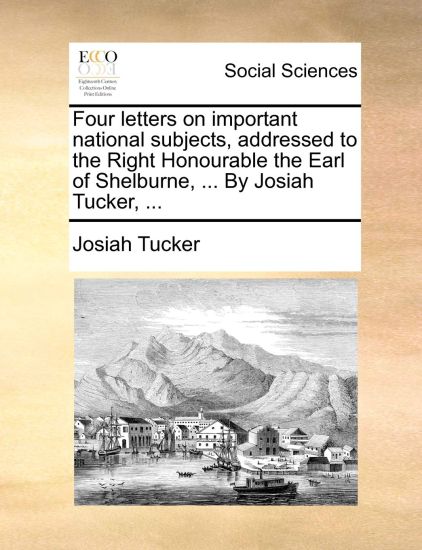
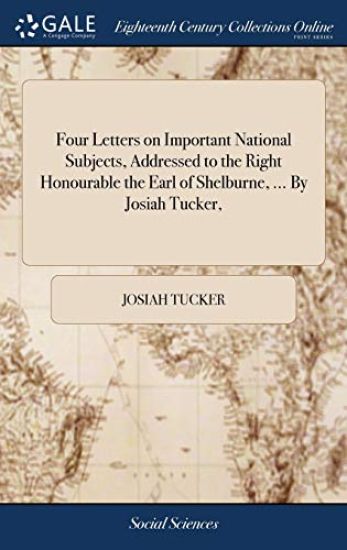
Four Letters on Important National Subjects, Addressed to the Right Honourable the Earl of Shelburne, ... By Josiah Tucker,
The 18th century was a wealth of knowledge, exploration and rapidly growing technology and expanding record-keeping made possible by advances in the printing press. In its determination to preserve the century of revolution, Gale initiated a revolution of its own: digitization of epic proportions to preserve these invaluable works in the largest archive of its kind. Now for the first time these high-quality digital copies of original 18th century manuscripts are available in print, making them highly accessible to libraries, undergraduate students, and independent scholars.Delve into what it was like to live during the eighteenth century by reading the first-hand accounts of everyday people, including city dwellers and farmers, businessmen and bankers, artisans and merchants, artists and their patrons, politicians and their constituents. Original texts make the American, French, and Industrial revolutions vividly contemporary.++++The below data was compiled from various identification fields in the bibliographic record of this title. This data is provided as an additional tool in helping to insure edition identification: ++++British LibraryT086230With a half-title.Dublin: printed by R. Marchbank, for W. and H. Whitestone, W. Wilson, and P. Byrne, 1783. vii, 1],72p.; 8
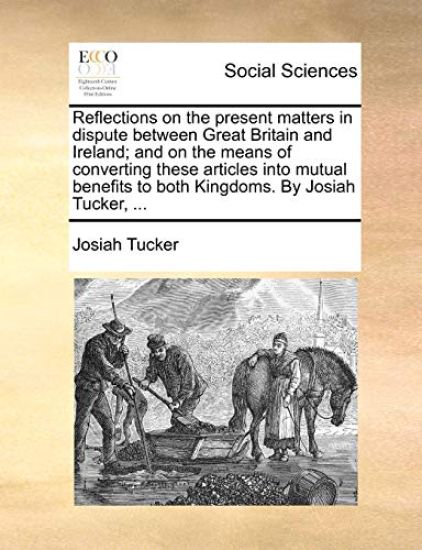
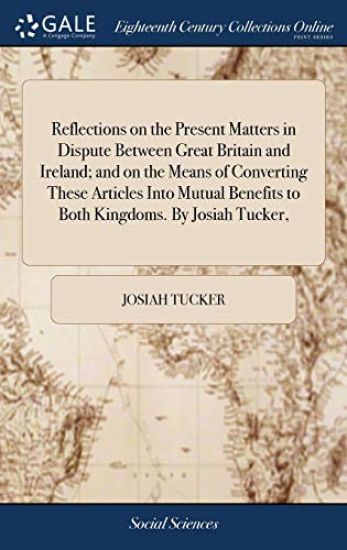
Reflections on the Present Matters in Dispute Between Great Britain and Ireland; and on the Means of Converting These Articles Into Mutual Benefits to Both Kingdoms. By Josiah Tucker,
The 18th century was a wealth of knowledge, exploration and rapidly growing technology and expanding record-keeping made possible by advances in the printing press. In its determination to preserve the century of revolution, Gale initiated a revolution of its own: digitization of epic proportions to preserve these invaluable works in the largest archive of its kind. Now for the first time these high-quality digital copies of original 18th century manuscripts are available in print, making them highly accessible to libraries, undergraduate students, and independent scholars.Delve into what it was like to live during the eighteenth century by reading the first-hand accounts of everyday people, including city dwellers and farmers, businessmen and bankers, artisans and merchants, artists and their patrons, politicians and their constituents. Original texts make the American, French, and Industrial revolutions vividly contemporary.++++The below data was compiled from various identification fields in the bibliographic record of this title. This data is provided as an additional tool in helping to insure edition identification: ++++Cambridge University LibraryT149934Dublin: printed for Messrs. Wilson, White, and Byrne, 1785. vi,41, 1]p.; 8