Kirjojen hintavertailu. Mukana 12 390 323 kirjaa ja 12 kauppaa.

Kirjahaku

Etsi kirjoja tekijän nimen, kirjan nimen tai ISBN:n perusteella.

3 kirjaa tekijältä Joyce Lee Malcolm

Guns and Violence

Guns and Violence

Joyce Lee Malcolm

Harvard University Press
2004
nidottu
Behind the passionate debate over gun control and armed crime lurk assumptions about the link between guns and violence. Indeed, the belief that more guns in private hands means higher rates of armed crime underlies most modern gun control legislation. But are these assumptions valid?Investigating the complex and controversial issue of the real relationship between guns and violence, Joyce Lee Malcolm presents an incisive, thoroughly researched historical study of England, whose strict gun laws and low rates of violent crime are often cited as proof that gun control works. To place the private ownership of guns in context, Malcolm offers a wide-ranging examination of English society from the Middle Ages to the late twentieth century, analyzing changing attitudes toward crime and punishment, the impact of war, economic shifts, and contrasting legal codes on violence. She looks at the level of armed crime in England before its modern restrictive gun legislation, the limitations that gun laws have imposed, and whether those measures have succeeded in reducing the rate of armed crime.Malcolm also offers a revealing comparison of the experience in England experience with that in the modern United States. Today Americans own some 200 million guns and have seen eight consecutive years of declining violence, while the English--prohibited from carrying weapons and limited in their right to self-defense have suffered a dramatic increase in rates of violent crime. This timely and thought-provoking book takes a crucial step in illuminating the actual relationship between guns and violence in modern society.
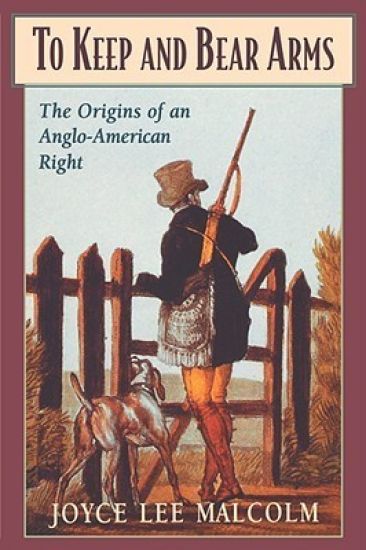
To Keep and Bear Arms

To Keep and Bear Arms

Joyce Lee Malcolm

Harvard University Press
1996
nidottu
Joyce Malcolm illuminates the historical facts underlying the current passionate debate about gun-related violence, the Brady Bill, and the NRA, revealing the original meaning and intentions behind the individual right to “bear arms.” Few on either side of the Atlantic realize that this extraordinary, controversial, and least understood liberty was a direct legacy of English law. This book explains how the Englishmen’s hazardous duty evolved into a right, and how it was transferred to America and transformed into the Second Amendment.Malcolm’s story begins in turbulent seventeenth-century England. She shows why English subjects, led by the governing classes, decided that such a dangerous public freedom as bearing arms was necessary. Entangled in the narrative are shifting notions of the connections between individual ownership of weapons and limited government, private weapons and social status, the citizen army and the professional army, and obedience and resistance, as well as ideas about civilian control of the sword and self-defense. The results add to our knowledge of English life, politics, and constitutional development, and present a historical analysis of a controversial Anglo-American legacy, a legacy that resonates loudly in America today.
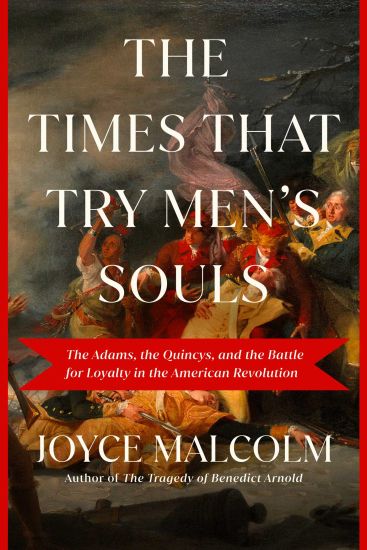
The Times That Try Men's Souls: The Adams, the Quincys, and the Battle for Loyalty in the American Revolution
A compelling, intimate history of the Revolutionary period through a series of charismatic and ambitious families, revealing how the American Revolution was, in many ways, a civil war. "Posterity You will never know, how much it cost the present Generation, to preserve your Freedom --John Adams to Abigail Adams, 26 April 1777 All wars are tragic, but the "revolutionary generation" paid an exceptionally personal price. Foreign wars pull men from home to fight and die abroad leaving empty seats at the family table. But the ideological war that forms the foundation of a civil war also severs intimate family relationships and bonds of friendship in addition to the loss of life on the battle fields. In The Times That Try Men's Soul, Joyce Lee Malcolm masterfully traces the origins and experience of that division during the American Revolution--the growing political disagreements, the intransigence of colonial and government officials swelling into a flood of intolerance, intimidation and mob violence. In that tidal wave opportunities for reconciliation were lost. Those loyal to the royal government fled into exile and banishment, or stayed home to support British troops. Patriots risked everything in a fight they seemed destined to lose. Many people simply hoped against hope to get on with ordinary life in extraordinary times. The hidden cost of this war was families and dear friends split along party lines. Samuel Quincy, Josiah Quincy's only surviving son, sailed to England, abandoning his father, wife, and three children. John Adam's dearest friend, Jonathan Sewell, fled with his family to England after his home was stormed by a mob. Sewell's sister-in-law was married to none other than John Hancock. James Otis's beloved wife Ruth was a wealthy Tory. One daughter would marry a British Army captain and spend the rest of her life abroad while the other wed the son of a major general in the Continental Army. The pain of husbands divided from wives, fathers from children, sisters and brothers from each other and close friends caught on opposite sides in the throes of war has been explored in histories of other American wars, yet Malcolm reveals how this conflict reaches into the heart of our country's foundation. Loyalists who fled to England became strangers in a strange land who did not fit into British society. They were Americans longing for home, wondering whether there would--or could--be reconciliation. The grief of separated loyalties is an important and often ignored part of the revolutionary war story. Those who risked their lives battling the great British empire, and those who left home loyal to the government were all caught in a war without an enemy. In his rough draft of the Declaration of Independence Thomas Jefferson reflected sadly that "we might have been a free and a great people together." The Times That Try Men's Souls is a poignant and vivid narrative that provides a fresh and timely perspective on a foundational part of our nation's history.