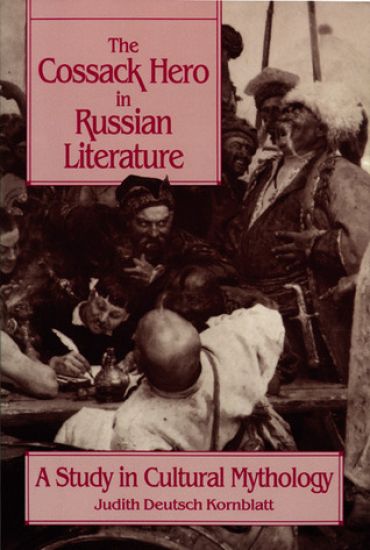
The Cossack Hero in Russian Literature
Judith Deutsch Kornblatt
University of Wisconsin Press
1992
nidottu
The Cossack Hero in Russian Literature studies the development of the Cossack hero and identifies him as part of Russian cultural mythology. Judith Kornblatt explores the power of the myth as a literary image, providing new and challenging readings of 19th- and 20th-century works by Pushkin, Gogol, Tolstoi, Khlebnikov, Babel, Tsvetaeva, Sholokhov and a number of lesser-known writers, all of whom were attracted to the Cossack. By comparing the Cossack with the American cowboy, she reveals what is both unique and universal about the Russian self-image. Grappling with the phenomenon of myth-formation Kornblatt places the Cossack hero in historical and sociopolitical context, chronicling the growth of the Cossack myth of unbounded wholeness and life, its gradually increasing influence on the Russian national consciousness during the 19th and early 20th centuries, and its eventual demise under the strictures of Stalinist socialist realism. Kornblatt's eclectic methodology draws upon Barthes, White, Turner and other Western theorists as well as upon such leading Russian critics and philosophers of language as Bakhtin, Lotman and Uspensky.