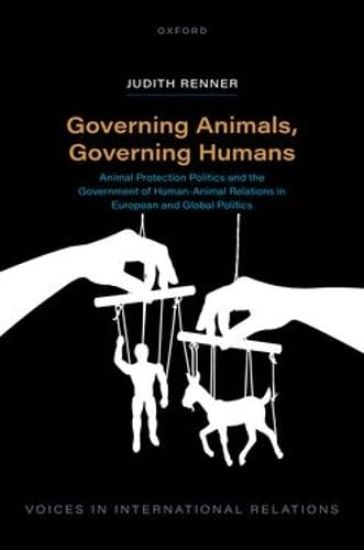
Governing Animals, Governing Humans explores how the global politics of animal protection works as the government of human-animal relations. Responding to recent calls by scholars coming from post-humanist, new materialist, or post-anthropocentric backgrounds who criticize the discipline's human-centred outlook it suggests a way how animals can be analyzed as targets of government by bringing into conversation Foucauldian scholarship within IR, political science and Critical Animal Studies (CAS). Empirically, the book is driven by an interest to understand and theorize two contradicting global tendencies in regard to how humans relate to animals: on the one hand, a growing global concern for animals which has led to animal protection and animal welfare turning into issues of international relevance. On the other hand, the growing use and exploitation of animals as means of human convenience which manifests in the increase of the global trade in animal products, in the numbers of animals used worldwide and in the conditions under which these animals are kept. The book argues that whereas these tendencies seem to be conflicting on the first view, they are in fact closely intertwined as animal welfare, which has emerged as the dominant strategy of global animal protection, establishes the intensive production and use of animals along animal welfare standards as the primary practice of animal protection, coopts animals and humans into this strategy as subjects of animal welfare and animal consumption and thus governs human-animal relations along the seemingly contradicting but intertwined tendencies of animal protection and animal use. ABOUT THE SERIES: Voices in International Relations, published under the auspices of the European International Studies Association (EISA), furthers the development of research at the frontiers of International Relations (IR). It expands the remit of the field by including innovative scholarship that broadens key debates in the discipline, but it is more interested in reconfiguring such debates by approaching them from inside and outside the conventional core. Thematically, we aim to publish research that pushes the limits of IR conventionally defined from within and connects it to debates developing outside the discipline. We are committed to furthering diversity and inclusion in terms of authorship, location, topics and approaches from both inside and outside Europe. We have an inclusive approach to neighbouring disciplines, be it sociology, history, anthropology, geography, economics, political theory or law. Series editors: Debbie Lisle, Tanja Aalberts, Anna Leander, and Laura Sjoberg.