Kirjojen hintavertailu. Mukana 11 717 486 kirjaa ja 12 kauppaa.

Kirjahaku

Etsi kirjoja tekijän nimen, kirjan nimen tai ISBN:n perusteella.

7 kirjaa tekijältä Judith Wilt

Abortion, Choice, and Contemporary Fiction

Abortion, Choice, and Contemporary Fiction

Judith Wilt

University of Chicago Press
1990
sidottu
In recent years, public debate has raged over the issue of maternal choice. While personal testimony and political argument have received widespread attention, artistic representations of birth and abortion have been submerged. Judith Wilt offers the first look at how contemporary writers tell and retell the stories that shape our perceptions about abortion. She reveals that the struggle to plot these painful, complex narratives of choice, control, guilt, loss, and liberation has preoccupied an astonishing number of our most distinguished novelists, male and female alike. Readers of twentieth-century novels are more likely to encounter plots centered on maternal choice than those dealing with the more traditional problems of courtship and marriage. In the opening of the book, Wilt discusses real case histories of several women. After studying the ambiguities of their decisions, she turns to their counterpoints depicted in contemporary fiction. Working from a feminist perspective, Wilt traces the theme of maternal choice in works by Margaret Atwood, Margaret Drabble, Joan Didion, Mary Gordon, Alice Walker, Toni Morrison, Gloria Naylor, Marge Piercy, Thomas Keneally, Graham Swift, Ernest Hemingway, William Faulkner, John Barth, John Irving, and others. Behind the political, medical, and moral debates on abortion, Wilt argues, is a profound psychocultural shock at the recognition that maternity is passing from the domain of instinct to that of conscious choice. Although never wholly instinctual, maternity's potential capture by consciousness raises complex questions. The novels Wilt discusses portray worlds in which principles are endangered by sexual inequality, male power and hidden male fear of abandonment, impotence, female submission, and covert rage, and, in the case of black maternity, the hideous aftermath of slavery. Wilt provides a resonant new context for debates—whether political or personal—on the issue of abortion and maternal choice. Ultimately she enables us to rethink how we shape our own identities and lives.

Ghosts of the Gothic

Ghosts of the Gothic

Judith Wilt

Princeton University Press
2014
pokkari
In a fascinating study of what, during the last decade, rekindled an avid readership, Judith Wilt proposes a new theory of Gothic fiction that challenges its reputation as merely a formula to be outgrown or a stock of images for the creation of terror. Emphasizing instead its status as an enduring component of the imagination, she establishes the Gothic as the mothering" form for three other popular genres--detective, historical, and science fiction. Originally published in 1980. The Princeton Legacy Library uses the latest print-on-demand technology to again make available previously out-of-print books from the distinguished backlist of Princeton University Press. These editions preserve the original texts of these important books while presenting them in durable paperback and hardcover editions. The goal of the Princeton Legacy Library is to vastly increase access to the rich scholarly heritage found in the thousands of books published by Princeton University Press since its founding in 1905.
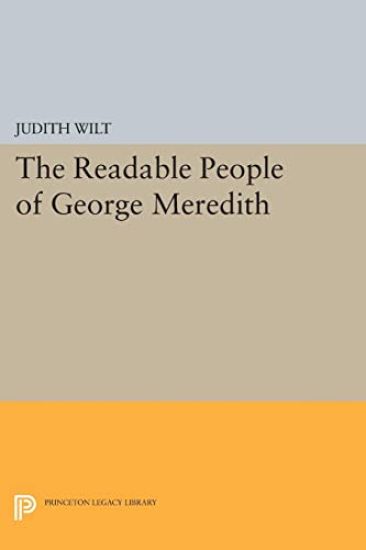
The Readable People of George Meredith

The Readable People of George Meredith

Judith Wilt

Princeton University Press
2015
pokkari
Meredith's reputation as an "unreadable" novelist prompted Judith Wilt to examine the relationship between author and reader in Meredith's fiction--a relationship that was combative and teacherly and, she contends, a central aspect of his art. Meredith was concerned with "readable people," by whom he meant his readers (as he imagined them and as they were), his characters (as he created them and as they were perceived), and himself. Focusing on Meredith's struggle to shape and change the reader, Judith Wilt examines five novels: The Ordeal of Richard Feverel, Sandra Belloni, The Egoist, One of Our Conquerors, and The Amazing Marriage. Her analysis develops a theory of Meredith's artistic processes and relates his concerns to those of recent fiction. Originally published in 1975. The Princeton Legacy Library uses the latest print-on-demand technology to again make available previously out-of-print books from the distinguished backlist of Princeton University Press. These editions preserve the original texts of these important books while presenting them in durable paperback and hardcover editions. The goal of the Princeton Legacy Library is to vastly increase access to the rich scholarly heritage found in the thousands of books published by Princeton University Press since its founding in 1905.
Ghosts of the Gothic

Ghosts of the Gothic

Judith Wilt

Princeton University Press
2016
sidottu
In a fascinating study of what, during the last decade, rekindled an avid readership, Judith Wilt proposes a new theory of Gothic fiction that challenges its reputation as merely a formula to be outgrown or a stock of images for the creation of terror. Emphasizing instead its status as an enduring component of the imagination, she establishes the Gothic as the mothering" form for three other popular genres--detective, historical, and science fiction. Originally published in 1980. The Princeton Legacy Library uses the latest print-on-demand technology to again make available previously out-of-print books from the distinguished backlist of Princeton University Press. These editions preserve the original texts of these important books while presenting them in durable paperback and hardcover editions. The goal of the Princeton Legacy Library is to vastly increase access to the rich scholarly heritage found in the thousands of books published by Princeton University Press since its founding in 1905.
The Readable People of George Meredith

The Readable People of George Meredith

Judith Wilt

Princeton University Press
2016
sidottu
Meredith's reputation as an "unreadable" novelist prompted Judith Wilt to examine the relationship between author and reader in Meredith's fiction--a relationship that was combative and teacherly and, she contends, a central aspect of his art. Meredith was concerned with "readable people," by whom he meant his readers (as he imagined them and as they were), his characters (as he created them and as they were perceived), and himself. Focusing on Meredith's struggle to shape and change the reader, Judith Wilt examines five novels: The Ordeal of Richard Feverel, Sandra Belloni, The Egoist, One of Our Conquerors, and The Amazing Marriage. Her analysis develops a theory of Meredith's artistic processes and relates his concerns to those of recent fiction. Originally published in 1975. The Princeton Legacy Library uses the latest print-on-demand technology to again make available previously out-of-print books from the distinguished backlist of Princeton University Press. These editions preserve the original texts of these important books while presenting them in durable paperback and hardcover editions. The goal of the Princeton Legacy Library is to vastly increase access to the rich scholarly heritage found in the thousands of books published by Princeton University Press since its founding in 1905.
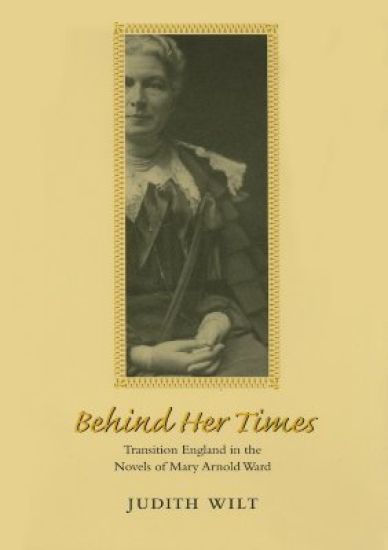
Behind Her Times

Behind Her Times

Judith Wilt

University of Virginia Press
2005
sidottu
From 1890 to 1905, Mary Arnold Ward was the best-selling novelist in the English language. As the Edwardian age came to an end, however, she became a target of scorn for modernists such as Virginia Woolf, and today most of her books have fallen out of print. But in her novels we can vividly experience the long transition from Victorian to modern England and see again the high melodrama of science's challenge to Christianity, of political socialism and the social gospel, and of women's suffrage and the First World War. The niece of Matthew Arnold and wife of the art critic of the ""Times"", Ward was a largely self-taught novelist who had to overcome obstacles in the male-dominated world of letters. She played a crucial role in the shift to the copyright-centered mass-market readership culture that would mark the new century, and though in many ways a political and cultural conservative, she approached the social issues of her day, such as urban settlement and child care, with the vigor of a progressive. Ward, for whom the term domestic referred not only to the home but to the most pressing national business, was also the first Englishwoman to report on World War I, both at home and on the front. Although an activist on behalf of women's education, she carved what was at best an ambiguous role as an early feminist and famously opposed the suffragist movement of the day. Her complex position in the society of her time is exemplified by the fact that she published her enormously popular novels under her married name, Mrs. Humphry Ward. In this vital new critical examination, Judith Wilt sees Ward as being ""behind her times"" in two senses - in her tireless defense of her evolving era's achievements and intentions, but also in her wariness of the advance of time and of the violence of change. Writing during what she recognized as a period of transition, she dramatized both a welcome of and a resistance to modernity, seeing the social developments of the day as temporary structures, subject to transition themselves. Wilt finds in Ward's antisuffrage and wartime novels, as well as in the better-known ""Robert Elsmere"", ""Marcella"", and ""Helbeck of Bannisdale"", an adherence to romantic fantasy that nonetheless feels the pull of the realist alternative. ""Behind Her Times"" is the definitive study of an author who in celebrating one era helped usher in the next.