Kirjojen hintavertailu. Mukana 12 390 323 kirjaa ja 12 kauppaa.

Kirjahaku

Etsi kirjoja tekijän nimen, kirjan nimen tai ISBN:n perusteella.

9 kirjaa tekijältä Judy Dunn

The Little Duck

The Little Duck

Judy Dunn

Random House Books for Young Readers
2017
pokkari
Phoebe Dunn s beloved photographic picture book "The Little Duck" is now available as a Step into Reading (Level 1). Featuring full-color photographs, this story of a little duck growing up will waddle its way into the hearts of emerging readers everywhere."
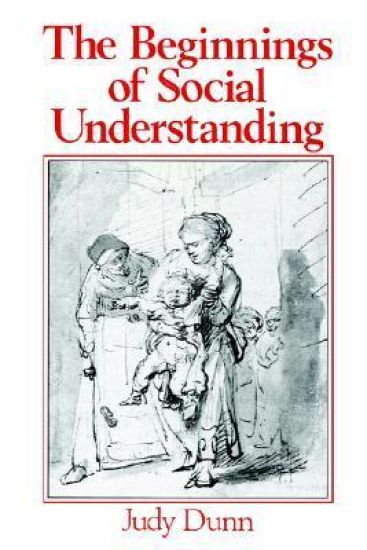
The Beginnings of Social Understanding

The Beginnings of Social Understanding

Judy Dunn

Blackwell Publishers
1988
nidottu
What do young children, as they grow from infancy to childhood, understand of others and of their social world? How does this understanding change, and what influences its development? The Beginnings of Social Understanding draws on detailed studies of children within their families - their disputes with mother and siblings, their empathy and cooperation, their `pretend' stories and questions about others, and their `jokes' - to show vividly how children come to understand the social rules of the family and the feelings, intentions and relationships of others. Illustrating this case with the words of the children themselves, Judy Dunn argues that self-interest is an important force in their social development and that children's emotional experiences and their moral discourse of the family contribute crucially to their growing understanding of their social world.
The Beginnings of Social Understanding

The Beginnings of Social Understanding

Judy Dunn

Harvard University Press
2014
sidottu
When does our acknowledgment of the social contract really begin? When do young children first display an understanding of their social world? When and why do they begin to grasp that other people have feelings and thoughts like their own, yet different? In this pathbreaking work Judy Dunn explores several aspects of the early process of social discovery: children's recognition of the feelings of others, their ability to interpret and anticipate the behavior and relationships of others, and their comprehension of the prohibitions and accepted practices of their world. Dunn's work brings into focus an apparent paradox in our current view of the very young child's social understanding. Whereas research on infancy reveals that babies are born with a predisposition to learn about other people, and appear sensitive to the emotions and behavior of others, experimental studies suggest that children of three, four, and five years of age have difficulty gauging the feelings, intentions, and perceptions of others. Why should this social intelligence--which might be expected to be high on the developmental agenda--proceed so slowly? Is the social understanding of young children really so limited? Dunn pursues answers to these questions through close observation of children in their homes, in the complex social world of the family; her findings suggest a sophistication that has not yet been appreciated or documented. "The Beginnings of Social Understanding" draws upon observations and analyses from three longitudinal studies of children during the transition from infancy to childhood, examining children's disputes, jokes, play, their questions and narratives about others. The book demonstrates children's increasing subtlety as members of a cultural world, and argues that emotional relationships and family discourse play crucial roles in the development of this understanding. Dunn breaks through traditional notions of child development as she sets forth a refreshingly original perspective from which to view the social potential of children.
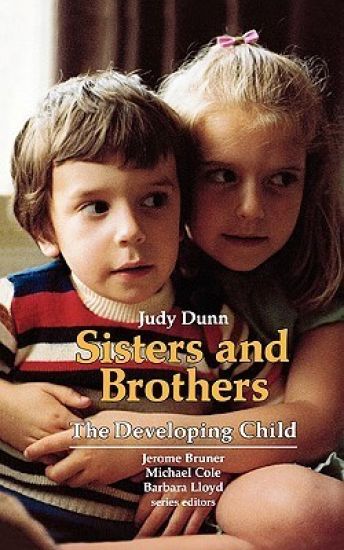
Sisters and Brothers

Sisters and Brothers

Judy Dunn

HARVARD UNIVERSITY PRESS
1985
nidottu
The sibling relationship, as any parent with two or more children knows, is an extraordinarily intense one: young brothers and sisters love and hate, play and fight, tease and mock each other with a devastating lack of inhibition. Why do some siblings get along harmoniously and affectionately, while others constantly squabble? To what extent are parents responsible for differences in siblings' personalities, and how can they ease the tensions? In this timely and unusual glimpse into the world of the child, Judy Dunn argues that in fighting, bullying, or comforting, very young sisters and brothers possess a far deeper understanding of others than psychologists have supposed. She challenges the usual assumptions that birth order, age gap, and gender are the most crucial factors in explaining dramatic differences between siblings within a family, and suggests that siblings themselves have an important influence on each other's development. She shows that by studying children with their brothers and sisters, rather than in unfamiliar situations, we gain a new and illuminating picture of how growing up with siblings affects children's personalities, their intelligence, their ways of thinking and talking, and their perceptions of themselves, their families, and their friends. Full of practical advice for coping with the daily trials of parenting two or more children, this warm and accessible book, based on new research, gives a fresh perception of a relationship which for many people lasts longer than any other in life.
Young Children's Close Relationships

Young Children's Close Relationships

Judy Dunn

SAGE Publications Inc
1993
nidottu
Through a careful examination of current research work including three on-going longitudinal studies, Dunn explores children's relationships with parents, siblings, friends, and the connections between these relationships. "This book presents a meticulous and perceptive account of the nature of young children's relationships with others. Judy Dunn confronts this task in its full complexity by skillfully blending objective, systematic research findings with observational reports that are both sensitive and insightful. In so doing, she has written an immensely readable, coherent state-of-the-art account of children's relationships, simultaneously forging an argument that challenges the paradigm with which much current research takes place." --Jennifer Castle, review in Personality & Individual Differences "Another gem from Judy Dunn! . . . This very readable and interesting book asks some searching questions about how relationships change with age, how one sort of relationship influences others, and how thought processes shape or control our interactions with other people. The answers are based on a judicious interweaving of qualitative observation and hard-headed quantitative analyses. The result is a challenging (and sometimes provocative) account of what we know today, together with a look forward to likely developments in the years to come." --Michael Rutter, Department of Child and Adolescent Psychiatry, The Bethlem Royal Hospital and Maudsley Hospital, London "This book presents a meticulous and perceptive account of the nature of young children's relationships with others. . . . Judy Dunn skilfully blends objective, systematic research findings with observational reports that are both sensitive and insightful. In so doing, she has written an immensely readable, coherent state-of-the-art account of children's relationships, simultaneously forging an argument that challenges the paradigm within which much current research takes place. . . . The breadth and scope of this book give it obvious appeal to all those interested in social and developmental psychology. . . . The style and presentation of the book will probably ensure it a readership beyond its intended audience: As usual, Judy Dunn presents complex material in a deceptively simple, uncluttered, commonsensical manner." --Behaviour Research & Therapy
Siblings

Siblings

Judy Dunn; Carol Kendrick

Harvard University Press
1982
sidottu
The birth of a younger sibling can be a traumatic event for the older child. Unquestionably it places increased demands on parents and causes important changes in the inner balance of the family. Childrearing manuals are full of advice about how to get through this difficult time. But until now such advice has been based more on clinical guesswork than on direct observation of what really happens to families when a sibling is born. With the arrival of "Siblings," this gap in our knowledge is admirably filled. Judy Dunn and Carol Kendrick studied forty families for a period of approximately one year starting shortly before the birth of a second child. Some families, they found, weather the storm much better than others, and their book examines the full catalog of factors that can make the difference. There are, for instance, parenting styles that ease the impact on the older child, improve relations between siblings, and generally make life easier for the entire family. But there are also differences among children in such characteristics as sex, age, and temperament, all of which have a major influence totally beyond parental control. Despite the undeniable stress involved, Dunn and Kendrick demonstrate that the advent of a sibling can be a stimulus for real cognitive and emotional growth on the part of the older child. No longer "the baby," the child must try to deal with a newcomer whose attempts to communicate are necessarily rudimentary. Siblings shows how the elder child's efforts to understand the baby can form the basis for a loving bond of extraordinary durability. A sensitive and informative book, "Siblings" takes psychology into an area of family life and child development that has long received too little attention.
Children's Friendships

Children's Friendships

Judy Dunn; Jerome S. Bruner

Wiley-Blackwell (an imprint of John Wiley Sons Ltd)
2004
nidottu
Drawing on evidence from studies on both sides of the Atlantic, this beautifully written book from Judy Dunn, the leading international authority on childhood development, considers the nature and significance of children’s early friendships. accessible and comprehensive book on friendship, beautifully written by a world authority; features a foreword by Jerome Bruner, one of the most influential psychologists alive today; stresses the importance of friendships to young children and considers the implications of friendship for our understanding of children’s development more generally; draws out the practical implications for parents, teachers and those who care for children; considers how to help children with friendship difficulties and what to do about 'trouble-making' friendships and bullying; latest addition to the Understanding Children’s Worlds series.
Family Relationships in Middle Childhood

Family Relationships in Middle Childhood

Joanne Coldwell; Alison Pike; Judy Dunn

National Children's Bureau Enterprises Ltd
2006
pokkari
Family Relationships in Middle Childhood presents a study of family life among parents and children during 'middle childhood'. Combining the perspectives of parents and young children aged 4-8 in each family, this book is based on a study which explores how family members get on together, the factors both within and outside of the home that affect family life, and the role of family relationships in children's developing well-being. Including both lone mother and two-parent households, the study provides comparisons between mothers and fathers, as well as between mothers in different family types. It finds that young children can provide meaningful accounts of family life and have a role to play in decisions that affect their life at home; relationships between family members, rather than the structure of families, define the quality of family life; links between children's social competence; and the sibling relationship suggest that brothers and sisters have the potential to 'teach' each other socially appropriate behaviour.