Kirjojen hintavertailu. Mukana 12 390 323 kirjaa ja 12 kauppaa.

Kirjahaku

Etsi kirjoja tekijän nimen, kirjan nimen tai ISBN:n perusteella.

3 kirjaa tekijältä Judy L. Klein

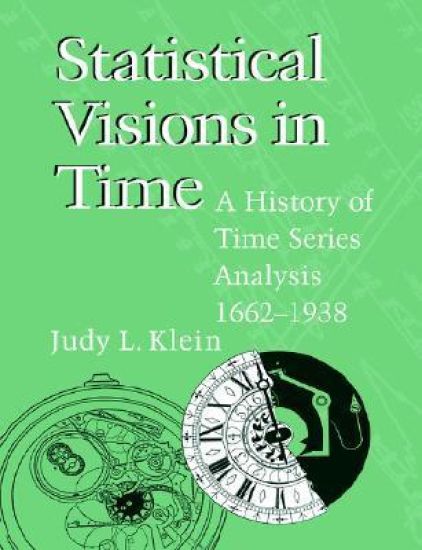
Statistical Visions in Time

Statistical Visions in Time

Judy L. Klein

Cambridge University Press
2005
pokkari
This work documents the history of techniques that statisticians have used to manipulate economic, meteorological, biological and physical data taken from observations recorded over time. The manipulation tools include per cent change, index numbers, moving averages and 'first differences', i.e., subtracting one observation from the previous value. Professor Klein argues that nineteenth-century business journals, such as The Economist, were as important to the development of time series analysis as Latin treatises on probability theory. While examining the roots of mathematical statistics in commercial practice, she traces changes in analytical forms from table to graph to equation. Klein cautions that we risk measurement without history in unduly mechanistic blending of stationary probability theory with the practical dynamics of commercial traders. This history is accessible to students with a basic knowledge of statistics as well as financial analysts, statisticians and historians of economic thought and science.
How Reason Almost Lost Its Mind

How Reason Almost Lost Its Mind

Paul Erickson; Judy L. Klein; Lorraine Daston; Rebecca Lemov; Thomas Sturm; Michael Gordin

University of Chicago Press
2013
sidottu
In the United States at the height of the Cold War, roughly between the end of World War II and the early 1980s, a new project of redefining rationality commanded the attention of sharp minds, powerful politicians, wealthy foundations, and top military brass. Its home was the human sciences - psychology, sociology, political science, and economics, among others - and its participants enlisted in an intellectual campaign to figure out what rationality should mean and how it could be deployed. How Reason Almost Lost Its Mind brings to life the people - Herbert Simon, Oskar Morgenstern, Herman Kahn, Anatol Rapoport, Thomas Schelling, and many others - and places, including the RAND Corporation, the Center for Advanced Study in the Behavioral Sciences, the Cowles Commission for Research and Economics, and the Council on Foreign Relations, that played a key role in putting forth a "Cold War rationality." Decision makers harnessed this picture of rationality - optimizing, formal, algorithmic, and mechanical - in their quest to understand phenomena as diverse as economic transactions, biological evolution, political elections, international relations, and military strategy. The authors chronicle and illuminate what it meant to be rational in the age of nuclear brinkmanship.
How Reason Almost Lost Its Mind – The Strange Career of Cold War Rationality

How Reason Almost Lost Its Mind – The Strange Career of Cold War Rationality

Paul Erickson; Judy L. Klein; Lorraine Daston; Rebecca Lemov; Thomas Sturm; Michael Gordin

University of Chicago Press
2015
nidottu
In the United States at the height of the Cold War, roughly between the end of World War II and the early 1980s, a new project of redefining rationality commanded the attention of sharp minds, powerful politicians, wealthy foundations, and top military brass. Its home was the human sciences—psychology, sociology, political science, and economics, among others—and its participants enlisted in an intellectual campaign to figure out what rationality should mean and how it could be deployed. How Reason Almost Lost Its Mind brings to life the people—Herbert Simon, Oskar Morgenstern, Herman Kahn, Anatol Rapoport, Thomas Schelling, and many others—and places, including the RAND Corporation, the Center for Advanced Study in the Behavioral Sciences, the Cowles Commission for Research and Economics, and the Council on Foreign Relations, that played a key role in putting forth a \u201cCold War rationality.\u201d Decision makers harnessed this picture of rationality—optimizing, formal, algorithmic, and mechanical—in their quest to understand phenomena as diverse as economic transactions, biological evolution, political elections, international relations, and military strategy. The authors chronicle and illuminate what it meant to be rational in the age of nuclear brinkmanship.