Kirjojen hintavertailu. Mukana 12 016 292 kirjaa ja 12 kauppaa.

Kirjahaku

Etsi kirjoja tekijän nimen, kirjan nimen tai ISBN:n perusteella.

4 kirjaa tekijältä Julia Bryan-Wilson

Fray

Fray

Julia Bryan-Wilson

University of Chicago Press
2017
sidottu
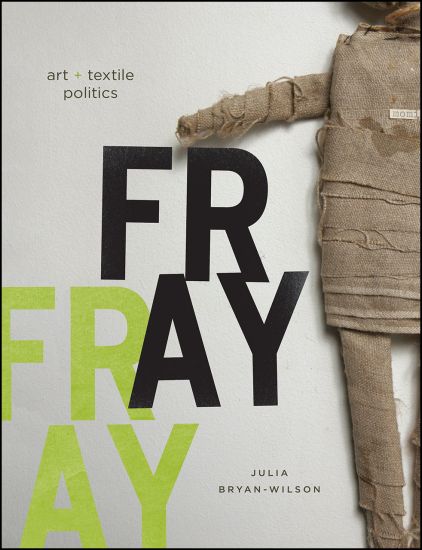
In 1974, women in a feminist consciousness-raising group in Eugene, Oregon, formed a mock organization called the Ladies Sewing Circle and Terrorist Society. Emblazoning its logo onto t-shirts, the group wryly envisioned female collective textile making as a practice that could upend conventions, threaten state structures, and wreak political havoc. Elaborating on this example as a prehistory to the more recent phenomenon of "craftivism" the politics and social practices associated with handmaking Fray explores textiles and their role at the forefront of debates about process, materiality, gender, and race in times of economic upheaval. Closely examining how amateurs and fine artists in the United States and Chile turned to sewing, braiding, knotting, and quilting amid the rise of global manufacturing, Julia Bryan-Wilson argues that textiles unravel the high/low divide and urges us to think flexibly about what the politics of textiles might be. Her case studies from the 1970s through the 1990s including the improvised costumes of the theater troupe the Cockettes, the braided rag rugs of US artist Harmony Hammond, the thread-based sculptures of Chilean artist Cecilia Vicuna, the small hand-sewn tapestries depicting Pinochet's torture, and the NAMES Project AIDS Memorial Quilt are often taken as evidence of the inherently progressive nature of handcrafted textiles. Fray, however, shows that such methods are recruited to often ambivalent ends, leaving textiles very much "in the fray" of debates about feminized labor, protest cultures, and queer identities; the malleability of cloth and fiber means that textiles can be activated, or stretched, in many ideological directions. The first contemporary art history book to discuss both fine art and amateur registers of handmaking at such an expansive scale, Fray unveils crucial insights into how textiles inhabit the broad space between artistic and political poles high and low, untrained and highly skilled, conformist and disobedient, craft and art.
Louise Nevelson's Sculpture

Louise Nevelson's Sculpture

Julia Bryan-Wilson

YALE UNIVERSITY PRESS
2023
nidottu
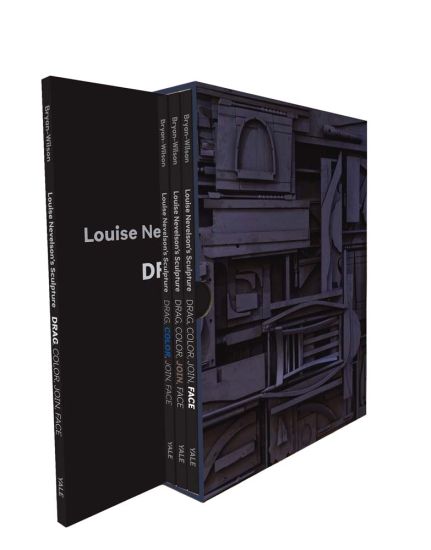
A daring reassessment of Louise Nevelson, an icon of twentieth-century art whose innovative procedures relate to gendered, classed, and racialized forms of making “Here is a book that is not only a transformative study of a single artist but also a record of the scholar’s own labor—and her devotion.”—Artforum In this radical rethinking of the art of Louise Nevelson (1899–1988), Julia Bryan-Wilson provides a long-overdue critical account of a signature figure in postwar sculpture. A Ukraine-born Jewish immigrant, Nevelson persevered in the male-dominated New York art world. Nonetheless, her careful procedures of construction—in which she assembled found pieces of wood into elaborate structures, usually painted black—have been little studied. Organized around a series of key operations in Nevelson’s own process (dragging, coloring, joining, and facing), the book comprises four slipcased, individually bound volumes that can be read in any order. Both form and content thus echo Nevelson’s own modular sculptures, the gridded boxes of which the artist herself rearranged. Exploring how Nevelson’s making relates to domesticity, racialized matter, gendered labor, and the environment, Bryan-Wilson offers a sustained examination of the social and political implications of Nevelson’s art. The author also approaches Nevelson’s sculptures from her own embodied subjectivity as a queer feminist scholar. She forges an expansive art history that places Nevelson’s assemblages in dialogue with a wide array of marginalized worldmaking and underlines the artist’s proclamation of allegiance to blackness.
Art Workers

Art Workers

Julia Bryan-Wilson

University of California Press
2011
pokkari
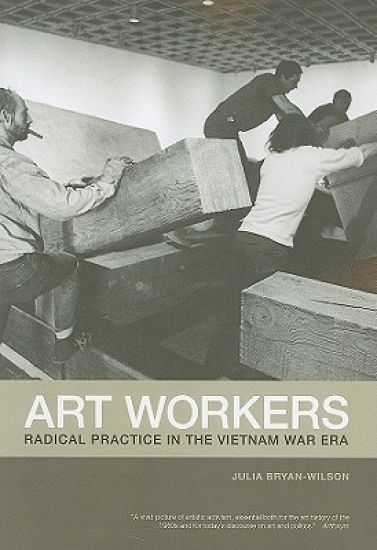
During the late 1960s and early 1970s, in response to the political turbulence generated by the Vietnam War, an important group of American artists and critics sought to expand the definition of creative labor by identifying themselves as 'art workers'. In the first book to examine this movement, Julia Bryan-Wilson shows how a polemical redefinition of artistic labor played a central role in minimalism, process art, feminist criticism, and conceptualism. In her close examination of four seminal figures of the period - American artists Carl Andre, Robert Morris, and Hans Haacke, and art critic Lucy Lippard - Bryan-Wilson frames an engrossing new argument around the double entendre that 'art works'. She traces the divergent ways in which these four artists and writers rallied around the 'art worker' identity, including participating in the Art Workers' Coalition - a short-lived organization founded in 1969 to protest the war and agitate for artists' rights - and the New York Art Strike. By connecting social art history and theories of labor, this book illuminates the artworks and protest actions that were central to this pivotal era in both American art and politics. This is a Best Book of 2009, "Artforum Magazine".
At pynte på Madalenas tråde

At pynte på Madalenas tråde

Julia Bryan-Wilson

-
2024
nidottu
Den queerfeministiske kunsthistoriker Julia Bryan-Wilsons essay At pynte på Madalenas tråde taler ind i samtidskunstens store engagement i tekstile praksisser. Med udgangspunkt i den brasilianske broderi- og multikunstner Madalena Santos Reinbolt spørger essayet kritisk til tekstilkunstnens nylige inklusion i kunstens hvide kube, hvorved dens relation til vigtige globale traditioner, omsorgspraksisser og kollektivt arbejde kan gå tabt.