Kirjojen hintavertailu. Mukana 12 390 323 kirjaa ja 12 kauppaa.

Kirjahaku

Etsi kirjoja tekijän nimen, kirjan nimen tai ISBN:n perusteella.

7 kirjaa tekijältä Julia M. Wright

Ireland, India and Nationalism in Nineteenth-Century Literature
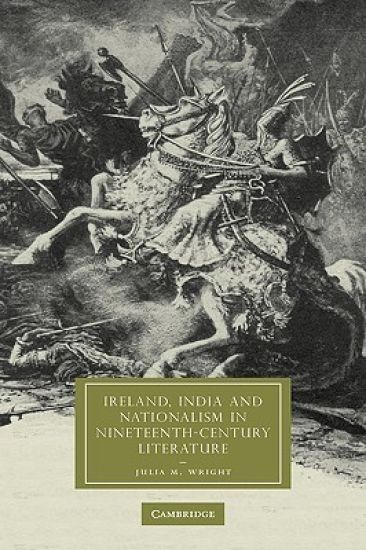
In this innovative study Julia M. Wright addresses rarely asked questions: how and why does one colonized nation write about another? Wright focuses on the way nineteenth-century Irish writers wrote about India, showing how their own experience of colonial subjection and unfulfilled national aspirations informed their work. Their writings express sympathy with the colonised or oppressed people of India in order to unsettle nineteenth-century imperialist stereotypes, and demonstrate their own opposition to the idea and reality of empire. Drawing on Enlightenment philosophy, studies of nationalism, and postcolonial theory, Wright examines fiction by Maria Edgeworth and Lady Morgan, gothic tales by Bram Stoker and Oscar Wilde, poetry by Thomas Moore and others, as well as a wide array of non-fiction prose. In doing so she opens up new avenues in Irish studies and nineteenth-century literature.
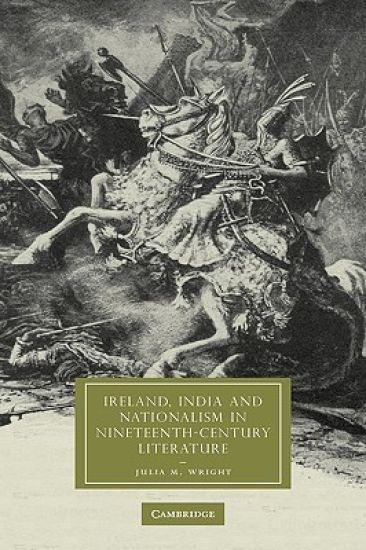
Ireland, India and Nationalism in Nineteenth-Century Literature
In this innovative study Julia M. Wright addresses rarely asked questions: how and why does one colonized nation write about another? Wright focuses on the way nineteenth-century Irish writers wrote about India, showing how their own experience of colonial subjection and unfulfilled national aspirations informed their work. Their writings express sympathy with the colonised or oppressed people of India in order to unsettle nineteenth-century imperialist stereotypes, and demonstrate their own opposition to the idea and reality of empire. Drawing on Enlightenment philosophy, studies of nationalism, and postcolonial theory, Wright examines fiction by Maria Edgeworth and Lady Morgan, gothic tales by Bram Stoker and Oscar Wilde, poetry by Thomas Moore and others, as well as a wide array of non-fiction prose. In doing so she opens up new avenues in Irish studies and nineteenth-century literature.
Representing the National Landscape in Irish Romanticism

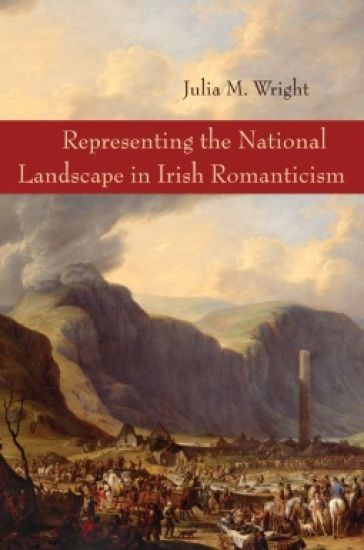
Representing the National Landscape in Irish Romanticism

Julia M. Wright

Syracuse University Press
2014
sidottu
Ireland is a country which has come to be defined in part by an ideology which conflates nationalism with the land. From the Irish Revival’s celebration of the Irish peasant farmer as the ideal Irishman to the fierce history of land claim battles between the Irish and their colonisers, notions of the land have become particularly bound up with conceptions of what Ireland is and what it is to be Irish. In this book, Wright considers this fraught relationship between land and national identity in Irish literature. In doing so, she presents a new vision of the Irish national landscape as one that is vitally connected to larger geographical spheres. By exploring issues of globalisation, international radicalism, trade routes, and the export of natural resources, Wright is at the cutting edge of modern global scholarly trends and concerns. In considering texts from the Romantic era such as Leslie’s Killarney, Edgeworth’s ""Limerick Gloves,"" and Moore’s Irish Melodies, Wright undercuts the nationalist myth of a ""people of the soil"" using the very texts which helped to construct this myth. Reigniting the field of Irish Romanticism, Wright presents original readings which call into question politically motivated mythologies while energising nationalist conceptions that reflect transnational networks and mobility.
Blake, Nationalism, and the Politics of Alienation

Blake, Nationalism, and the Politics of Alienation

Julia M. Wright

Ohio University Press
2004
sidottu
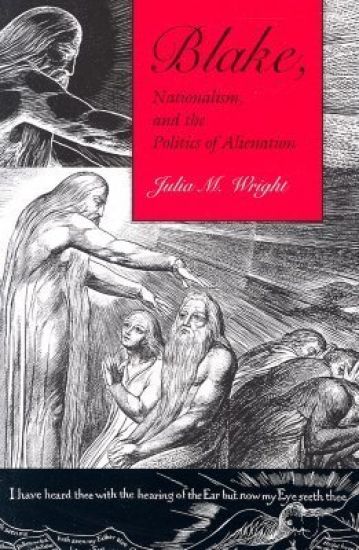
William Blake's reputation as a staunch individualist is based in large measure on his repeated attacks on institutions and belief systems that constrain the individual's imagination. Blake, however, rarely represents isolation positively, suggesting that the individual's absolute freedom from communal pressures is not the ideal. Instead, as Julia Wright argues in her award-winning study Blake, Nationalism, and the Politics of Alienation, Blake's concern lies with the kind of community that is being established. Moreover, writing at the moment of the emergence of modern nationalism, Blake reveals a concern with the national community in particular. Beginning with a discussion of the priority of national narrative in late-eighteenth-century art theory and antiquarianism, Blake, Nationalism, and the Politics of Alienation traces its relevance in Blake's printed works, from The Poetical Sketches and the Lambeth Prophecies to The Laocoön. Professor Wright then turns to Europe, America, and Visions of the Daughters of Albion, focusing on Blake's portrayals of particular characters' alienation from the groups and ideologies represented in the texts. The book closes by arguing that Blake's major printed works, Milton and Jerusalem, are explicit and extensive engagements with the question of nation—and empire. Although nationalism existed in various forms during the Romantic period, Blake's contemporaries generally assumed that nations should progress continuously, producing a clear narrative line from an auspicious origin to the perfect fulfillment of that promise. Wright argues that these mutually determining constructs of national character and national narrative inform Blake's handling of the problem of the individual-within-a-community.
Transatlantic Literary Exchanges, 1790-1870

Transatlantic Literary Exchanges, 1790-1870

Julia M. Wright

TAYLOR FRANCIS LTD
2024
nidottu
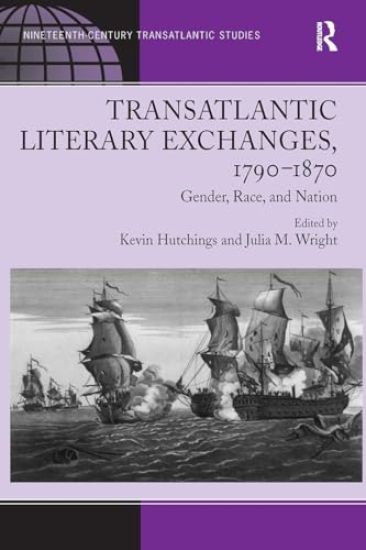
Exploring the ways in which transatlantic relationships functioned in the nineteenth century to unsettle hierarchical models of gender, race, and national and cultural differences, this collection demonstrates the generative potential of transatlantic studies to loosen demographic frames and challenge conveniently linear histories. The contributors take up a rich and varied range of topics, including Charlotte Smith's novelistic treatment of the American Revolution, The Old Manor House; Anna Jameson's counter-discursive constructions of gender in a travelogue; Felicia Hemans, Herman Melville, and the 'Queer Atlantic'; representations of indigenous religion and shamanism in British Romantic literary discourse; the mid-nineteenth-century transatlantic abolitionist movement; the transatlantic adventure novel; the exchanges of transatlantic print culture facilitated by the Minerva Press; British and Anglo-American representations of Niagara Falls; and Charles Brockden Brown's intervention in the literature of exploration. Taken together, the essays underscore the strategic power of the concept of the transatlantic to enable new perspectives on the politics of gender, race, and cultural difference as manifested in late eighteenth- and nineteenth-century Britain and North America.
Thomas Moore and the Transatlantic, 18001840

Thomas Moore and the Transatlantic, 18001840

Julia M. Wright

EDINBURGH UNIVERSITY PRESS
2025
sidottu
Thomas Moore has long been considered Ireland's national bard and the face of colonial grievance in Ireland. But he also grew up in a port city and then travelled with and worked for the British Navy. Dubbing himself 'transatlantic Tom', Moore rode and wrote about the currents of the north Atlantic and coastal locations key to naval operations and trade routes. Following Moore on these lines of motion allows us to trace local and global circuits, including literary networks, agricultural trade, interests in the Atlantic fishery, migration, military activity and the coercions of the slave trade. Powered by water, such motion pulls against the fictions of stable, bounded property necessary to the British Empire and influential in British Romanticism. Moore not only transits Irish Romanticism and British Romanticism: he is also a window onto a sea-level view of the Romantic era.
Transatlantic Literary Exchanges, 1790-1870

Transatlantic Literary Exchanges, 1790-1870

Julia M. Wright

Ashgate Publishing Limited
2011
sidottu
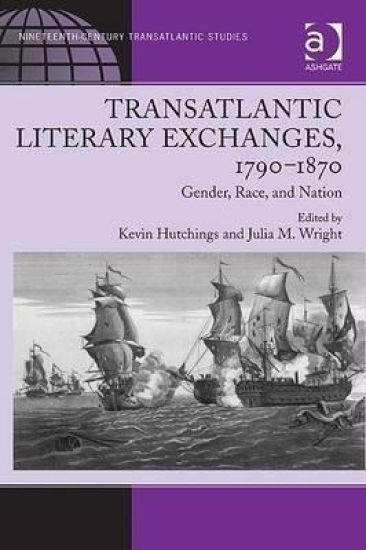
Exploring the ways in which transatlantic relationships functioned in the nineteenth century to unsettle hierarchical models of gender, race, and national and cultural differences, this collection demonstrates the generative potential of transatlantic studies to loosen demographic frames and challenge conveniently linear histories. The contributors take up a rich and varied range of topics, including Charlotte Smith's novelistic treatment of the American Revolution, The Old Manor House; Anna Jameson's counter-discursive constructions of gender in a travelogue; Felicia Hemans, Herman Melville, and the 'Queer Atlantic'; representations of indigenous religion and shamanism in British Romantic literary discourse; the mid-nineteenth-century transatlantic abolitionist movement; the transatlantic adventure novel; the exchanges of transatlantic print culture facilitated by the Minerva Press; British and Anglo-American representations of Niagara Falls; and Charles Brockden Brown's intervention in the literature of exploration. Taken together, the essays underscore the strategic power of the concept of the transatlantic to enable new perspectives on the politics of gender, race, and cultural difference as manifested in late eighteenth- and nineteenth-century Britain and North America.