Kirjojen hintavertailu. Mukana 12 390 323 kirjaa ja 12 kauppaa.

Kirjahaku

Etsi kirjoja tekijän nimen, kirjan nimen tai ISBN:n perusteella.

12 kirjaa tekijältä Julia Straub

A Victorian Muse

A Victorian Muse

Julia Straub

BLOOMSBURY PUBLISHING PLC
2009
sidottu
This title offers new research into cultural afterlife of Dante in nineteenth-century literature, culture and the visual arts. The figure of Dante's Beatrice can be seen as a cultural phenomenon or myth during the nineteenth century, inspiring a wide variety of representations in literature and the visual arts. This study looks at the cultural afterlife of Beatrice in the Victorian period in remarkably different contexts. Focusing on literary representations and selected examples from the visual arts, this book examines works by Dante Gabriel Rossetti and Christina Rossetti, George Eliot, Alfred Lord Tennyson and Walter Pater as well as by John Ruskin, Maria Rossetti and Arthur Henry Hallam. Julia Straub's analysis shows how the various representations of Beatrice in literature and in the visual arts reflect in meaningful ways some of the central social and aesthetic concerns of the Victorian period, most importantly its discourse on gender. This study offers fascinating insights into the Victorian reception of Dante by exploring the powerful appeal of his muse.
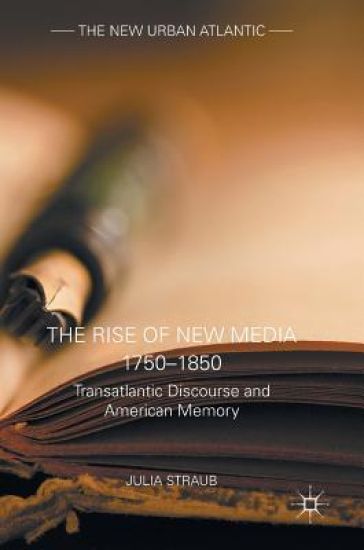
The Rise of New Media 1750–1850

The Rise of New Media 1750–1850

Julia Straub

Palgrave Macmillan
2017
sidottu
This monograph explores transatlantic literary culture by tracing the proliferation of ‘new media,’ such as the anthology, the literary history and the magazine, in the period between 1750 and 1850. The fast-paced media landscape out of which these publishing genres developed produced the need of a ‘memory of literature’ and a concomitant rhetoric of remembering strikingly similar to what today is called a cultural memory debate. Thus, rather than depicting the emergence of an American national literature, The Rise of New Media(1750–1850) combines impulses from media history, the history of print, the sociology of literature and canon theory to uncover nascent forms and genres of literary self-reflectivity and early stirrings of a canon debate in the Atlantic World.
The Rise of New Media 1750–1850

The Rise of New Media 1750–1850

Julia Straub

Palgrave Macmillan
2018
nidottu
This monograph explores transatlantic literary culture by tracing the proliferation of ‘new media,’ such as the anthology, the literary history and the magazine, in the period between 1750 and 1850. The fast-paced media landscape out of which these publishing genres developed produced the need of a ‘memory of literature’ and a concomitant rhetoric of remembering strikingly similar to what today is called a cultural memory debate. Thus, rather than depicting the emergence of an American national literature, The Rise of New Media(1750–1850) combines impulses from media history, the history of print, the sociology of literature and canon theory to uncover nascent forms and genres of literary self-reflectivity and early stirrings of a canon debate in the Atlantic World.
A Victorian Muse

A Victorian Muse

Julia Straub

Continuum Publishing Corporation
2012
nidottu
The figure of Dante's Beatrice can be seen as a cultural phenomenon or myth during the nineteenth century, inspiring a wide variety of representations in literature and the visual arts. This study looks at the cultural afterlife of Beatrice in the Victorian period in remarkably different contexts. Focusing on literary representations and selected examples from the visual arts, this book examines works by Dante Gabriel Rossetti and Christina Rossetti, George Eliot, Alfred Lord Tennyson and Walter Pater as well as by John Ruskin, Maria Rossetti and Arthur Henry Hallam. Julia Straub's analysis shows how the various representations of Beatrice in literature and in the visual arts reflect in meaningful ways some of the central social and aesthetic concerns of the Victorian period, most importantly its discourse on gender. This study offers fascinating insights into the Victorian reception of Dante by exploring the powerful appeal of his muse.