Kirjojen hintavertailu. Mukana 11 717 486 kirjaa ja 12 kauppaa.

Kirjahaku

Etsi kirjoja tekijän nimen, kirjan nimen tai ISBN:n perusteella.

4 kirjaa tekijältä Julia Vaingurt

Wonderlands of the Avant-Garde

Wonderlands of the Avant-Garde

Julia Vaingurt

Northwestern University Press
2013
sidottu
In postrevolutionary Russia, as the Soviet government was initiating a program of rapid industrialisation, avant-garde artists declared their intent to serve the nascent state and to transform life in accordance with their aesthetic designs. In spite of their professed utilitarianism, however, most avant-gardists created works that can hardly be regarded as practical instruments of societal transformation. Exploring this paradox, Vaingurt claims that the artists’ investment of technology with aesthetics prevented their creations from being fully conscripted into the arsenal of political hegemony. The purposes of avant-garde technologies, she contends, are contemplative rather than constructive. Looking at Meyerhold’s theater, Tatlin’s and Khlebnikov’s architectural designs, Mayakovsky’s writings, and other works from the period, Vaingurt offers an innovative reading of an exceptionally complex moment in the formation of Soviet culture.
Wonderlands of the Avant-Garde

Wonderlands of the Avant-Garde

Julia Vaingurt

Northwestern University Press
2017
nidottu
In postrevolutionary Russia, as the Soviet government pursued rapid industrialization, avant-garde artists declared their intent to serve the nascent state and to transform life in accordance with their aesthetic designs. Despite their utilitarian intentions, however, most avant-gardists rarely created works regarded as practical instruments of societal transformation. Exploring this paradox, Vaingurt claims that the artists' fusion of technology and aesthetics prevented their creations from being fully conscripted into the arsenal of political hegemony. The purposes of avant-garde technologies, she contends, are contemplative rather than constructive. Looking at Meyerhold's theater, Tatlin's and Khlebnikov's architectural designs, Mayakovsky's writings, and other works from the period, Vaingurt offers an innovative reading of an exceptionally complex moment in the formation of Soviet culture.
Soft Matter

Soft Matter

Julia Vaingurt

NORTHWESTERN UNIVERSITY PRESS
2025
nidottu
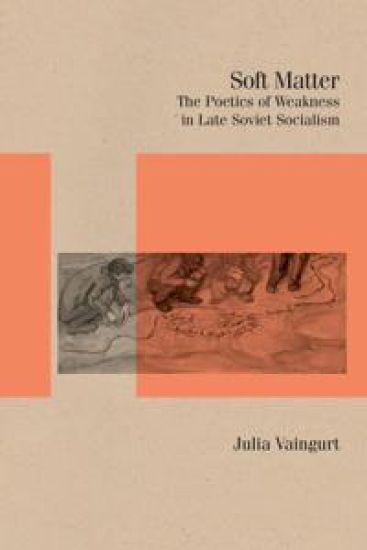
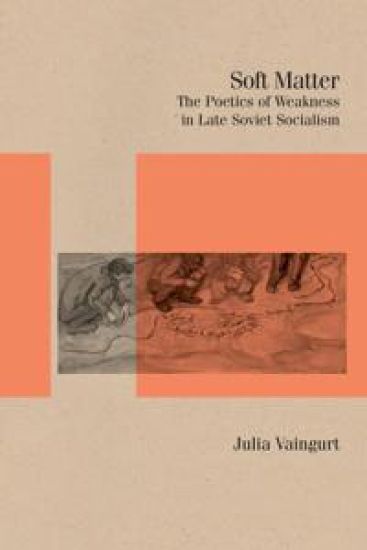
Identifies and examines a poetics of weakness in Soviet underground literature Artists of the late Soviet era sought new, nonconformist ways of approaching literary fiction, arriving at weaknessas a crucial principle of narrative and character formation. Julia Vaingurt argues that this counter-discourse of strategic weakness constituted both an aesthetic strategy and an ethical code, affording like-minded authors a feeling of recognition and commonality and uniting an international community of artists in resistance to the divisiveness of their worlds. Soft Matter: The Poetics of Weakness in Late Soviet Socialism explores the cultivation of weak subjectivity through modes such as gender subversion, queer holy foolishness, intoxication, madness, and writing disorders like graphomania and writer’s block. Identifying the poetics of weakness as formative for Soviet underground literature of the 1960s and ’70s, Vaingurt also traces the inheritance of a far older tradition within Russian culture of salutary weakness. As democratic deliberation continues to be under threat around the world, alternatives to the ubiquitous politics of force are an aesthetic, ethical, and ideological imperative.
Soft Matter

Soft Matter

Julia Vaingurt

NORTHWESTERN UNIVERSITY PRESS
2025
sidottu
Identifies and examines a poetics of weakness in Soviet underground literature Artists of the late Soviet era sought new, nonconformist ways of approaching literary fiction, arriving at weaknessas a crucial principle of narrative and character formation. Julia Vaingurt argues that this counter-discourse of strategic weakness constituted both an aesthetic strategy and an ethical code, affording like-minded authors a feeling of recognition and commonality and uniting an international community of artists in resistance to the divisiveness of their worlds. Soft Matter: The Poetics of Weakness in Late Soviet Socialism explores the cultivation of weak subjectivity through modes such as gender subversion, queer holy foolishness, intoxication, madness, and writing disorders like graphomania and writer’s block. Identifying the poetics of weakness as formative for Soviet underground literature of the 1960s and ’70s, Vaingurt also traces the inheritance of a far older tradition within Russian culture of salutary weakness. As democratic deliberation continues to be under threat around the world, alternatives to the ubiquitous politics of force are an aesthetic, ethical, and ideological imperative.