Kirjahaku
Etsi kirjoja tekijän nimen, kirjan nimen tai ISBN:n perusteella.
13 kirjaa tekijältä Julian Bauer



In 1915 the Ottoman Empire falters after dominating the Mediterranean region for six hundred years. As World War I explodes through Europe and heads east, the empire sides with the Central Powers, aligning itself against the United States. Ibrahim zt rk, scion of a prominent Turkish family and proponent of democracy, will spend the next seventy-five years fighting to erase totalitarianism in the fledgling Turkish nation. The fight for a new Turkey will take Ibrahim, his sister Nebile, and his uncle, Rauf, across three continents. They'll see the historic city of Constantinople transform into the modern metropolis of Istanbul. Through it all Ibrahim must stand against those who would thrust his nation back into the past, including the zt rks' ancient enemies, the powerful and wealthy Galip family. Ibrahim, Nebile, and Rauf each have one great love, and the triumphs and heartbreaks of those legendary romances exist alongside sensitive diplomatic missions, religious conflicts, and political maneuvering. Ibrahim, the Turk, is a meticulously researched and vividly imagined exploration of the origins of one of America's great allies. Many would say Islam and democracy are mutually exclusive, but in Turkey, and through the long struggles of the zt rk family, it's evident all people desire freedom, dignity, and opportunity.
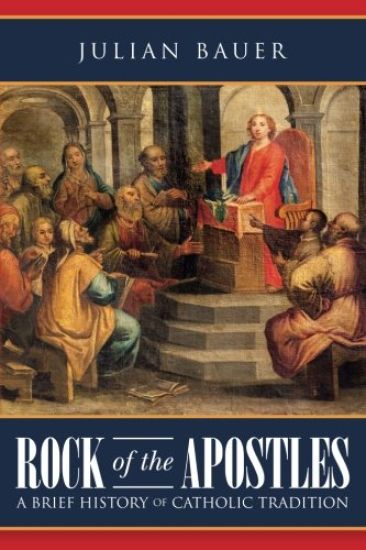
Rock of the Apostles A Brief History of Catholic Tradition
Julian Bauer
Createspace Independent Publishing Platform
2017
nidottu
For over two thousand years, the Catholic Church has relied on both Holy Scriptures and its Living Tradition to explain the Word of God. This highly readable and informative history of that amazing tradition recounts the major schisms, heresies, and slanders that were aimed at the Church in each danger-filled generation and how the Church countered those attacks. No student of the Catholic Church can ignore its traditions and its need for a teaching authority-a magisterium. From the Fathers of the Church to recent popes, from Doctors of the Church to its saints, the human race has benefited by the teachings of the Church. This enjoyable and fascinating revelation of the Deposit of Faith from one generation to another explains the need to inculcate new cultures, new languages, new ways of explaining the road to salvation passed down from the lips of Jesus Christ to the Universal Church. While the audience for this brief but highly interesting book is expected to be high school, CCD, and home school students, any history buff or Catholic adult will find in it an excellent overview of the religious influence wielded by the Church over the years. An influence which cries out for acceptance in today's secular world.

Die Systemtheorie hat eine Geschichte. Diese Geschichte beginnt jedoch nicht erst in der Nachkriegszeit des 20. Jahrhunderts unter dem aufsteigenden Leitstern der Kybernetik. Sie beginnt bereits im späten 19. Jahrhundert mit der weithin vergessenen organismischen Soziologie. Denkern wie Talcott Parsons oder Niklas Luhmann kann man allerdings kaum nur durch eine derart schlichte Rückführung gerecht werden. Um der breiten Fundierung ihrer Theoreme auf die Spur zu kommen, skizziert Julian Bauer die vielen Entstehungsherde systemischer Ideen. Die Mehrschichtigkeit einer Theoriebildung, die sich selber rühmt, traditionelle binäre Beobachtungsschemata sowie die engen Schranken disziplinär bestimmter Arbeitsweisen hinter sich zu lassen, kann man indes nur rekonstruieren, wenn man die Leitunterscheidungen dieser Theorietradition provinzialisiert. Julian Bauer wirft hier einen dezentrierten Blick auf die intellektuelle und visuelle Kultur systemischen Denkens zwischen 1880 und 1980.
Theorie, Komposition Und Analyse - Der Einfluss Der Mathematik Auf Die Musik Im 20. Jahrhundert
Julian Bauer
Peter Lang AG
2010
sidottu
Diese Arbeit ist eine musiktheoretische und musikhistorische Analyse der Interdependenzen von Musik und Mathematik im 20. Jahrhundert, thematisiert an den vier Beispielen Joseph Schillinger, Conlon Nancarrow, Iannis Xenakis und Jan Beran. Methodisches Konzept der Analyse der Interdependenzen von Musik und Mathematik ist die strukturelle Analyse der komplexen ideengeschichtlichen Interdependenzen der beiden Disziplinen. Die Analyse dient der Aufdeckung und Vermittlung sinntragender Zusammenhange der beiden Disziplinen innerhalb der Epoche des 20. Jahrhunderts.

Das Wahlverhalten der SPD-Wähler bei der Bundestagswahl 2009 anhand des Ann-Arbor-Modells. Eine empirische Analyse
Julian Bauer
GRIN Verlag
2018
nidottu