Kirjojen hintavertailu. Mukana 12 424 033 kirjaa ja 12 kauppaa.

Kirjahaku

Etsi kirjoja tekijän nimen, kirjan nimen tai ISBN:n perusteella.

8 kirjaa tekijältä Julian Hoppit

The Dreadful Monster and its Poor Relations

The Dreadful Monster and its Poor Relations

Julian Hoppit

PENGUIN BOOKS LTD
2022
pokkari
'An invaluable primer to some of the underlying tensions behind contemporary political debate' Financial TimesIt has always been an important part of British self-image to see the United Kingdom as an ancient, organic and sensibly managed place, in striking contrast to the convulsions of other European countries. Yet, as Julian Hoppit makes clear in this fascinating and surprising book, beneath the complacent surface the United Kingdom has in fact been in a constant, often very tense argument with itself about how it should be run and, most significantly, who should pay for what.The book takes its argument from an eighteenth century cartoon which shows the central state as the 'Dreadful Monster', gorging itself at the dinner table on all the taxes it can grab. Meanwhile the 'Poor Relations' - Scotland, Wales and Ireland, both poor because of tax but also poor in the sense of needing special treatment - are viewed in London as an endless 'drain on the state'. With drastically different levels of prosperity, population, industry, agriculture and accessibility between the United Kingdom's different nations, what is a fair basis for paying for the state?
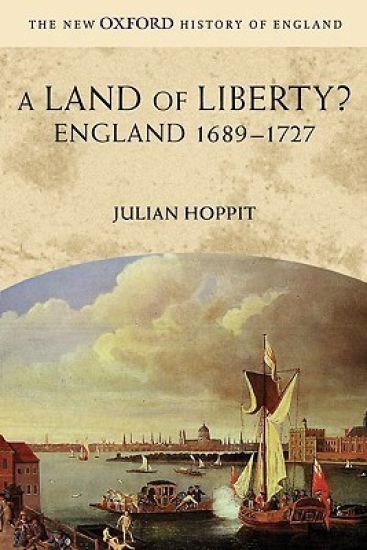
A Land of Liberty?

A Land of Liberty?

Julian Hoppit

Oxford University Press
2000
sidottu
The Glorious Revolution of 1688-9 was a decisive moment in England's history; an invading Dutch army forced James II to flee to France, and his son-in-law and daughter, William and Mary, were crowned as joint sovereigns. The wider consequences were no less startling: bloody war in Ireland, Union with Scotland, Jacobite intrigue, deep involvement in two major European wars, Britain's emergence as a great power, a 'financial revolution', greater religious toleration, a riven Church, and a startling growth of parliamentary government. Such changes were only part of the transformation of English society at the time. An enriching torrent of new ideas from the likes of Newton, Defoe, and Addison, spread through newspapers, periodicals, and coffee-houses, provided new views and values that some embraced and others loathed. England's horizons were also growing, especially in the Caribbean and American colonies. For many, however, the benefits were uncertain: the slave trade flourished, inequality widened, and the poor and 'disorderly' were increasingly subject to strictures and statutes. If it was an age of prospects it was also one of anxieties.
A Land of Liberty?

A Land of Liberty?

Julian Hoppit

Oxford University Press
2002
nidottu
The Glorious Revolution brought more than the replacement of James II with William and Mary. Benefits such as a more tolerant religious outlook and an enriching literary scene went hand-in-hand with greater inequality and other anxieties; not least, war in Europe and within the isles.
Risk and Failure in English Business 1700–1800

Risk and Failure in English Business 1700–1800

Julian Hoppit

Cambridge University Press
2002
pokkari
This major study considers bankruptcy in eighteenth-century England. Typically, business enterprise in this period has been seen as a success story - where men like Boulton, Watt, Wedgwood and Arkwright helped to forge the Industrial Revolution. But this is a myth, for thousands of businesses failed, hounded by their creditors into bankruptcy and ignominy. This book charts their history by looking at the incidence and causes of bankruptcy and by examining contemporary reactions to these. In this way, not only is evidence produced to improve our understanding of the nature of business enterprise, but the dynamics of the eighteenth-century economy over both the short and the long term are uncovered.
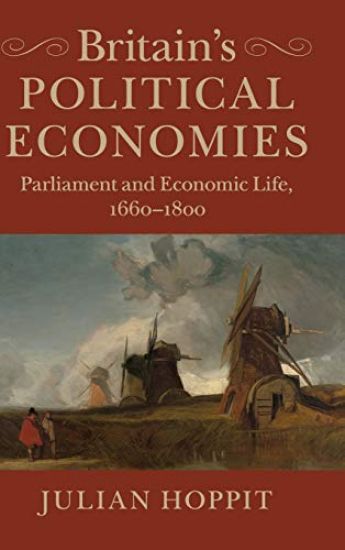
Britain's Political Economies

Britain's Political Economies

Julian Hoppit

Cambridge University Press
2017
sidottu
The Glorious Revolution of 1688–9 transformed the role of parliament in Britain and its empire. Large numbers of statutes resulted, with most concerning economic activity. Julian Hoppit here provides the first comprehensive account of these acts, revealing how government affected economic life in this critical period prior to the Industrial Revolution, and how economic interests across Britain used legislative authority for their own benefit. Through a series of case studies, he shows how ideas, interests, and information influenced statutory action in practice. Existing frameworks such as 'mercantilism' and the 'fiscal-military state' fail to capture the full richness and structural limitations of how political power influenced Britain's precocious economic development in the period. Instead, finely grained statutory action was the norm, guided more by present needs than any grand plan, with regulatory ambitions constrained by administrative limitations, and some parts of Britain benefiting much more than others.
Britain's Political Economies

Britain's Political Economies

Julian Hoppit

Cambridge University Press
2017
pokkari
The Glorious Revolution of 1688–9 transformed the role of parliament in Britain and its empire. Large numbers of statutes resulted, with most concerning economic activity. Julian Hoppit here provides the first comprehensive account of these acts, revealing how government affected economic life in this critical period prior to the Industrial Revolution, and how economic interests across Britain used legislative authority for their own benefit. Through a series of case studies, he shows how ideas, interests, and information influenced statutory action in practice. Existing frameworks such as 'mercantilism' and the 'fiscal-military state' fail to capture the full richness and structural limitations of how political power influenced Britain's precocious economic development in the period. Instead, finely grained statutory action was the norm, guided more by present needs than any grand plan, with regulatory ambitions constrained by administrative limitations, and some parts of Britain benefiting much more than others.
The Industrial Revolution in Britain I, Volume 2

The Industrial Revolution in Britain I, Volume 2

Julian Hoppit; E. A. Wrigley

Blackwell Publishers
1994
sidottu
Volumes 2 and 3 of the Industrial Revolutionseleven part set (Industrial Revolution in Britain vol I and II) present over thirty of the articles which have best illuminated Britain's Industrial revolution, and cover four main areas: the concept of the Industrial Revolution, and the central themes of land, labour and capital. They provide a way of exploring historians' changing approaches to the first Industrial Revolution. A substantial introduction sets the articles into their conceptual, evidential and histiographical context and directs readers to recent work.
The Industrial Revolution in Britain II, Volume 3

The Industrial Revolution in Britain II, Volume 3

Julian Hoppit; E. A. Wrigley

Blackwell Publishers
1994
sidottu
Volumes 2 and 3 of the Industrial Revolutions eleven part set, (Industrial Revolution in Britain Vol I and II) present over thirty of the articles which have best illuminated Britain's Industrial revolution, and cover four main areas: the concept of the Industrial Revolution, and the central themes of land, labour and capital. They provide a way of exploring historians' changing approaches to the first Industrial Revolution. A substantial introduction sets the articles into their conceptual, evidential and histiographical context and directs readers to recent work.