Kirjojen hintavertailu. Mukana 11 627 467 kirjaa ja 12 kauppaa.

Kirjahaku

Etsi kirjoja tekijän nimen, kirjan nimen tai ISBN:n perusteella.

8 kirjaa tekijältä Julian Johnson

After Debussy

After Debussy

Julian Johnson

Oxford University Press Inc
2020
sidottu
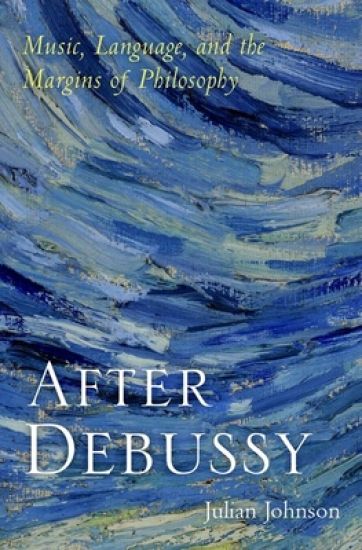
Classical music shows a close relationship to language, and both musicology and philosophy have tended to approach music from that angle, exploring it in terms of expression, representation, and discourse. This book turns that idea on its head. Focusing on the music of Debussy and its legacy in the century since his death, After Debussy offers a groundbreaking new perspective on twentieth-century music that foregrounds a sensory logic of sound over quasi-linguistic ideas of structure or meaning. Author Julian Johnson argues that Debussy's music exemplifies this idea, influencing the music of successive composers who took up the mantle of emphasizing sound over syntax, sense over signification. In doing so, this music not only anticipates a central problem of contemporary thought—the gap between language and our embodied relation to the world—but also offers a solution. With a readable narrative structure grounded in an impressive body of literature, After Debussy ranges widely across French music, demonstrating the impact of Debussy's music on composers from Fauré and Ravel to Dutilleux, Boulez, Grisey, Murail and Saariaho. It ranges similarly through a set of French writers and philosophers, from Mallarmé and Proust to Merleau-Ponty, Jankélévitch, Derrida, Lyotard and Nancy, and even draws from the visual arts to help embody key ideas. In accessibly tackling substantial ideas of both musicology and philosophy, this book not only presents bold new ways of understanding each discipline but also lays the groundwork for exciting new discourse between them.
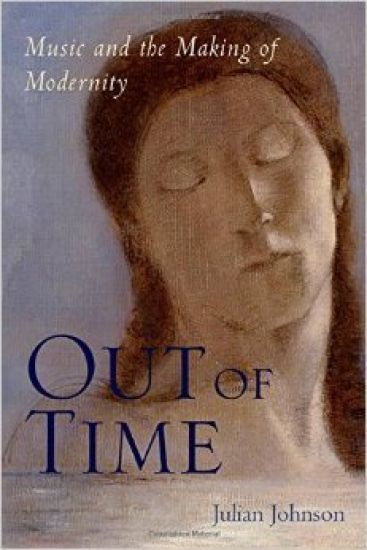
Out of Time

Out of Time

Julian Johnson

Oxford University Press Inc
2015
sidottu
What does music have to say about modernity? How can this apparently unworldly art tell us anything about modern life? In Out of Time, author Julian Johnson begins from the idea that it can, arguing that music renders an account of modernity from the inside, a history not of events but of sensibility, an archaeology of experience. If music is better understood from this broad perspective, our idea of modernity itself is also enriched by the specific insights of music. The result is a rehearing of modernity and a rethinking of music - an account that challenges ideas of linear progress and reconsiders the common concerns of music, old and new. If all music since 1600 is modern music, the similarities between Monteverdi and Schoenberg, Bach and Stravinsky, or Beethoven and Boulez, become far more significant than their obvious differences. Johnson elaborates this idea in relation to three related areas of experience - temporality, history and memory; space, place and technology; language, the body, and sound. Criss-crossing four centuries of Western culture, he moves between close readings of diverse musical examples (from the madrigal to electronic music) and drawing on the history of science and technology, literature, art, philosophy, and geography. Against the grain of chronology and the usual divisions of music history, Johnson proposes profound connections between musical works from quite different times and places. The multiple lines of the resulting map, similar to those of the London Underground, produce a bewildering network of plural connections, joining Stockhausen to Galileo, music printing to sound recording, the industrial revolution to motivic development, steam trains to waltzes. A significant and groundbreaking work, Out of Time is essential reading for anyone interested in the history of music and modernity.
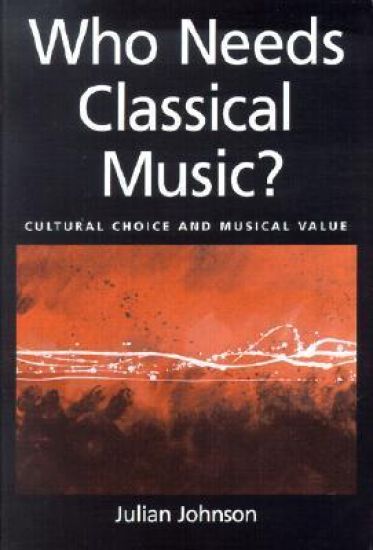
Who Needs Classical Music?

Who Needs Classical Music?

Julian Johnson

Oxford University Press Inc
2002
sidottu
During the last several decades, most cultural critics have come to agree that the division between 'high' and 'low' art is an artificial one, that Beethoven's Ninth and 'Blue Suede Shoes' are equally valuable as cultural texts. In Who Needs Classical Music?, Julian Johnson challenges these dominant assumptions about the relativism of cultural judgements. The author maintains that music is more than just 'a matter of taste': while some music provides entertainment, or serves as background noise, other music functions as art. This book considers the value of classical music in contemporary society, arguing that it remains distinctive because it works in quite different ways than most of the other music that surrounds us. In this long essay, Johnson aims to restore classical music's intrinsic aesthetic value and to rescue it from a designation as mere signifier of elitism or refinement. Who Needs Classical Music? is certain to spark debate among cultural critics and have important repercussions for arts policy.
Mahler's Voices

Mahler's Voices

Julian Johnson

Oxford University Press Inc
2009
sidottu
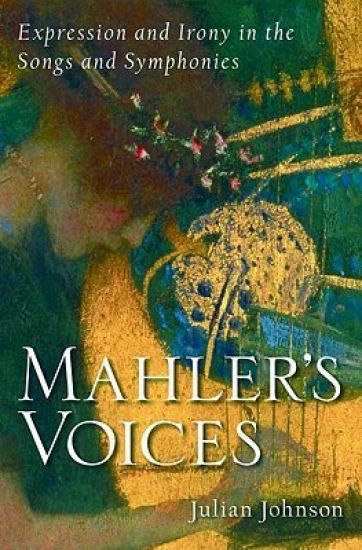
Passionate and intense in one moment, ironic or brash in the next, Mahler's music speaks with a diversity of voices that often undermine its own ideals of unity, narrative struggle and transcendent affirmation. The composer plays constantly with musical genres and styles, moving between them without warning in a way that often bewildered his contemporaries. Ranging freely across Mahler's symphonies and songs in a thoughtful and thorough study of his musical speech, Julian Johnson considers how this body of music foregrounds the idea of artifice, construction and musical convention while at the same time presenting itself as act of authentic expression and disclosure. Mahler's Voices explores the shaping of this music through strategies of calling forth its own mysterious voice—as if from nature or the Unconscious—while at other times revealing itself as a made object, often self-consciously assembled from familiar and well-worn materials. A unique study not of Mahler's works as such but of Mahler's musical style, Mahler's Voices brings together a close reading of the renowned composer's music with wide-ranging cultural and historical interpretation. Through a radical self-awareness that links the romantic irony of the late 18th-century to the deconstructive attitude of the late 20th-century, Mahler's music forces us to rethink historical categories themselves. Yet what sets it apart, what continues to fascinate and disturb, is the music's ultimate refusal of this position, acknowledging the conventionality of all its voices while at the same time, in the intensity of its tone, speaking "as if" what it said were true. However bound up with the Viennese modernism that Mahler prefigured, the urgency of this act remains powerfully resonant for our own age.
Who Needs Classical Music?

Who Needs Classical Music?

Julian Johnson

Oxford University Press Inc
2011
nidottu
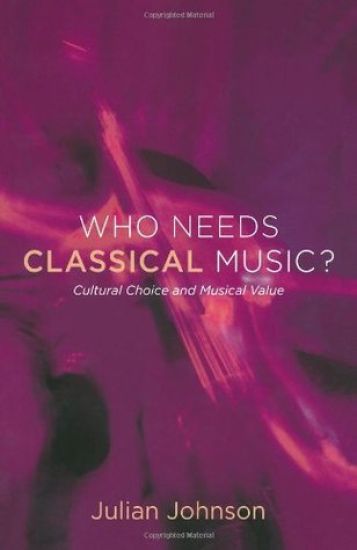
During the last few decades, most cultural critics have come to agree that the division between "high" and "low" art is an artificial one, that Beethoven's Ninth and "Blue Suede Shoes" are equally valuable as cultural texts. In Who Needs Classical Music?, Julian Johnson challenges these assumptions about the relativism of cultural judgments. The author maintains that music is more than just "a matter of taste": while some music provides entertainment, or serves as background noise, other music claims to function as art. This book considers the value of classical music in contemporary society, arguing that it remains distinctive because it works in quite different ways to most of the other music that surrounds us. This intellectually sophisticated yet accessible book offers a new and balanced defense of the specific values of classical music in contemporary culture. The paperback edition includes a new preface from the author, re-contextualizing the debate ten years out. Who Needs Classical Music? will stimulate readers to reflect on their own investment (or lack of it) in music and art of all kinds.
Webern and the Transformation of Nature

Webern and the Transformation of Nature

Julian Johnson

Cambridge University Press
2006
pokkari
This book is about the way in which a society constructs an idea of nature and the role that art, and specifically music, may have in the articulation of that idea. It explores such an idea in relation to Webern, whose music has been almost exclusively portrayed as abstract and autonomous. In opposition to the exclusively formalist concerns of post-Darmstadt Webern reception, this book argues that abstraction in music is understood fully only in relation to the material, historical reality from which it abstracts, and that musical modernism is more fully understood by exposing its underground roots in the aesthetics of romanticism.
Webern and the Transformation of Nature

Webern and the Transformation of Nature

Julian Johnson

Cambridge University Press
2000
sidottu
This book is about the way in which a society constructs an idea of nature and the role that art, and specifically music, may have in the articulation of that idea. It explores such an idea in relation to Webern, whose music has been almost exclusively portrayed as abstract and autonomous. In opposition to the exclusively formalist concerns of post-Darmstadt Webern reception, this book argues that abstraction in music is understood fully only in relation to the material, historical reality from which it abstracts, and that musical modernism is more fully understood by exposing its underground roots in the aesthetics of romanticism.
Classical Music

Classical Music

Julian Johnson

Oneworld Publications
2009
nidottu
What does classical music mean to the Western World? How has it transformed over the centuries? With such a rich tradition, what relevance does it have today? Julian Johnson inspires readers to explore the field, and examines how music is related to some of the big ideas of Western experience including spirituality, emotion, the weight of history, and self identity.