Kirjojen hintavertailu. Mukana 11 582 914 kirjaa ja 12 kauppaa.

Kirjahaku

Etsi kirjoja tekijän nimen, kirjan nimen tai ISBN:n perusteella.

9 kirjaa tekijältä Justin Quinn

Between Two Fires

Between Two Fires

Justin Quinn

Oxford University Press
2015
sidottu
Between Two Fires is about the transnational movement of poetry during the Cold War. Beginning in the 1950s, it examines transnational engagements across the Iron Curtain, reassessing US poetry through a consideration of overlooked radical poets of the mid-century, and then asking what such transactions tell us about the way that anglophone culture absorbed new models during this period. The Cold War synchronized culture across the globe, leading to similar themes, forms, and critical maneuvers. Poetry, a discourse routinely figured as distant from political concerns, was profoundly affected by the ideological pressures of the period. But beyond such mirroring, there were many movements across the Iron Curtain, despite the barriers of cultural and language difference, state security surveillance, spies, traitors and translators. Justin Quinn shows how such factors are integral to transnational cultural movements during this period, and have influenced even postwar anglophone poetry that is thematically distant from the Cold War. For the purposes of the study, Czech poetry--its writers, its translators, its critics--stands on the other side of the Iron Curtain as receptor and, which has been overlooked, part creator, of the anglophone tradition in this period. By stepping outside the frameworks by which anglophone poetry is usually considered, we see figures such as Robert Lowell, Derek Walcott, Allen Ginsberg, and Seamus Heaney, in a new way, with respect to the ideological mechanisms that were at work behind the promotion of the aesthetic as a category independent of political considerations, foremost among these postcolonial theory.
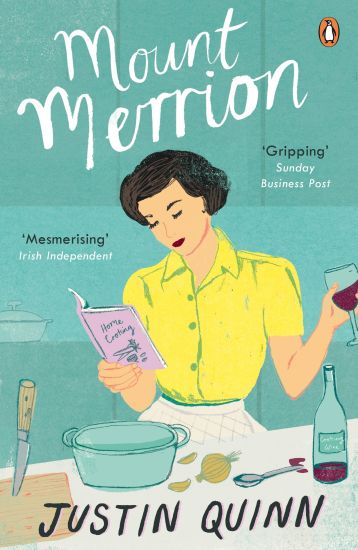
Mount Merrion

Mount Merrion

Justin Quinn

Penguin Books Ltd
2014
pokkari
Justin Quinn's Mount Merrion: a gripping family story spanning half a century, in the mould of Jonathan Franzen and John Lanchester.Declan and Sinead Boyle are pillars of society - born into prosperous families, educated at Dublin's finest schools, dwellers in a fine house in a leafy suburb. So why are they in so much trouble?Declan wants to serve his country - but he also wants to serve his own ambition. Sinead wonders if she is allowed, in the Ireland of the sixties and seventies, to have ambitions at all. Their son, Owen, seems intent on squandering the advantages of a prosperous upbringing and an expensive education. Their daughter Issie, gifted and attractive, has all the options in the world - and keeps choosing the wrong one.Mount Merrion, the dazzling debut novel by Justin Quinn, tells the story of the Boyles from Declan and Sinead's first meeting, in the late fifties, through decades of success, failure and tragedy. Set against the brilliantly realized backdrop of a changing Ireland, it is a page-turning drama, a biting satire and a lovingly detailed portrait of a marriage and a family.'Imaginative and compassionate ... Mount Merrion is about how a decent man, anxious to play by the rules - even if they're someone else's rules - can make the sort of choices that may end up ruining him' Mail on Sunday (four stars)'Taking the form of a family saga, [Quinn's] assured debut plays out over half a century - a state-of-the-nation novel as told through the fast-changing fortunes of middle-class married life ... his novel is filled with perfectly judged moments' Independent 'Mesmerising ... The story is a page-turner, and Quinn's prose consistently light and controlled' Irish Independent'A book that people will find hard to put down ... a gripping story' Sunday Business Post'A great story ... both beautifully written and a well-paced page-turner' Irish Times'Justin Quinn's debut novel is poignant - but it is also fiercely and poetically written, a beautifully observed trajectory of the rise and fall of a society and its assumptions, through the medium of a family story ... This is one of the best books of the year' Evening Herald'Exquisite' Irish Examiner'Absorbing ... A closely and sympathetically observed portrait of family life and Ireland's changing face, Quinn's wide-ranging tale culminates in a conclusion of considerable pathos' Daily Mail'An impressively accomplished trip through forty-odd years of Ireland's recent history ... quite brilliant' RTÉ Guide 'A bona fide thumping good read' Image'An ambitious take on both personal dramas and the altering political landscape of Europe' Sunday Telegraph'An epic yet intimate account of one family caught in the maelstrom of recent history' Metro Herald'Accomplished ... as a condition-of-Ireland novel it makes for salutary reading' TLS'Mount Merrion is epic and intimate, deliciously observed and wholly enjoyable. Justin Quinn is a shining talent.' Claire Kilroy
The Cambridge Introduction to Modern Irish Poetry, 1800–2000
Over the last two centuries, Ireland has produced some of the world's most outstanding and best-loved poets, from Thomas Moore to W. B. Yeats to Seamus Heaney. This introduction not only provides an essential overview of the history and development of poetry in Ireland, but also offers new approaches to aspects of the field. Justin Quinn argues that the language issues of Irish poetry have been misconceived and re-examines the divide between Gaelic and Anglophone poetry. Quinn suggests an alternative to both nationalist and revisionist interpretations and fundamentally challenges existing ideas of Irish poetry. This lucid book offers a rich contextual background against which to read the individual works, and pays close attention to the major poems and poets. Readers and students of Irish poetry will learn much from Quinn's sharp and critically acute account.
The Cambridge Introduction to Modern Irish Poetry, 1800–2000
Over the last two centuries, Ireland has produced some of the world's most outstanding and best-loved poets, from Thomas Moore to W. B. Yeats to Seamus Heaney. This introduction not only provides an essential overview of the history and development of poetry in Ireland, but also offers new approaches to aspects of the field. Justin Quinn argues that the language issues of Irish poetry have been misconceived and re-examines the divide between Gaelic and Anglophone poetry. Quinn suggests an alternative to both nationalist and revisionist interpretations and fundamentally challenges existing ideas of Irish poetry. This lucid book offers a rich contextual background against which to read the individual works, and pays close attention to the major poems and poets. Readers and students of Irish poetry will learn much from Quinn's sharp and critically acute account.
Literature in the Age of Lingua Franca English

Literature in the Age of Lingua Franca English

Justin Quinn

TAYLOR FRANCIS LTD
2024
sidottu
The English language is now a lingua franca spoken by about two billion people. This insightful study considers how a "bridge language" affects world literature by analyzing what it is, how it works, what are its themes, what it means for canons, and how it is mediated.Cultural criticism often employs perspectives of race, citizenship, and colonialism, as well as considerations of scale (archipelagic, planetary), form (analogies between the literary and the social), and technologies (as they inflect artifacts). These approaches help rethink the new dynamics of anglophone literature, but they have often overlooked one of the basic elements of literature – the language itself. Literatures in English vernaculars have flourished, and Justin Quinn shows that writers are also creating a new idiom in English that is not fixed to a particular locale or community. While sentences may become simpler, the vocabulary range narrower, and rich cultural references lost, Quinn reveals how much this new form of writing gains. He explores the work of a wide range of authors, including Daisy Hildyard, Kim Stanley Robinson, Bryan Washington, Yiyun Li, and Terrance Hayes.Literature in the Age of Lingua Franca English: The Zero Style is an innovative and illuminating resource for students and scholars of global anglophone literature, comparative literature, and cultural studies.
Literature in the Age of Lingua Franca English

Literature in the Age of Lingua Franca English

Justin Quinn

TAYLOR FRANCIS LTD
2024
nidottu
The English language is now a lingua franca spoken by about two billion people. This insightful study considers how a "bridge language" affects world literature by analyzing what it is, how it works, what are its themes, what it means for canons, and how it is mediated.Cultural criticism often employs perspectives of race, citizenship, and colonialism, as well as considerations of scale (archipelagic, planetary), form (analogies between the literary and the social), and technologies (as they inflect artifacts). These approaches help rethink the new dynamics of anglophone literature, but they have often overlooked one of the basic elements of literature – the language itself. Literatures in English vernaculars have flourished, and Justin Quinn shows that writers are also creating a new idiom in English that is not fixed to a particular locale or community. While sentences may become simpler, the vocabulary range narrower, and rich cultural references lost, Quinn reveals how much this new form of writing gains. He explores the work of a wide range of authors, including Daisy Hildyard, Kim Stanley Robinson, Bryan Washington, Yiyun Li, and Terrance Hayes.Literature in the Age of Lingua Franca English: The Zero Style is an innovative and illuminating resource for students and scholars of global anglophone literature, comparative literature, and cultural studies.
Gathered Beneath the Storm: Wallace Stevens Nature and Community

Gathered Beneath the Storm: Wallace Stevens Nature and Community

Justin Quinn

University College Dublin Press
2002
sidottu
Wallace Stevens (1879-1955) has been acknowledged by writers as diverse as Harold Bloom, Adrienne Rich and R.S. Thomas as one of the central poets of the 20th century. Justin Quinn offers a fundamental reassessment of Stevens's work and the connections it makes between nature, community and art. He engages fully with the recent wave of historicist criticism, and displays the shortcomings of this approach, not only for a reading of Stevens, but also for literature in general. Quinn asks in his introduction "why shouldn't there be a criticism which attends to the societal contexts of poetry without reneging on responsibilities to poetry as a discourse distinct from politics and ideology, one with its own special rhetorical funds and resources, which can nevertheless allow it to comment on the political aspects of our lives in special ways?" His book responds to that requirement and is a valuable contribution to the critical debate on Wallace Stevens's poetry.
Gathered Beneath the Storm

Gathered Beneath the Storm

Justin Quinn

University College Dublin Press
2002
nidottu
Wallace Stevens (1879-1955) has been acknowledged by writers as diverse as Harold Bloom, Adrienne Rich and R.S. Thomas as one of the central poets of the 20th century. Justin Quinn offers a fundamental reassessment of Stevens's work and the connections it makes between nature, community and art. He engages fully with the recent wave of historicist criticism, and displays the shortcomings of this approach, not only for a reading of Stevens, but also for literature in general. Quinn asks in his introduction "why shouldn't there be a criticism which attends to the societal contexts of poetry without reneging on responsibilities to poetry as a discourse distinct from politics and ideology, one with its own special rhetorical funds and resources, which can nevertheless allow it to comment on the political aspects of our lives in special ways?" His book responds to that requirement and is a valuable contribution to the critical debate on Wallace Stevens's poetry.
American Errancy

American Errancy

Justin Quinn

University College Dublin Press
2005
sidottu
American Errancy is a wide-ranging study of the connection between ideology and the sublime in the work of twentieth-century poets, all American with two, or perhaps three important exceptions. The poets chosen are in debate with the Romantic individualism of Emerson - some reject it outright, but the remainder have devoted substantial work to adjusting to the changed circumstances of their century. The link between Romantic individualism and ideological contexts has preoccupied much criticism of American literature in the last twenty years. For the most part, critics arraign this tradition, suggesting that the writers abscond from difficult political dilemmas to the realm of transcendence. In consequence, the sublime as category for thinking about literary texts has been largely abandoned. Emerson's transcendence is considered at best naive, at worst as providing the nascent corporate capitalism of the late nineteenth century with an iconography with which to execute its agenda. Justin Quinn argues that this critical approach distorts the achievement of poets in the twentieth century: many of the poets discussed extend the tradition of Romantic individualism, but they are not ideologically naive in the above sense. Their work anticipated historicist criticism of the 1980s and 1990s as they began to 'socialise' the sublime, and to explore the ways in which the inheritance of Romantic individualism could engage with ideological contexts. For some of the poets, these explorations supported their oppositional politics (i.e., Allen Ginsberg); for others, paradoxically, the explorations supported conservative politics (i.e., A. R. Ammons); others rejected the Emersonian inheritance outright (Eliot, Hill), but that rejection itself has left an enduring mark on their work.