Kirjojen hintavertailu. Mukana 11 699 587 kirjaa ja 12 kauppaa.

Kirjahaku

Etsi kirjoja tekijän nimen, kirjan nimen tai ISBN:n perusteella.

2 kirjaa tekijältä K.J. Radford

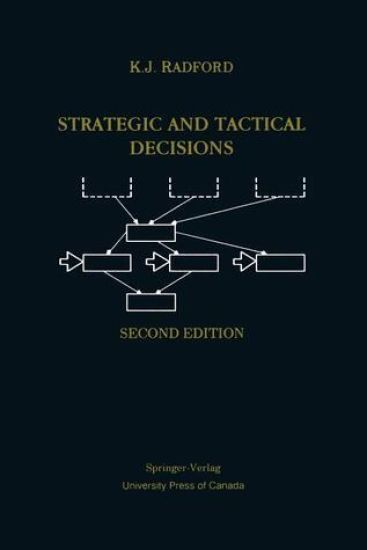
Strategic and Tactical Decisions

Strategic and Tactical Decisions

K.J. Radford

Springer-Verlag New York Inc.
1988
nidottu
Much of the work that has been done in the last fifty years in the area of decision analysis has been concerned with situations in which formal mathematical models of the decision process can be used. For example, deterministic models of operations research have been used as a means of treating decisions under conditions of certainty. Statistical decision theory has been applied to decision making under conditions of uncertainty and risk. Some attempts have been made to treat decisions under conditions of competition by methods derived from game theory. However, many of the decisions that we meet today in business and in our daily lives do not fall conveniently into the areas covered by these models. Many modern decisions are ill-structured by nature. These decisions have been called ''wicked" in comparison to the "tame" decisions that yield to formal analyti­ cal treatment. Complex decision situations are found in every aspect of our lives today. They are normally centred around an issue, opportunity, venture or threat that involves an individual or an organization on the one hand and other participants on the other hand. The issue in such a situation might involve, for example, the proposed move of the Head Office of a corporation from one political jurisdiction to another. It might be concerned with the oppor­ tunities and new ventures that would arise with the introduction of a new and different type of product or service into an organization.
Individual and Small Group Decisions

Individual and Small Group Decisions

K.J. Radford

Springer-Verlag New York Inc.
1989
nidottu
ecision making is one of the most important activities in both our profes­ D sional and our private lives today. The literature on the subject has grown considerably over the last fifty years and it now covers many different approaches to the subject. These approaches range from that of creating a mathematical model of the decision situation under consideration, as in operations research and other forms of mathematical decision analysis, to those that are based on human and organizational behavior. Recently, those working in the field have begun to combine approaches to the study of decision situations that arise in organizations, in our personal lives and in the communities in which we live. This book is an attempt to assist those concerned with decision making to work with this combination of approaches. In the past, decision problems have been considered according to the condi­ tions under which they arise and to some extent in terms of the approaches available for their resolution. Writers on the subject who are mathematically­ oriented have devised a method of classifying decisions based on the type of mathematics that they suggest be used in the resolution of the problems. This approach leads to the division of decision situations into the categories of cer­ tainty, uncertainty, risk and competition. Deterministic models available in oper­ ations research have then been offered as the means of treating decision situations in the category of certainty.