Kirjojen hintavertailu. Mukana 11 244 527 kirjaa ja 12 kauppaa.

Kirjahaku

Etsi kirjoja tekijän nimen, kirjan nimen tai ISBN:n perusteella.

10 kirjaa tekijältä Kari Palonen

Quentin Skinner

Quentin Skinner

Kari Palonen

Polity Press
2003
sidottu
This book is the first comprehensive exposition of the work of one of the most important intellectual historians and political theorists writing today. Quentin Skinner's treatment of political theory as a dimension of political life marks a revolutionary move in the historical as well as the philosophical study of political thought. Skinner brings the study of political theory closer to the language of agents and treats theorists as politicians of a special kind. This is as true of his accounts of his contemporaries, such as Rawls, Rorty, Geertz and Habermas, as it is of his interpretations of classical thinkers such as Machiavelli and Hobbes. Skinner has become internationally renowned for this approach, which ties together historical and contemporary analysis in order to integrate the study of the past and the present, and which tries fully to uncover the historical context and development of key concepts in political theory such as freedom and the state. This volume charts Skinner's work from the early 1960s right up to the present, including his most recent studies in the theory of persuasive speech, and is organized around five major themes: history, linguistic action, political thought, liberty and rhetoric. It pays particular attention to Skinner's work in relation to that of continental thinkers, especially Max Weber and Reinhart Koselleck. The book will be essential reading for students and scholars of political and social theory, history, philosophy and cultural studies.
Quentin Skinner

Quentin Skinner

Kari Palonen

Polity Press
2003
nidottu
An exposition of the work of the important intellectual historian and political theorist Quentin Skinner. The volume charts Skinner's work from the early 1960s onwards and is organized around five major themes: history; linguistic action; political thought; liberty and rhetoric.
A Political Style of Thinking

A Political Style of Thinking

Kari Palonen

ECPR Press
2016
sidottu
Max Weber studies have been radically transformed since the 1980s. The author continues this revision by reading Weber as a thoroughly political thinker. Weber’s key concept is Chance, a concept that allows us to study politics as contingent activity and to understand both the actions of politicians and the presence of the political aspect in research. This collection contains essays from 1999 to 2014 and a new introduction. The first part deals with Weber’s concept of politics and the politician as an ideal type, the second discusses Weber’s reinterpretations of key political concepts of freedom, democracy, parliament, nation and the state. The third part links Weber’s concept of ‘objectivity’ with the parliamentary style of politics. The essays set Weber’s political thought in relationship to his predecessors (Constant, Bagehot, Nietzsche), contemporaries (Sombart, Schmitt, Benjamin), later (Arendt, Sartre) or contemporary scholars (Skinner, Koselleck) and current Weber studies (Hennis, Scaff, Ghosh).
A Political Style of Thinking

A Political Style of Thinking

Kari Palonen

ECPR Press
2019
nidottu
Max Weber studies have been radically transformed since the 1980s. The author continues this revision by reading Weber as a thoroughly political thinker. Weber’s key concept is Chance, a concept that allows us to study politics as contingent activity and to understand both the actions of politicians and the presence of the political aspect in research. This collection contains essays from 1999 to 2014 and a new introduction. The first part deals with Weber’s concept of politics and the politician as an ideal type, the second discusses Weber’s reinterpretations of key political concepts of freedom, democracy, parliament, nation and the state. The third part links Weber’s concept of ‘objectivity’ with the parliamentary style of politics. The essays set Weber’s political thought in relationship to his predecessors (Constant, Bagehot, Nietzsche), contemporaries (Sombart, Schmitt, Benjamin), later (Arendt, Sartre) or contemporary scholars (Skinner, Koselleck) and current Weber studies (Hennis, Scaff, Ghosh).
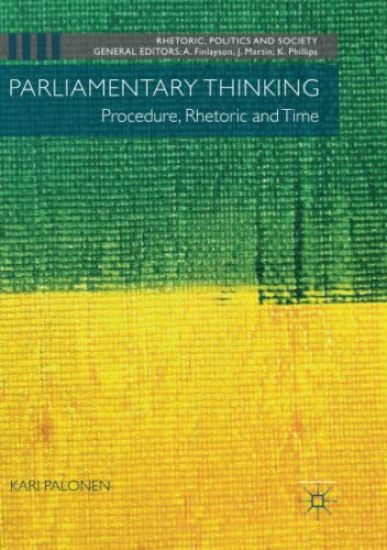
Parliamentary Thinking

Parliamentary Thinking

Kari Palonen

Springer Nature Switzerland AG
2019
nidottu
The parliamentary style of politics has been formed over centuries; nobody theorised it in advance. This book presents a thought experiment to spell out key principles of the parliamentary ideal type of politics. Max Weber offers the main intellectual inspiration, Westminster parliament provides the main historical reference and the author’s studies on parliamentary procedure and rhetoric provide the background for the book. Parliamentary acting and thinking offer us the best example of politics as a contingent and controversial activity. Using a parliamentary imagination, the author constructs the ideal type in five main chapters: dissensual modes of proceeding; rhetoric of parliamentary debate; parliamentary formation and control of government; parliamentarians as politicians; and parliamentary time as their common subtext. In the last two chapters, the book outlines the possibilities of extending parliamentary judgment to politics beyond parliaments proper and the chancesfor parliamentary politics succeeding today.
Parliamentary Thinking

Parliamentary Thinking

Kari Palonen

Springer International Publishing AG
2018
sidottu
The parliamentary style of politics has been formed over centuries; nobody theorised it in advance. This book presents a thought experiment to spell out key principles of the parliamentary ideal type of politics. Max Weber offers the main intellectual inspiration, Westminster parliament provides the main historical reference and the author’s studies on parliamentary procedure and rhetoric provide the background for the book. Parliamentary acting and thinking offer us the best example of politics as a contingent and controversial activity. Using a parliamentary imagination, the author constructs the ideal type in five main chapters: dissensual modes of proceeding; rhetoric of parliamentary debate; parliamentary formation and control of government; parliamentarians as politicians; and parliamentary time as their common subtext. In the last two chapters, the book outlines the possibilities of extending parliamentary judgment to politics beyond parliaments proper and the chancesfor parliamentary politics succeeding today.
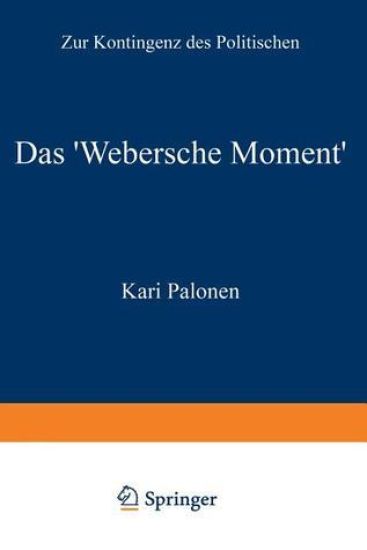
Das ‘Webersche Moment’

Das ‘Webersche Moment’

Kari Palonen

Vs Verlag Fur Sozialwissenschaften
1998
nidottu
Pococks "The Machiavellian Moment" versteht Politik als Kontingenzbehandlung. Das "Webersche Moment" deutet Max Weber ebenfalls in diesem Sinne, interpretiert ihn jedoch als Denker, der die Kontingenz uminterpretiert. Anstatt sie als 'fortuna' im Hintergrund der Politik zu deuten, sieht Weber die Kontingenz der Chancen als Voraussetzung dafür, politisches Handeln zu verstehen. Diese Sicht prägt auch seine Politikkonzeption: Streben, Macht und Kampf ebenso wie Leidenschaft, Verantwortungsgefühl und Augenmaß verweisen auf verschiedene Aspekte der Kontingenz. Der Autor zeigt, daß die "Globalisierung der Kontingenz" (Connolly) in der gegenwärtigen Politik eine Art Rückkehr der 'fortuna' bedeutet. Politik hat nun beide Aspekte der Kontingenz, die Chancen und die 'fortuna' aufeinander zu beziehen.
At the Origins of Parliamentary Europe

At the Origins of Parliamentary Europe

Kari Palonen

VERLAG BARBARA BUDRICH
2024
sidottu
Im Jahr 1952 bildeten Politiker aus Deutschland, Frankreich, Belgien, Italien, den Niederlanden und Luxemburg die erste Ad-hoc-Versammlung mit dem Ziel, eine Verfassung für eine künftige europäische politische Gemeinschaft zu entwerfen. In ihren Überlegungen, wie eine parlamentarische Regierung in einer supranationalen Gemeinschaft realisiert werden könnte, formulierten die Teilnehmer zentrale Aspekte der europäischen Politisierung. Das Buch entdeckt diesen bisher vernachlässigten Ursprung des parlamentarischen Europas neu und untersucht die Bedeutung der Ad-hoc-Versammlung für die Politisierung der europäischen Integration. Es geht der Frage nach, wie die Versammlung als Projekt der europäischen Integration nach dem Zweiten Weltkrieg funktionierte, und erklärt sie als einen Moment in der politischen Theorie- und Begriffsgeschichte des Parlamentarismus, der Perspektiven für spätere Phasen der Parlamentarisierung der EU eröffnet.