
Kirjojen hintavertailu. Mukana 12 016 292 kirjaa ja 12 kauppaa.

Kirjahaku

Etsi kirjoja tekijän nimen, kirjan nimen tai ISBN:n perusteella.

4 kirjaa tekijältä Karl F. Zender

Faulkner and the Politics of Reading

Faulkner and the Politics of Reading

Karl F. Zender

Louisiana State University Press
2002
sidottu
With this study Karl F. Zender offers fresh readings of individual novels, themes, and motifs while also assessing the impact of recent politicised interpretations on our understanding of Faulkner's achievement. Sympathetically acknowledging the need to decenter the canon, Zender's searching interrogation of current theory clears a breathing space for Faulkner and his readers between the fustier remnants of New Criticism and the excesses of post-structuralism.Each chapter opens with a balanced presentation of the genuine gifts contemporary theory has bestowed on our comprehension of a particular novel or problem in Faulkner criticism and then proceeds with a groundbreaking reading. ""The Politics of Incest"" challenges older psychoanalytic interpretations of Faulkner's use of the incest motif, and ""Faulkner's Privacy"" defends the novelist's difficulty or ""reticence"" as an aesthetic resistance against the rude candor of deregionalized and depersonalized culture. Subsequent chapters take up the volatile issues of Faulkner's representations of women and of African Americans, and a close reading of the classic ""Barn Burning"" critiques the current tendency to blur the concepts of patriarchy and paternity. The elegiac final chapter, ""Where is Yoknapatawpha County?"" draws on a comparison with John Updike's Pennsylvania fiction and a reading of Joan Williams's The Wintering to explore Faulkner's disinclination to represent the quotidian realities of southern life in his later novels. Zender shows that Faulkner's stylistic withdrawal attempts to ""transform into beauty"" his alienation from the postwar world and his fear of aging. That Faulkner and the Politics of Reading itself recovers and gives new luster to Faulkner's beauty will surely please, in the author's words, ""those readers . . . for whom literature is less a mechanism of social change than a source of pleasure."" The originality of its critical vision will inspire Faulkner scholars, students of American literature, and general readers.
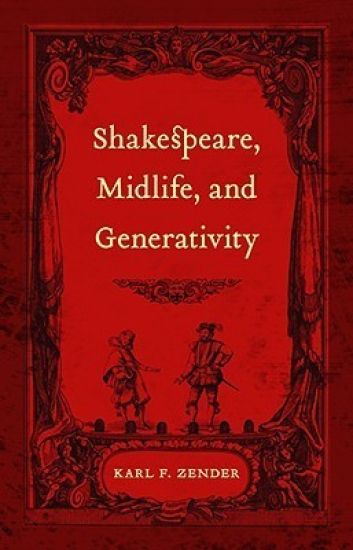
Shakespeare, Midlife, and Generativity

Shakespeare, Midlife, and Generativity

Karl F. Zender

Louisiana State University Press
2008
sidottu
The life expectancy in Shakespearean times averaged only about twenty-five to thirty-five years, but those who survived the illnesses of infancy and childhood could look forward to a long life with nearly the same level of confidence as someone living now. But even so long ago, some faced conflicts in their middle and later years that remain familiar today. In Shakespeare, Midlife, and Generativity, Karl F. Zender explores William Shakespeare's depictions of middle age by examining the relationships between middle-aged parents -- mainly fathers -- and their children in five of his greatest plays. He finds that the middle-aged characters in King Lear, Macbeth, Antony and Cleopatra, The Winter's Tale, and The Tempest -- much like their modern counterparts -- experience a fear of aging and debility.Representations of middle age occur throughout the Shakespearean canon, in forms ranging from Jaques' ""seven ages"" speech in As You Like It to the emphasis -- almost an obsession -- in many plays on relations between the generations. Lear, Zender shows, tries to forestall the approach of old age with a fantasy of literal rebirth in his relationship with Cordelia. Macbeth depicts an even more urgent struggle against midlife decline, while in Antony and Cleopatra, Shakespeare portrays two characters in midlife crisis who attempt to redefine their identities by memorializing their former status and power, now lost. Drawing on Erik Erikson's theory of generativity -- a midlife shift from advancing one's own career to aiding a younger generation -- Zender explores the difficulties Shakespeare's characters face as they transfer power and authority to their children and others in the next generation. Paying careful attention to the plays' moral and ethical implications, he demonstrates how Shakespeare's innovative depiction of the midlife experience focuses on internal psychological understanding rather than external actions such as ceremony and ritual.Illuminating and engaging, Shakespeare, Midlife, and Generativity offers a fresh analysis of several of Shakespeare's most important plays and explores a profound, centuries-old perspective on the challenges inherent in middle age.
Shakespeare and Faulkner

Shakespeare and Faulkner

Karl F. Zender

Louisiana State University Press
2021
sidottu
Shakespeare and Faulkner: Selves and Others explores the moral and ethical dilemmas that characters face inside themselves and in their interactions with others in the works of these two famed authors. Karl F. Zender's characterological study offers insightful, critically rigorous, and at times quite personal analyses of the complicated figures who inhabit several major Shakespeare plays and Faulkner novels. The two parts of this book-the first of which focuses on the English playwright, the second on the Mississippi novelist-share a common methodology in that they originate in Zender's history as a teacher of and writer on the two authors, who until now he generally approached separately. He emphasizes the evolving insights gleaned from reading these authors over several decades, situating their texts in relation to shifting trends in criticism and highlighting the contemporary relevance of their works. The final chapter, an extended discussion of Faulkner's Intruder in the Dust, attempts something unusual in Zender's critical practice: It relies less on the close textual analysis that characterizes his previous work and instead explores the intersections between events depicted in the novel and his own life, both as a child and as an adult. Shakespeare and Faulkner speaks to the power of literature as a form of pleasure and of consolation. With this work of engaged and thoughtful scholarly criticism, Zender reveals the centrality of storytelling to human beings' efforts to make sense both of their journey through life and of the circumstances in which they live.
Faulkner and the Politics of Reading

Faulkner and the Politics of Reading

Karl F. Zender

LOUISIANA STATE UNIVERSITY PRESS
2023
pokkari
With this study Karl F. Zender offers fresh readings of individual novels, themes, and motifs while also assessing the impact of recent politicized interpretations on our understanding of Faulkner's achievement. Sympathetically acknowledging the need to decenter the canon, Zender's searching interrogation of current theory clears a breathing space for Faulkner and his readers between the fustier remnants of New Criticism and the excesses of post-structuralism.Each chapter opens with a balanced presentation of the genuine gifts contemporary theory has bestowed on our comprehension of a particular novel or problem in Faulkner criticism and then proceeds with a groundbreaking reading. "The Politics of Incest" challenges older psychoanalytic interpretations of Faulkner's use of the incest motif, and "Faulkner's Privacy" defends the novelist's difficulty or "reticence" as an aesthetic resistance against the rude candor of deregionalized and depersonalized culture. Subsequent chapters take up the volatile issues of Faulkner's representations of women and of African Americans, and a close reading of the classic "Barn Burning" critiques the current tendency to blur the concepts of patriarchy and paternity. The elegiac final chapter, "Where is Yoknapatawpha County?" draws on a comparison with John Updike's Pennsylvania fiction and a reading of Joan Williams's The Wintering to explore Faulkner's disinclination to represent the quotidian realities of southern life in his later novels. Zender shows that Faulkner's stylistic withdrawal attempts to "transform into beauty" his alienation from the postwar world and his fear of aging. That Faulkner and the Politics of Reading itself recovers and gives new luster to Faulkner's beauty will surely please, in the author's words, "those readers . . . for whom literature is less a mechanism of social change than a source of pleasure." The originality of its critical vision will inspire Faulkner scholars, students of American literature, and general readers.