
Kirjojen hintavertailu. Mukana 11 244 527 kirjaa ja 12 kauppaa.

Kirjahaku

Etsi kirjoja tekijän nimen, kirjan nimen tai ISBN:n perusteella.

6 kirjaa tekijältä Karl Galinsky

Classical and Modern Interactions

Classical and Modern Interactions

Karl Galinsky

University of Texas Press
2013
nidottu
Postmodernism, multiculturalism, the alleged decline of the United States, deconstruction, leadership, and values-these topics have been at the forefront of contemporary intellectual and cultural debate and are likely to remain so for the near future. Participants in the debate can usefully enlarge the perspective to a comparison between the Greco-Roman world and contemporary society. In this thought-provoking work, a noted classics scholar tests the ancient-modern comparison, showing what it can add to the contemporary debates and what its limitations are.Writing for intellectually adventurous readers, Galinsky explores Greece and Rome as multicultural societies, debates the merits of classicism in postmodern architecture, discusses the reign of Augustus in terms of modern leadership theories, and investigates the modern obsession with finding parallels between the supposed "decline and fall" of Rome and the "decay" of U.S. society.Within these discussions, Galinsky shows the continuing vitality of the classical tradition in the contemporary world. The Greek and Roman civilizations have provided us not only with models for conscious adaptation but also points for radical departures. This ability to change and innovate from classical models is crucial, Galinsky maintains. It creates a reciprocal process whereby contemporary issues are projected into the past while aspects of the ancient world are redefined in terms of current approaches.These essays result in a balanced assessment and stimulating restatement of some major issues in both contemporary U.S. society and the Greco-Roman world. The book, which speaks to a wide interdisciplinary audience, is based on a series of lectures that Galinsky gave as a national visiting scholar for Phi Beta Kappa. It concludes with a discussion of the role of classical studies in the United States today.
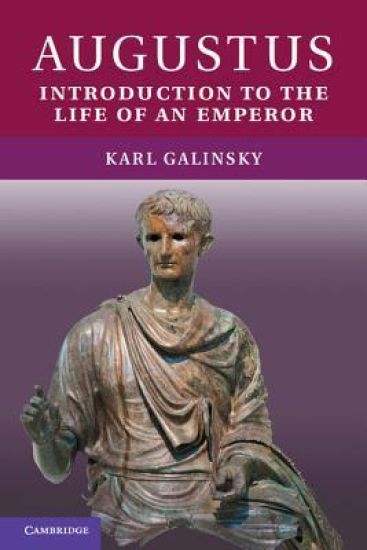
Augustus

Augustus

Karl Galinsky

Cambridge University Press
2012
pokkari
Augustus, Rome's first emperor, is one of the great figures of world history and one of the most fascinating. In this lively and concise biography Karl Galinsky examines Augustus' life from childhood to deification. He chronicles the mosaic of vicissitudes, challenges, setbacks and successes that shaped Augustus' life, both public and private. How did he use his power? How did he manage to keep re-inventing himself? What kind of man was he? A transformative leader, Augustus engineered profound change in Rome and throughout the Mediterranean world. No one would have expected such vast achievements from the frail and little-known eighteen-year-old who became Caesar's heir amid turmoil and crisis. A mere thirteen years later, after defeating Antony and Cleopatra, he had, in his words, 'power over all things'.
Augustus

Augustus

Karl Galinsky

Cambridge University Press
2012
sidottu
Augustus, Rome's first emperor, is one of the great figures of world history and one of the most fascinating. In this lively and concise biography Karl Galinsky examines Augustus' life from childhood to deification. He chronicles the mosaic of vicissitudes, challenges, setbacks and successes that shaped Augustus' life, both public and private. How did he use his power? How did he manage to keep re-inventing himself? What kind of man was he? A transformative leader, Augustus engineered profound change in Rome and throughout the Mediterranean world. No one would have expected such vast achievements from the frail and little-known eighteen-year-old who became Caesar's heir amid turmoil and crisis. A mere thirteen years later, after defeating Antony and Cleopatra, he had, in his words, 'power over all things'.
Augustan Culture

Augustan Culture

Karl Galinsky

Princeton University Press
1998
pokkari
Grand political accomplishment and artistic productivity were the hallmarks of Augustus Caesar's reign (31 B.C. to A.D. 14), which has served as a powerful model of achievement for societies throughout Western history. Although much research has been done on individual facets of Augustan culture, Karl Galinsky's book is the first in decades to present a unified overview, one that brings together political and social history, art, literature, architecture, and religion. Weaving analysis and narrative throughout a richly illustrated text, Galinsky provides not only an enjoyable account of the major ideas of the age, but also an interpretation of the creative tensions and contradictions that made for its vitality and influence. Galinsky draws on source material ranging from coins and inscriptions to the major works of poetry and art, and challenges the schematic concepts and dichotomies that have commonly been applied to Augustan culture. He demonstrates that this culture was neither monolithic nor the mere result of one man's will. Instead it was a nuanced process of evolution and experimentation. Augustan culture had many contributors, as Galinsky demonstrates, and their dynamic interactions resulted in a high point of creativity and complexity that explains the transcendence of the Augustan age. Far from being static, its sophisticated literary and artistic monuments call for the active response and involvement of the reader and viewer even today.
Aeneas, Sicily, and Rome

Aeneas, Sicily, and Rome

Karl Galinsky

Princeton University Press
2015
pokkari
The legend of Aeneas as preserved in the art and artifacts of antiquity is the focus of this study. Gallant warrior, accomplice in the abduction of Helen, fugitive from burning Troy, founder of Rome-in all his roles, Aeneas appears in ancient sculpture and wall painting, on vases, coins, lamps, mirrors, and gems, as richly illustrated here. To what extent he was known to the Greeks and Romans, for what qualities he was admired, and how his legend served the propaganda of empire building are examined in this survey of the visual data, and these are correlated with what is known of the legend in the literary, historical, and religious traditions of the ancient Mediterranean world. Originally published in 1969. The Princeton Legacy Library uses the latest print-on-demand technology to again make available previously out-of-print books from the distinguished backlist of Princeton University Press. These editions preserve the original texts of these important books while presenting them in durable paperback and hardcover editions. The goal of the Princeton Legacy Library is to vastly increase access to the rich scholarly heritage found in the thousands of books published by Princeton University Press since its founding in 1905.
Aeneas, Sicily, and Rome

Aeneas, Sicily, and Rome

Karl Galinsky

Princeton University Press
2016
sidottu
The legend of Aeneas as preserved in the art and artifacts of antiquity is the focus of this study. Gallant warrior, accomplice in the abduction of Helen, fugitive from burning Troy, founder of Rome-in all his roles, Aeneas appears in ancient sculpture and wall painting, on vases, coins, lamps, mirrors, and gems, as richly illustrated here. To what extent he was known to the Greeks and Romans, for what qualities he was admired, and how his legend served the propaganda of empire building are examined in this survey of the visual data, and these are correlated with what is known of the legend in the literary, historical, and religious traditions of the ancient Mediterranean world. Originally published in 1969. The Princeton Legacy Library uses the latest print-on-demand technology to again make available previously out-of-print books from the distinguished backlist of Princeton University Press. These editions preserve the original texts of these important books while presenting them in durable paperback and hardcover editions. The goal of the Princeton Legacy Library is to vastly increase access to the rich scholarly heritage found in the thousands of books published by Princeton University Press since its founding in 1905.