This book is an outstanding overview of the life and thoughts of Karl Marx. The editor masterfully weaves together Marx's published works and private letters into a rich tapestry of history and ideas. In addition to what you might expect to find in a collection like this (the text of The Communist Manifesto, selections from Das Kapital...), there are also tidbits from Marx's hand that help you truly understand the man and the history of his ideology, from his predictions on the fates of France and Russia, even down to his favorite color (red, of course) and his old report cards. No serious student of economic and political philosophy should be without an understanding of Karl Marx. This book provides it like no other.
This second edition of McLellan's comprehensive selection of Marx's writings includes carefully selected extracts from the whole range of Marx's political, philosophical and economic thought. Each section of the book deals with a different period of Marx's life with the sections arranged in chronological order, thus allowing the reader to trace the development of Marx's thought, from his early years as a student and political journalist in Germany right through to his final letters of the early 1880s. The inclusion of extracts from some of Marx's less well-known works alongside selections from classic texts such as The Communist Manifesto and Capital provides the reader with an unparalleled overview of Marx's thinking, whilst Professor McLellan's fully updated and revised introduction and bibliographical notes accompanying each extract put Marx's writings into biographical and historical context. This edition also includes a general bibliography and a full index of names and ideas as well as a new general introduction for each section of the book by Professor McLellan. As with the first edition, this comprehensive and clearly structured selection of Marx's writings will be essential reading for all those interested in the political thought of this perennially important figure in Western political philosophy.
This volume presents those writings of Marx that best reveal his contribution to sociology, particularly to the theory of society and social change. The editor, Neil J. Smelser, has divided these selections into three topical sections and has also included works by Friedrich Engels. The first section, "The Structure of Society," contains Marx's writings on the material basis of classes, the basis of the state, and the basis of the family. Among the writings included in this section are Marx's well-known summary from the Preface of A Contribution to a Critique of Political Economy and his equally famous observations on the functional significance of religion in relation to politics. The second section is titled "The Sweep of Historical Change." The first selection here contains Marx's first statement of the main precapitalist forms of production. The second selection focuses on capitalism, its contradictions, and its impending destruction. Two brief final selections treat the nature of communism, particularly its freedom from the kinds of contradictions that have plagued all earlier forms of societies. The last section, "The Mechanisms of Change," reproduces several parts of Marx's analysis of the mechanisms by which contradictions develop in capitalism and generate group conflicts. Included is an analysis of competition and its effects on the various classes, a discussion of economic crises and their effects on workers, and Marx's presentation of the historical specifics of the class struggle. In his comprehensive Introduction to the selections, Professor Smelser provides a biography of Marx, indentifies the various intellectual traditions which formed the background for Marx's writings, and discusses the selections which follow. The editor describes Marx's conception of society as a social system, the differences between functionalism and Marx's theories, and the dynamics of economic and political change as analyzed by Marx.
Much of Karl Marx's most important work came out of his critique of other thinkers, including many socialists who differed significantly in their conceptions of socialism. The fourth volume in Hal Draper's series looks at these critiques to illuminate what Marx's socialism was, as well as what it was not. Some of these debates are well-known elements in Marx's work, such as his writings on the anarchists Proudhon and Bakunin. Others are less familiar, such as the writings on "Bismarckian socialism" and "Boulangism," but promise to become better known and understood with Draper's exposition. He also discusses the more general ideological tendencies of "utopian" and "sentimental" socialisms, which took various forms and were ingredients in many different socialist movements.
Thank you for checking out this book by Theophania Publishing. We appreciate your business and look forward to serving you soon. We have thousands of titles available, and we invite you to search for us by name, contact us via our website, or download our most recent catalogues. The present volume consists of a translation of some of Karl Marx's principal writings during the six years 1844-1850. In 1843 Marx was twenty-five years old. He had just married, apparently on the strength of the modest salary he was to receive for editing, jointly with Arnold Ruge, a periodical called the Deutsch-Franz sische Jahrb cher (Franco-German Annuals), the purpose of which was to promote the union of German philosophy with French social science. Only one double-number of this journal appeared in 1844. It contained Marx's criticism of the Hegelian Philosophy of Right and his exposition of the social significance of the Jewish question, in the form of a review of two works by Bruno Bauer. Translations of both articles are given in this volume. They possess a special interest for the Marxian student, as they exhibit the grafting of a materialist philosophy upon the idealist philosophy of Hegel, and show the employment of the Hegelian dialectic in the investigation of political and historical questions. It was not long before Marx and Ruge became intellectually estranged, and the third essay, The King of Prussia and Social Reform, which appeared in the Paris socialist journal Vorw rts, contains a severe polemic against Ruge. In the same organ Marx published an elaborate defence of Engels in particular and communists in general from the strictures of Karl Heinzen, a radical republican politician. In both essays Marx ranges over a wide field, and develops his own views upon economic, political and historical questions. The essay on Proudhon emphasizes the special merits of that writer as a pioneer of economic criticism, and forms a counterweight to Marx's devastating criticism of Proudhon in the Poverty of Philosophy. This piece and the sketch of French materialism are extracted from Die Heilige Familie (The Holy Family), a comprehensive work of satirical criticism, in which Marx and Engels (whose share in writing the book was a very small one), settled accounts with their philosophic conscience. The critique of the views of M. Guizot upon the English and French middle-class revolutions appeared in the Neue Rhenische Revue (New Rhenish Review), a periodical which Marx and Engels edited from London in 1850.
Karl Marx (1818-1883), Philosoph und Revolution r, gilt nach einer Umfrage der BBC. London im Herbst 1999 als der bedeutendste Philosoph des ausgehenden zweiten Jahrtausends. Sein Hauptwerk "Das Kapital," bestehend aus drei B ndern, ist nicht nur eine konomische Theorie sondern zugleich ein gewaltiges Gedankengeb ude aus Geschichte, Wirtschaftswissenschaft und Soziologie in dem er immer wieder leidenschaftlich Partei ergreift f r eine humane Weltordnung. Auch wenn die Marxschen Gedanken, dort wo versucht wurde sie umzusetzen, vorerst gescheitert sind, sind sie f r das Verst ndnis des heutigen weltbeherrschenden Kapitalismus von aktueller Bedeutung. Die persische bersetzung des I., II. und Teil I des III. Bandes des "Kapital" wurden im Laufe der Jahre 1973 bis 1984 von Iraj Eskandari gemacht und von der Edition "Hezbe Tudehje Iran" herausgegeben. Erst viele Jahre sp ter wurde die bersetzung des II. Teiles des III. Bandes von Bahram Habibi ausgefertigt und wird hiermit den Interessenten zur Nutzung angeboten.
'...one of Karl Marx' most profound and most brilliant monographs.' The Eighteenth Brumaire of Louis Bonaparteby Karl MarxThe Eighteenth Brumaire of Louis Napoleon (German: Der 18te Brumaire des Louis Napoleon) was an essay written by Karl Marx between December 1851 and March 1852, and originally published in 1852 in Die Revolution, a German monthly magazine published in New York and established by Joseph Weydemeyer. Later English editions, such as an 1869 Hamburg edition, were entitled The Eighteenth Brumaire of Louis Bonaparte."The Eighteenth Brumaire of Louis Bonaparte" is one of Karl Marx' most profound and most brilliant monographs. It may be considered the best work extant on the philosophy of history, with an eye especially upon the history of the Movement of the Proletariat, together with the bourgeois and other manifestations that accompany the same, and the tactics that such conditions dictate.The recent populist uprising; the more recent "Debs Movement"; the thousand and one utopian and chimerical notions that are flaring up; the capitalist maneuvers; the hopeless, helpless grasping after straws, that characterize the conduct of the bulk of the working class; all of these, together with the empty-headed, ominous figures that are springing into notoriety for a time and have their day, mark the present period of the Labor Movement in the nation a critical one. The best information acquirable, the best mental training obtainable are requisite to steer through the existing chaos that the death-tainted social system of today creates all around us. To aid in this needed information and mental training, this instructive work is now made accessible to English readers, and is commended to the serious study of the serious.The teachings contained in this work are hung on an episode in recent French history. With some this fact may detract of its value. A pedantic, supercilious notion is extensively abroad among us that we are an "Anglo Saxon" nation; and an equally pedantic, supercilious habit causes many to look to England for inspiration, as from a racial birthplace Nevertheless, for weal or for woe, there is no such thing extant as "Anglo-Saxon"--of all nations, said to be "Anglo-Saxon," in the United States least. What we still have from England, much as appearances may seem to point the other way, is not of our bone-and-marrow, so to speak, but rather partakes of the nature of "importations." We are no more English on account of them than we are Chinese because we all drink tea.
L'Allemagne en 1848; Karl Marx devant les jures de Cologne; Revelations sur le proces des communistes / par Karl Marx; traduit de l'allemand par Leon RemyDate de l'edition originale: 1901"Collection: Bibliotheque internationale des sciences sociologiques; XII"Ce livre est la reproduction fidele d'une oeuvre publiee avant 1920 et fait partie d'une collection de livres reimprimes a la demande editee par Hachette Livre, dans le cadre d'un partenariat avec la Bibliotheque nationale de France, offrant l'opportunite d'acceder a des ouvrages anciens et souvent rares issus des fonds patrimoniaux de la BnF.Les oeuvres faisant partie de cette collection ont ete numerisees par la BnF et sont presentes sur Gallica, sa bibliotheque numerique.En entreprenant de redonner vie a ces ouvrages au travers d'une collection de livres reimprimes a la demande, nous leur donnons la possibilite de rencontrer un public elargi et participons a la transmission de connaissances et de savoirs parfois difficilement accessibles.Nous avons cherche a concilier la reproduction fidele d'un livre ancien a partir de sa version numerisee avec le souci d'un confort de lecture optimal. Nous esperons que les ouvrages de cette nouvelle collection vous apporteront entiere satisfaction.Pour plus d'informations, rendez-vous sur www.hachettebnf.fr
La collection Conna tre une oeuvre vous offre la possibilit de tout savoir du Manifeste du Parti Communiste, de Karl Marx, gr ce une fiche de lecture aussi compl te que d taill e. La r daction, claire et accessible, a t confi e un sp cialiste universitaire. Cette fiche de lecture r pond une charte qualit mise en place par une quipe d'enseignants. Ce livre contient la biographie de Karl Marx, la pr sentation de l'essai, le r sum d taill , les raisons du succ s, les th mes principaux et l' tude du courant philosophique de l'auteur.
La colecci n Conocer una obra os ofrece la posibilidad de saberlo todo sobre Manifiesto del Partido Comunista de Karl Marx, gracias a una gu a de lectura tan completa como detallada. Su escritura, clara y accesible, fue confiada a un especialista acad mico. Esta gu a de lectura responde a unos est ndares de calidad definidos por un equipo de profesores. Este libro contiene la biograf a de Karl Marx, la presentaci n de la obra, el resumen detallado (cap tulo por cap tulo), los motivos de su xito, los temas principales y el an lisis del movimiento literario del autor.
Venez d couvrir le Manifeste du Parti Communiste de Karl Marx gr ce une analyse litt raire de r f rence crite par un sp cialiste universitaire, cette fiche de lecture est recommand e par de nombreux enseignants. Cet ouvrage contient la biographie de l' crivain, le r sum d taill , l' tude litt raire, le contexte de publication de l'oeuvre et l'analyse compl te. Retrouvez tous nos titres sur: www.fichedelecture.fr.
SOBRE OS AUTORESKarl Marx e Friedrich Engels criaram uma das obras filos ficas mais discutidas e controversas da atualidade. Publicado s v speras das revolu es de 1848, este tratado apresenta os objetivos pol ticos do socialismo e do comunismo, colocando a luta entre classes como o motor da hist ria e do progresso da humanidade. Trata-se de uma leitura que, independentemente da posi o pol tica, continua relevante, j que traz uma discuss o anal tica acerca da sociedade, e cuja for a continua a ser questionada por intelectuais vinculados s mais diversas correntes pol ticas e sociol gicas.
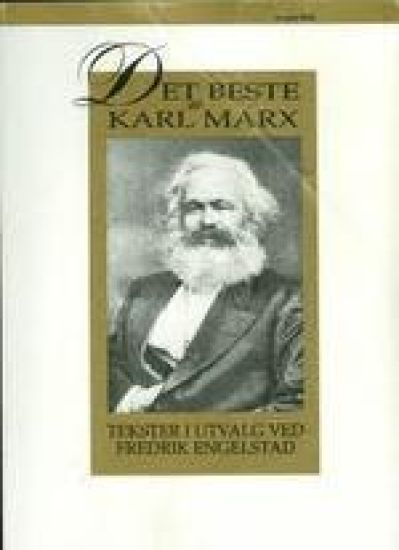
Denne ettbindsutgaven inneholder "det beste" av Karl Marx, hentet fra hans Samlede verker. Utvalget er ved Fredrik Engelstad, som også har laget en generell innledning til tekstene samt innføringer til de ulike delene. Disse tar for seg emner som sosial endring, kunnskapssosiologi, arbeid og utbytting, arbeidsliv og organisasjonsforhold, klasser og klassemotsetninger og det nye samfunnet - alternativer til kapitalismen. Boka inneholder også en kronologisk oversikt over Marx' liv og virke.
The "Complete Works of Karl Marx" represents an extensive compilation of the writings of one of the most influential thinkers in history.This comprehensive collection includes Marx's philosophical, political, economic, and historical works, providing readers with a deep understanding of his revolutionary ideas. Spanning a wide range of topics, from capitalism and communism to class struggle and historical materialism, these works offer profound insights into the development of Marxist theory.This anthology serves as a valuable resource for scholars, students, and anyone interested in the evolution of Marx's thought and its enduring relevance in contemporary discussions of politics, economics, and social justice.