Kirjojen hintavertailu. Mukana 12 392 396 kirjaa ja 12 kauppaa.

Kirjahaku

Etsi kirjoja tekijän nimen, kirjan nimen tai ISBN:n perusteella.

6 kirjaa tekijältä Kate Eichhorn

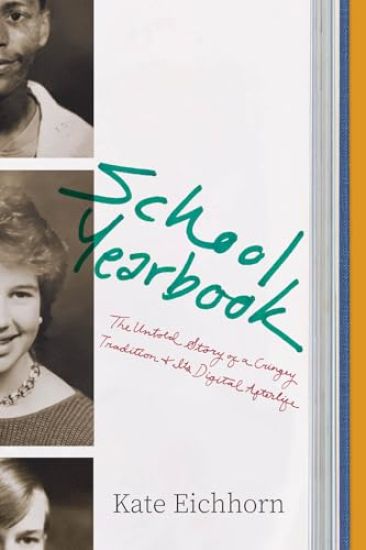
School Yearbook

School Yearbook

Kate Eichhorn

THE UNIVERSITY OF CHICAGO PRESS
2025
sidottu
Why school yearbooks—as frivolous and cringey as they are—are far more than just objects of nostalgia. We’re all familiar with the embarrassment that washes over us when recalling our high school yearbooks. Questionable fashion choices, gravity-defying hair, a melodramatic quote—what were we thinking? Even as school yearbooks decline in popularity among contemporary teens, they continue to impact our lives in shocking ways. Collected, digitized, aggregated, and recombined in ways that would have been impossible to imagine just a few decades ago, yearbooks are no longer bound personal archives of adolescent memories. In the twenty-first century, they are shaping our lives in surprising and sometimes disturbing ways. And what could be a more fitting afterlife for these cringey books? In School Yearbook, cultural critic Kate Eichhorn investigates this ubiquitous object. On the surface, school yearbooks are easily dismissed as innocuous collections of embarrassing photographs and cheesy affirmations, but as Eichhorn reveals, there has never been anything innocent about the school yearbook tradition. Since the early twentieth century, yearbooks have circulated as forms of public relations, propaganda, and hate speech. They have been routinely used by police detectives, private investigators, and even the FBI to identify and profile suspects. With over half a million yearbooks now available online, these books have also acquired the power to continue shaping our lives long after graduation. Would-be landlords, employers, and even creditors can now turn to data culled from their embarrassing pages to make judgments about who we are and what we merit. In a digital era, school yearbooks have acquired the ability to keep judging us in perpetuity. Both timely and insightful, School Yearbook explores how these books have always been used to rank and judge us.
Adjusted Margin

Adjusted Margin

Kate Eichhorn

MIT Press
2016
sidottu
How xerography became a creative medium and political tool, arming artists and activists on the margins with an accessible means of making their messages public. This is the story of how the xerographic copier, or "Xerox machine," became a creative medium for artists and activists during the last few decades of the twentieth century. Paper jams, mangled pages, and even fires made early versions of this clunky office machine a source of fear, rage, dread, and disappointment. But eventually, xerography democratized print culture by making it convenient and affordable for renegade publishers, zinesters, artists, punks, anarchists, queers, feminists, street activists, and others to publish their work and to get their messages out on the street. The xerographic copier adjusted the lived and imagined margins of society, Eichhorn argues, by supporting artistic and political expression and mobilizing subcultural movements. Eichhorn describes early efforts to use xerography to create art and the occasional scapegoating of urban copy shops and xerographic technologies following political panics, using the post-9/11 raid on a Toronto copy shop as her central example. She examines New York's downtown art and punk scenes of the 1970s to 1990s, arguing that xerography-including photocopied posters, mail art, and zines-changed what cities looked like and how we experienced them. And she looks at how a generation of activists and artists deployed the copy machine in AIDS and queer activism while simultaneously introducing the copy machine's gritty, DIY aesthetics into international art markets.Xerographic copy machines are now defunct. Office copiers are digital, and activists rely on social media more than photocopied posters. And yet, Eichhorn argues, even though we now live in a post-xerographic era, the grassroots aesthetics and political legacy of xerography persists.
Content

Content

Kate Eichhorn

MIT PRESS LTD
2022
nidottu
A concise introduction to content and the content industry, from the early internet to the Instagram egg.From the time we roll out of bed to check overnight updates to our last posts, likes, and views of the previous day, we're consuming and producing content. But what does the term “content” even mean? When did it become ubiquitous? And at what cost? In this volume in the MIT Press Essential Knowledge series, Kate Eichhorn offers a concise introduction to content and the content industry, examining the far-reaching effects content has on culture, politics, and labor in a digital age. Eichhorn traces the evolution of our current understanding of content from the early internet to the current social mediaverse. The quintessential example of content, she says, is the Instagram egg—an image that imparted no information or knowledge and circulated simply for the sake of circulation. Eichhorn explores what differentiates user-generated content from content produced by compensated (although often undercompensated) workers; examines how fields from art and literature to journalism and politics have weathered the rise of the content industry; and investigates the increasing importance of artists’ “content capital”—the ability of artists, writers, and performers to produce content not about their work but about their status as artists.
The End of Forgetting

The End of Forgetting

Kate Eichhorn

Harvard University Press
2019
sidottu
Thanks to Facebook and Instagram, our childhoods have been captured and preserved online, never to go away. But what happens when we can’t leave our most embarrassing moments behind?Until recently, the awkward moments of growing up could be forgotten. But today we may be on the verge of losing the ability to leave our pasts behind. In The End of Forgetting, Kate Eichhorn explores what happens when images of our younger selves persist, often remaining just a click away.For today’s teenagers, many of whom spend hours each day posting on social media platforms, efforts to move beyond moments they regret face new and seemingly insurmountable obstacles. Unlike a high school yearbook or a shoebox full of old photos, the information that accumulates on social media is here to stay. What was once fleeting is now documented and tagged, always ready to surface and interrupt our future lives. Moreover, new innovations such as automated facial recognition also mean that the reappearance of our past is increasingly out of our control.Historically, growing up has been about moving on—achieving a safe distance from painful events that typically mark childhood and adolescence. But what happens when one remains tethered to the past? From the earliest days of the internet, critics have been concerned that it would endanger the innocence of childhood. The greater danger, Eichhorn warns, may ultimately be what happens when young adults find they are unable to distance themselves from their pasts. Rather than a childhood cut short by a premature loss of innocence, the real crisis of the digital age may be the specter of a childhood that can never be forgotten.
The Archival Turn in Feminism

The Archival Turn in Feminism

Kate Eichhorn

Temple University Press,U.S.
2013
sidottu
In the 1990s, a generation of women born during the rise of the second wave feminist movement plotted a revolution. These young activists funneled their outrage and energy into creating music, and zines using salvaged audio equipment and stolen time on copy machines. By 2000, the cultural artifacts of this movement had started to migrate from basements and storage units to community and university archives, establishing new sites of storytelling and political activism. The Archival Turn in Feminism chronicles these important cultural artifacts and their collection, cataloging, preservation, and distribution. Cultural studies scholar Kate Eichhorn examines institutions such as the Sallie Bingham Center for Women’s History and Culture at Duke University, The Riot Grrrl Collection at New York University, and the Barnard Zine Library. She also profiles the archivists who have assembled these significant feminist collections. Eichhorn shows why young feminist activists, cultural producers, and scholars embraced the archive, and how they used it to stage political alliances across eras and generations.A volume in the American Literatures Initiative
The Archival Turn in Feminism

The Archival Turn in Feminism

Kate Eichhorn

Temple University Press,U.S.
2014
pokkari
In the 1990s, a generation of women born during the rise of the second wave feminist movement plotted a revolution. These young activists funneled their outrage and energy into creating music, and zines using salvaged audio equipment and stolen time on copy machines. By 2000, the cultural artifacts of this movement had started to migrate from basements and storage units to community and university archives, establishing new sites of storytelling and political activism. The Archival Turn in Feminism chronicles these important cultural artifacts and their collection, cataloging, preservation, and distribution. Cultural studies scholar Kate Eichhorn examines institutions such as the Sallie Bingham Center for Women’s History and Culture at Duke University, The Riot Grrrl Collection at New York University, and the Barnard Zine Library. She also profiles the archivists who have assembled these significant feminist collections. Eichhorn shows why young feminist activists, cultural producers, and scholars embraced the archive, and how they used it to stage political alliances across eras and generations.A volume in the American Literatures Initiative