

Kirjahaku
Etsi kirjoja tekijän nimen, kirjan nimen tai ISBN:n perusteella.
7 kirjaa tekijältä Kathy E. Ferguson

Turning on its head that familiar "woman question," this innovative work poses masculinity as a problem that requires explanation. Ferguson rebukes the sense of coherence contained in patriarchal theory in the name of a voice that both calls upon and challenges the category woman. Stepping back from the opposition of male and female, she artfully loosens the hold of gender on life and meaning, creating and at the same time deconstructing a women's point of view. Posing the "man question" provides a way not only to view male power and female subordination but also to valorize and problematize women's experiences, thus destabilizing conventional notions of man and woman.
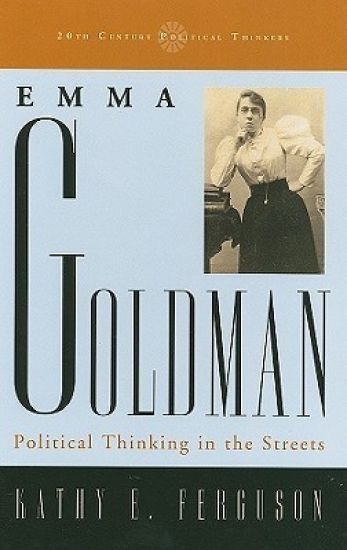
Emma Goldman has often been read for her colorful life story, her lively if troubled sex life, and her wide-ranging political activism. Few have taken her seriously as a political thinker, even though in her lifetime she was a vigorous public intellectual within a global network of progressive politics. Engaging Goldman as a political thinker allows us to rethink the common dualism between theory and practice, scrutinize stereotypes of anarchism by placing Goldman within a fuller historical context, recognize the remarkable contributions of anarchism in creating public life, and open up contemporary politics to the possibilities of transformative feminism.

Emma Goldman has often been read for her colorful life story, her lively if troubled sex life, and her wide-ranging political activism. Few have taken her seriously as a political thinker, even though in her lifetime she was a vigorous public intellectual within a global network of progressive politics. Engaging Goldman as a political thinker allows us to rethink the common dualism between theory and practice, scrutinize stereotypes of anarchism by placing Goldman within a fuller historical context, recognize the remarkable contributions of anarchism in creating public life, and open up contemporary politics to the possibilities of transformative feminism.

Considers what the military presence in Hawai’i tells us about colonialism, gender, race, and class.Everywhere you look in Hawai’i, you might see the military. And yet, in daily life few residents see the military at all-it is hidden in plain sight. This paradox of invisibility and visibility, of the available and the hidden, is the subject of Oh, Say, Can You See?, which maps the power relations involving gender, race, and class that define Hawai’i in relation to the national security state.Western intruders into Hawai’i-from the early explorers, missionaries, and sugar planters to the military, tourists, and foreign investors-have seen the island nation as a feminine place, waiting to embrace those who come to penetrate, protect, mold, and develop, yet conveniently lacking whatever the newcomers claim to possess. Thus feminized, this book contends, the islands and the people have been reinscribed with meanings according to the needs, fears, and desires of outsiders. Authors Kathy E. Ferguson and Phyllis Turnbull locate and “excavate” sites of memory, such as cemeteries, memorials, monuments, and museums, to show how the military constructs its gendered narrative upon prior colonial discourses. Among the sites considered are Fort DeRussy, Pearl Harbor, and Punchbowl Cemetery, as well as the practices of citizenship that are produced or foreclosed by the narratives of order and security written upon Hawai’i by the military.This semiotic investigation of ways the military marks Hawai’i necessarily explores the intersection of immigration, colonialism, military expansion, and tourism on the islands. Attending to the ways in which the military represents itself and others represent the military, the authors locate the particular representational elements that both conceal and reveal the military’s presence and power; in doing so, they seek to expand discursive space so that other voices can be heard. ISBN 0-8166-2978-1 Cloth $49.95xxISBN 0-81662979-X Paper $19.95x240 pages 5 7/8 x 9 DecemberBorderlines Series, Volume 10Translation inquiries: University of Minnesota Press

While the stock image of the anarchist as a masked bomber or brick thrower prevails in the public eye, a more representative figure should be a printer at a printing press. In Letterpress Revolution, Kathy E. Ferguson explores the importance of printers, whose materials galvanized anarchist movements across the United States and Great Britain from the late nineteenth century to the 1940s. Ferguson shows how printers-whether working at presses in homes, offices, or community centers-arranged text, ink, images, graphic markers, and blank space within the architecture of the page. Printers' extensive correspondence with fellow anarchists and the radical ideas they published created dynamic and entangled networks that brought the decentralized anarchist movements together. Printers and presses did more than report on the movement; they were constitutive of it, and their vitality in anarchist communities helps explain anarchism’s remarkable persistence in the face of continuous harassment, arrest, assault, deportation, and exile. By inquiring into the political, material, and aesthetic practices of anarchist print culture, Ferguson points to possible methods for cultivating contemporary political resistance.
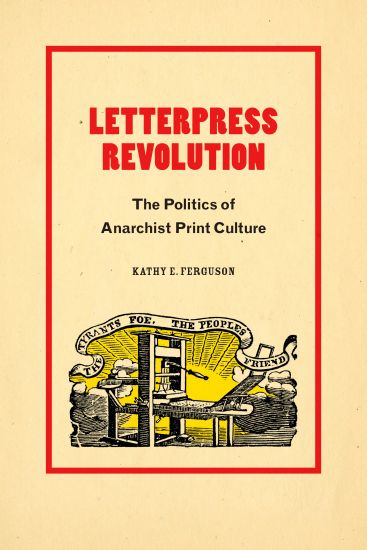
While the stock image of the anarchist as a masked bomber or brick thrower prevails in the public eye, a more representative figure should be a printer at a printing press. In Letterpress Revolution, Kathy E. Ferguson explores the importance of printers, whose materials galvanized anarchist movements across the United States and Great Britain from the late nineteenth century to the 1940s. Ferguson shows how printers-whether working at presses in homes, offices, or community centers-arranged text, ink, images, graphic markers, and blank space within the architecture of the page. Printers' extensive correspondence with fellow anarchists and the radical ideas they published created dynamic and entangled networks that brought the decentralized anarchist movements together. Printers and presses did more than report on the movement; they were constitutive of it, and their vitality in anarchist communities helps explain anarchism’s remarkable persistence in the face of continuous harassment, arrest, assault, deportation, and exile. By inquiring into the political, material, and aesthetic practices of anarchist print culture, Ferguson points to possible methods for cultivating contemporary political resistance.