Kirjojen hintavertailu. Mukana 11 627 467 kirjaa ja 12 kauppaa.

Kirjahaku

Etsi kirjoja tekijän nimen, kirjan nimen tai ISBN:n perusteella.

8 kirjaa tekijältä Keith E. Stanovich

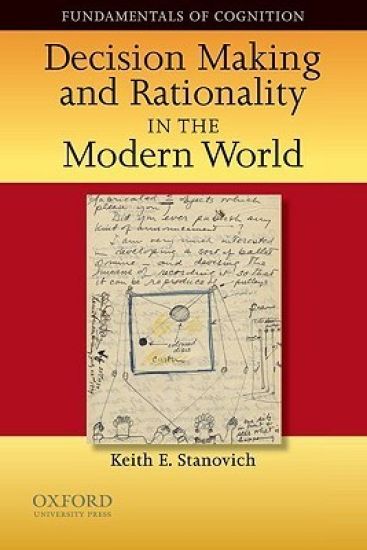
Decision Making and Rationality in the Modern World

Decision Making and Rationality in the Modern World

Keith E. Stanovich

Oxford University Press Inc
2009
nidottu
In Decision Making and Rationality in the Modern World, Keith E. Stanovich demonstrates how work in the cognitive psychology of decision making has implications for the large and theoretically contentious debates about the nature of human rationality. Written specifically for undergraduate psychology students, the book presents a very practical approach to decision making, which is too often perceived by students as an artificial set of skills used only in academia and not in the real world. Instead, Stanovich shows how good decision-making procedures support rational behavior that enables people to act most efficiently to fulfill their goals. He explains how the concept of rationality is understood in cognitive science in terms of good decision making and judgment. Books in the Fundamentals of Cognition series serve as ideal instructional resources for advanced courses in cognitive psychology. They provide an up-to-date, well-organized survey of our current understanding of the major theories of cognitive psychology. The books are concise, which allows instructors to incorporate the latest original research and readings into their courses without overburdening their students. Focused without being too advanced--and comprehensive without being too broad--these books are the perfect resource for both students and instructors.
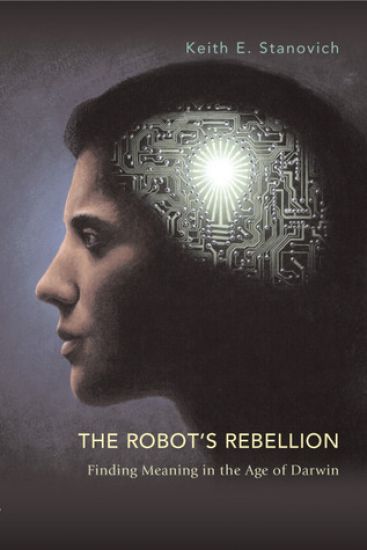
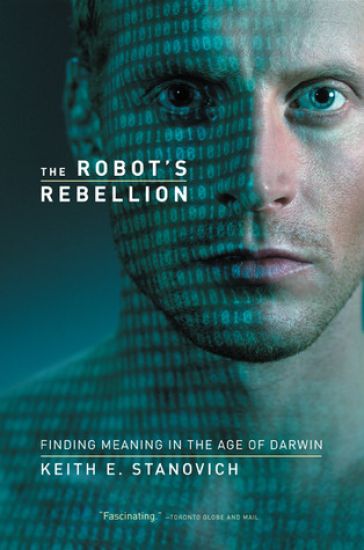
The Robot's Rebellion

The Robot's Rebellion

Keith E. Stanovich

University of Chicago Press
2004
sidottu
The idea that we might be robots is no longer the stuff of science fiction; decades of research in evolutionary biology and cognitive science have led many esteemed thinkers and scientists to the conclusion that, following the precepts of universal Darwinism, humans are merely the hosts for two replicators (genes and memes) that have no interest in us except as conduits for replication. Accepting and now forcefully responding to this disturbing idea that precludes the possibilities of morality or free will, among other things, Keith Stanovich here provides the tools for the "robot's rebellion," a program of cognitive reform necessary to advance human interests over the limited interest of the replicators. He shows how concepts of rational thinking from cognitive science interact with the logic of evolution to create opportunities for humans to structure their behavior to serve their own ends. These evaluative activities of the brain, he argues, fulfill the need that we have to ascribe significance to human life. Only by recognizing ourselves as robots, argues Stanovich, can we begin to construct a concept of self based on what is truly singular about humans: that they gain control of their lives in a way unique among life forms on Earth - through rational self-determination.
The Robot's Rebellion

The Robot's Rebellion

Keith E. Stanovich

University of Chicago Press
2005
nidottu
The idea that we might be robots is no longer the stuff of science fiction; decades of research in evolutionary biology and cognitive science have led many esteemed thinkers and scientists to the conclusion that, following the precepts of universal Darwinism, humans are merely the hosts for two replicators (genes and memes) that have no interest in us except as conduits for replication. Accepting and now forcefully responding to this disturbing idea that precludes the possibilities of morality or free will, among other things, Keith Stanovich here provides the tools for the "robot's rebellion," a program of cognitive reform necessary to advance human interests over the limited interest of the replicators. He shows how concepts of rational thinking from cognitive science interact with the logic of evolution to create opportunities for humans to structure their behavior to serve their own ends. These evaluative activities of the brain, he argues, fulfill the need that we have to ascribe significance to human life. Only by recognizing ourselves as robots, argues Stanovich, can we begin to construct a concept of self based on what is truly singular about humans: that they gain control of their lives in a way unique among life forms on Earth - through rational self-determination.
The Bias That Divides Us

The Bias That Divides Us

Keith E. Stanovich

MIT Press
2021
sidottu
Why we don't live in a post-truth society but rather a myside society: what science tells us about the bias that poisons our politics. In The Bias That Divides Us, psychologist Keith Stanovich argues provocatively that we don't live in a post-truth society, as has been claimed, but rather a myside society. Our problem is not that we are unable to value and respect truth and facts, but that we are unable to agree on commonly accepted truth and facts. We believe that our side knows the truth. Post-truth? That describes the other side. The inevitable result is political polarization. Stanovich shows what science can tell us about myside bias: how common it is, how to avoid it, and what purposes it serves. Stanovich explains that although myside bias is ubiquitous, it is an outlier among cognitive biases. It is unpredictable. Intelligence does not inoculate against it, and myside bias in one domain is not a good indicator of bias shown in any other domain. Stanovich argues that because of its outlier status, myside bias creates a true blind spot among the cognitive elite--those who are high in intelligence, executive functioning, or other valued psychological dispositions. They may consider themselves unbiased and purely rational in their thinking, but in fact they are just as biased as everyone else. Stanovich investigates how this bias blind spot contributes to our current ideologically polarized politics, connecting it to another recent trend: the decline of trust in university research as a disinterested arbiter.
What Intelligence Tests Miss

What Intelligence Tests Miss

Keith E. Stanovich

Yale University Press
2010
pokkari
An engaging discussion of the important cognitive characteristics missing from IQ tests Critics of intelligence tests—writers such as Robert Sternberg, Howard Gardner, and Daniel Goleman—have argued in recent years that these tests neglect important qualities such as emotion, empathy, and interpersonal skills. However, such critiques imply that though intelligence tests may miss certain key noncognitive areas, they encompass most of what is important in the cognitive domain. In this book, Keith E. Stanovich challenges this widely held assumption.Stanovich shows that IQ tests (or their proxies, such as the SAT) are radically incomplete as measures of cognitive functioning. They fail to assess traits that most people associate with “good thinking,” skills such as judgment and decision making. Such cognitive skills are crucial to real-world behavior, affecting the way we plan, evaluate critical evidence, judge risks and probabilities, and make effective decisions. IQ tests fail to assess these skills of rational thought, even though they are measurable cognitive processes. Rational thought is just as important as intelligence, Stanovich argues, and it should be valued as highly as the abilities currently measured on intelligence tests.
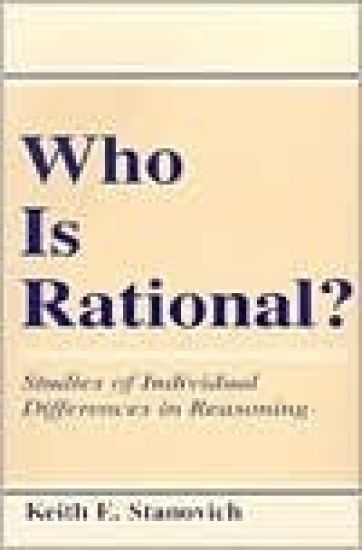
Who Is Rational?

Who Is Rational?

Keith E. Stanovich

Psychology Press
1999
sidottu
Integrating a decade-long program of empirical research with current cognitive theory, this book demonstrates that psychological research has profound implications for current debates about what it means to be rational. The author brings new evidence to bear on these issues by demonstrating that patterns of individual differences--largely ignored in disputes about human rationality--have strong implications for explanations of the gap between normative and descriptive models of human behavior. Separate chapters show how patterns of individual differences have implications for all of the major critiques of purported demonstrations of human irrationality in the heuristics and biases literature. In these critiques, it has been posited that experimenters have observed performance errors rather than systematically irrational responses; the tasks have required computational operations that exceed human cognitive capacity; experimenters have applied the wrong normative model to the task; and participants have misinterpreted the tasks. In a comprehensive set of studies, Stanovich demonstrates that gaps between normative and descriptive models of performance on some tasks can be accounted for by positing these alternative explanations, but that not all discrepancies from normative models can be so explained. Individual differences in rational thought can in part be predicted by psychological dispositions that are interpreted as characteristic biases in people's intentional-level psychologies. Presenting the most comprehensive examination of individual differences in the heuristics and biases literature that has yet been published, experiments and theoretical insights in this volume contextualize the heuristics and biases literature exemplified in the work of various investigators.
Who Is Rational?

Who Is Rational?

Keith E. Stanovich

Psychology Press
1999
nidottu
Integrating a decade-long program of empirical research with current cognitive theory, this book demonstrates that psychological research has profound implications for current debates about what it means to be rational. The author brings new evidence to bear on these issues by demonstrating that patterns of individual differences--largely ignored in disputes about human rationality--have strong implications for explanations of the gap between normative and descriptive models of human behavior. Separate chapters show how patterns of individual differences have implications for all of the major critiques of purported demonstrations of human irrationality in the heuristics and biases literature. In these critiques, it has been posited that experimenters have observed performance errors rather than systematically irrational responses; the tasks have required computational operations that exceed human cognitive capacity; experimenters have applied the wrong normative model to the task; and participants have misinterpreted the tasks. In a comprehensive set of studies, Stanovich demonstrates that gaps between normative and descriptive models of performance on some tasks can be accounted for by positing these alternative explanations, but that not all discrepancies from normative models can be so explained. Individual differences in rational thought can in part be predicted by psychological dispositions that are interpreted as characteristic biases in people's intentional-level psychologies. Presenting the most comprehensive examination of individual differences in the heuristics and biases literature that has yet been published, experiments and theoretical insights in this volume contextualize the heuristics and biases literature exemplified in the work of various investigators.
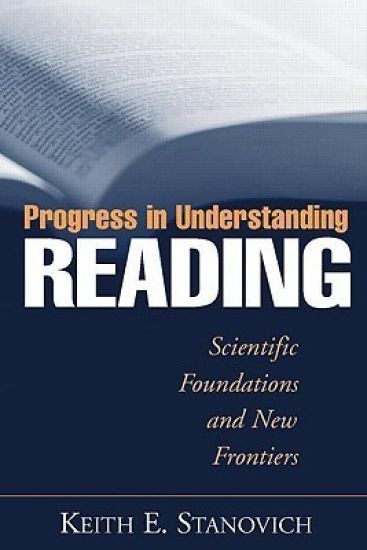
Progress in Understanding Reading

Progress in Understanding Reading

Keith E. Stanovich

Guilford Publications
2001
sidottu
The last 25 years have seen tremendous advances in the study of psychological processes in reading. Our growing body of knowledge on the reading process and reading acquisition has applications to such important problems as the prevention of reading difficulties and the identification of effective instructional practices. This volume summarizes the gains that have been made in key areas of reading research and provides authoritative insights on current controversies and debates. From one of the most accomplished and widely cited scholars in the field, the volume is divided into seven parts. Each part begins with a new introductory chapter presenting up-to-date findings on the topic at hand, followed by one or more classic papers from the author's exemplary research program. Significant issues covered include phonological processes and context effects in reading, the "reading wars" and how they should be resolved, the meaning of the term "dyslexia," and the cognitive effects and benefits of reading.