Kirjojen hintavertailu. Mukana 11 244 527 kirjaa ja 12 kauppaa.

Kirjahaku

Etsi kirjoja tekijän nimen, kirjan nimen tai ISBN:n perusteella.

4 kirjaa tekijältä Keith Kendig

Sink or Float?

Sink or Float?

Keith Kendig

Mathematical Association of America
2008
sidottu
This collection of problems drawn from mathematics and the real world reveals just how much can be learned by using everyday common sense. Its easily understandable style will hook school students and professional mathematicians alike. The more than 250 questions cover a wide range of classical mathematics and physics, with a solution and explanation provided for each one. A generous sprinkling of boxes appear throughout the text containing historical asides or little-known facts, which help make the book a starting point for some interesting discussions. The problems themselves can easily turn into serious debate-starters, and the book will find a natural home in the classroom. Often a single concrete problem represents an introduction to a more general concept or method of solution that the student will encounter later on. Conversely, a quick, common-sense solution to a problem can represent a surprising alternative to applying the standard but more lengthy technique.
A Guide to Plane Algebraic Curves

A Guide to Plane Algebraic Curves

Keith Kendig

Mathematical Association of America
2011
sidottu
This is an informal and accessible introduction to plane algebraic curves that also serves as a natural entry point to algebraic geometry. There is a unifying theme to the book: give curves enough living space and beautiful theorems will follow. This book provides the reader with a solid intuition for the subject, while at the same time keeping the exposition simple and understandable, by introducing abstract concepts with concrete examples and pictures. It can be used as the text for an undergraduate course on plane algebraic curves, or as a companion to algebraic geometry at graduate level. This book is accessible to those with a limited mathematical background. This is because for those outside mathematics there is a growing need for an entree to algebraic geometry, a need created by the ever-expanding role algebraic geometry is playing in areas ranging from biology to chemistry and robotics to cryptology.
Never a Dull Moment

Never a Dull Moment

Keith Kendig

American Mathematical Society
2018
nidottu
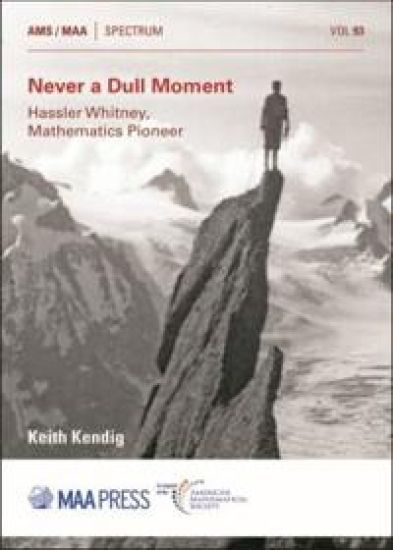
Hassler Whitney was a giant of twentieth-century mathematics. This biography paints a picture of him and includes dozens of revealing anecdotes. Mathematically, he had a rare detector that went off whenever he spotted a piece of mathematical gold, and he would then draw countless pictures, gradually forging a path from hunch to proof. This geometric path is seldom reflected in the rigor of his formal papers, but thanks to a close friendship and many conversations over decades, author Kendig was able to see how he actually worked. This book shows this through accessible accounts of his major mathematical contributions, with figures copiously supplied.Whitney is probably best known for introducing the grandfather of today's innumerable embedding theorems--his strong embedding theorem stating that any smooth manifold can be smoothly embedded in a Euclidean space of twice the manifold's dimension. This in turn led to several standard techniques used every day in algebraic topology. Whitney also established the fundamentals of graph theory, the four-color problem, matroids, extending smooth functions, and singularities of smooth functions. He almost never used complicated technical machinery, so most of his work is accessible to a general reader with a modest mathematical background.His math-music connection was intense: He played piano, violin, and viola and won ``best composition of the year'' while earning a Bachelor's degree in music at Yale. He was an accomplished mountain climber, and as a tinkerer, at age sixteen he built the large-format camera used to take this book's cover photograph. Whitney's family generously provided dozens of photographs appearing here for the very first time. This biography is a revealing portrait of a fascinating personality and a titan of twentieth-century mathematics.
A Gateway to Number Theory

A Gateway to Number Theory

Keith Kendig

American Mathematical Society
2021
nidottu
Challenge: Can you find all the integers $a$, $b$, $c$ satisfying $2a^{2} + 3b^{2} = 5c^{2}$? Looks simple, and there are in fact a number of easy solutions. But most of them turn out to be anything but obvious! There are infinitely many possibilities, and as any computer will tell you, each of $a$, $b$, $c$ will usually be large. So the challenge remains ... Find all integers$a$, $b$, $c$satisfying$2a^{2} + 3b^{2} = 5c^{2}$.A major advance in number theory means this book can give an easy answer to this and countless similar questions. The idea behind the approach is transforming a degree-two equation in integer variables $a$, $b$, $c$ into a plane curve defined by a polynomial. Working with the curve makes obtaining solutions far easier, and the geometric solutions then get translated back into integers. This method morphs hard problems into routine ones and typically requires no more than high school math. (The complete solution to $2a^{2} + 3b^{2} = 5c^{2}$ is included in the book.) In addition to equations of degree two, the book addresses degree-three equations--a branch of number theory that is today something of a cottage industry, and these problems translate into ""elliptic curves''. This important part of the book includes many pictures along with the exposition, making the material meaningful and easy to grasp.This book will fit nicely into an introductory course on number theory. In addition, the many solved examples, illustrations, and exercises make self-studying the book an option for students, thus becoming a natural candidate for a capstone course.