Kirjojen hintavertailu. Mukana 11 244 527 kirjaa ja 12 kauppaa.

Kirjahaku

Etsi kirjoja tekijän nimen, kirjan nimen tai ISBN:n perusteella.

11 kirjaa tekijältä Keith Lehrer

Exemplars of Truth

Exemplars of Truth

Keith Lehrer

Oxford University Press Inc
2019
sidottu
This monograph is both an intellectual summation as well as a philosophical advancement of key themes of the work of Keith Lehrer on several key topics--including knowledge, self-trust, autonomy, and consciousness. He here attempts to integrate these themes and develop an intellectual system that can constructively solve philosophical problems. The system is indebted to the modern work of Sellars, Quine, and Chisholm, as well as historically to Hume and Reid. At the core of this system lies Lehrer's theory of knowledge, which he previously called a coherence theory of knowledge but now calls a defensibility theory. Lehrer argues that knowledge requires the capacity to justify or defend the target claim of knowledge in terms of a background system. Defensibility is an internal capacity supplied by that system to meet objections to the claim. This theory however leaves open the problem of "experience"--noted by other philosophers--i.e. how to explain the special role of experience in a background system even granted we are fallible in describing it. Lehrer offers a solution to the problem of experience, arguing that reflection on experience converts the experience itself into an exemplar, something like a sample that becomes a vehicle or term of representation. The exemplar represents itself and extends to represent the external world. It exhibits something about evidence and truth concerning experience that, as Wittgenstein noted, cannot be fully described but can only be shown. Exemplar representation is the missing link of a background system to truth about the world.

Art, Self and Knowledge

Art, Self and Knowledge

Keith Lehrer

Oxford University Press Inc
2011
sidottu
Art can provide us with a sensory experience that provokes us to reconfigure how we think about our world and ourselves. Theories of art have often sought to find some feature of art that isolates it from the rest of experience. Keith Lehrer argues, in opposition, that art is connected, not isolated, from how we think and feel, represent and react. When art directs our attention to sensory exemplars in aesthetic experience of which we become conscious in a special way, it also shows us our autonomy as we represent ourselves and our world, ourselves in our world, and our world in ourselves. This form of representation, exemplar representation, uses the exemplar as a term of representation and exhibits the nature of the content it represents in terms of itself. It shows us both what our world is like and how we represent the world thereby revealing the nature of intentionality to us. Issues of general interest in philosophy such as knowledge, autonomy, rationality and self-trust enter the book along with more specifically aesthetic issues of formalism, expressionism, representation, artistic creativity and beauty. The author goes on to demonstrate how the connection between art and broader issues of feminism, globalization, collective wisdom, and death show us the connection between art, life, politics and the self. Drawing from Hume, Reid, Goodman, Danto, Brand, Ismael and Lopes, Lehrer argues here that the artwork is a mentalized physical object engaging us philosophically with the content of exemplar experience. The exemplar representation of experience provoked by art ties art and science, mind and body, self and world, together in a dynamic loop, reconfiguring them all as it reconfigures art itself.
Art, Self and Knowledge

Art, Self and Knowledge

Keith Lehrer

Oxford University Press Inc
2011
nidottu
Art can provide us with a sensory experience that provokes us to reconfigure how we think about our world and ourselves. Theories of art have often sought to find some feature of art that isolates it from the rest of experience. Keith Lehrer argues, in opposition, that art is connected, not isolated, from how we think and feel, represent and react. When art directs our attention to sensory exemplars in aesthetic experience of which we become conscious in a special way, it also shows us our autonomy as we represent ourselves and our world, ourselves in our world, and our world in ourselves. This form of representation, exemplar representation, uses the exemplar as a term of representation and exhibits the nature of the content it represents in terms of itself. It shows us both what our world is like and how we represent the world thereby revealing the nature of intentionality to us. Issues of general interest in philosophy such as knowledge, autonomy, rationality and self-trust enter the book along with more specifically aesthetic issues of formalism, expressionism, representation, artistic creativity and beauty. The author goes on to demonstrate how the connection between art and broader issues of feminism, globalization, collective wisdom, and death show us the connection between art, life, politics and the self. Drawing from Hume, Reid, Goodman, Danto, Brand, Ismael and Lopes, Lehrer argues here that the artwork is a mentalized physical object engaging us philosophically with the content of exemplar experience. The exemplar representation of experience provoked by art ties art and science, mind and body, self and world, together in a dynamic loop, reconfiguring them all as it reconfigures art itself.
Ultimate Freedom

Ultimate Freedom

Keith Lehrer

OXFORD UNIVERSITY PRESS INC
2023
sidottu
Philosopher Keith Lehrer outlines a view of freedom of choice based on a Kahneman-derived distinction between what he calls a first order system that is intuitive and immediate, and a higher order system of response, which he calls a second system of scientific analysis. Lehrer argues that freedom of choice is an expression of attention to the higher order system, and that what is often called free will is often just doing what you desire, a response that neglects consideration of other options. Freedom of choice acknowledges those options, and preference among them forms in response to the acceptance of evidence. We might suppose that in responding to beliefs that one has attended to evidence, but that is a delusion, because our higher order acceptance of evidence can be overwhelmed by the fixation created by first level belief. What is the difference between just doing what you desire because it feels good and acting on what you prefer because of scientific acceptance? Lehrer points to a form of preference that he says is the ultimate explanation of choice -- what he calls a power preference. It is a preference that loops back on to itself, a fixed-point vector, and suffices to explain choice. Lehrer's theory of such a power preference includes scientific explanation and consistently accommodates determinism. It is itself a scientific and philosophical explanation, and an ultimate principle of explanation. Lehrer terms the freedom of choice expressing that preference “ultimate freedom”-- the source of our knowledge and agency both in theory, directing what we rationally accept, and in practice directing freedom of choice.
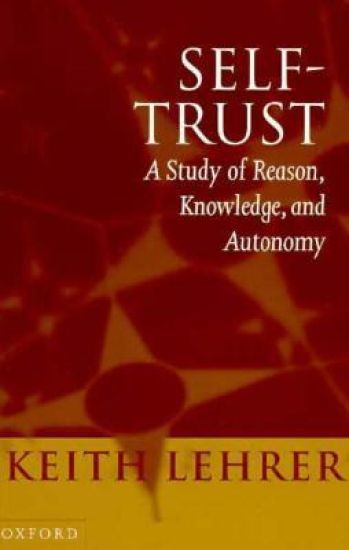
Self-Trust

Self-Trust

Keith Lehrer

Clarendon Press
1997
sidottu
Keith Lehrer offers an original philosophical view of principal aspects of the human condition, such as reason, knowledge, wisdom, autonomy, love, consensus, and consciousness. Three unifying ideas run through the book. The first is that what is uniquely human is the capacity for metamental ascent, the ability to consider and evaluate first-order mental states (such as beliefs and desires) that arise naturally within us. A primary function of this metamental ascent is the resolution of personal and interpersonal conflict, essential to such central human goods as wisdom, autonomy, and consensus. The second unifying idea is that we have a system for such reflective evaluation which yields acceptance (in relation to beliefs) or preference (in relation to the objects of desires). The third unifying idea is that there are `keystones' of evaluation in this system: loops of trustworthiness that are themselves supported by the structure that they hold together. Self-trust is the basis of our trustworthiness, on which reason, knowledge, and wisdom are grounded.
Self-Trust

Self-Trust

Keith Lehrer

Clarendon Press
1997
nidottu
Keith Lehrer offers an original philosophical view of principal aspects of the human condition, such as reason, knowledge, wisdom, autonomy, love, consensus, and consciousness. Three unifying ideas run through the book. The first is that what is uniquely human is the capacity for metamental ascent, the ability to consider and evaluate first-order mental states (such as beliefs and desires) that arise naturally within us. A primary function of this metamental ascent is the resolution of personal and interpersonal conflict, essential to such central human goods as wisdom, autonomy, and consensus. The second unifying idea is that we have a system for such reflective evaluation which yields acceptance (in relation to beliefs) or preference (in relation to the objects of desires). The third unifying idea is that there are `keystones' of evaluation in this system: loops of trustworthiness that are themselves supported by the structure that they hold together. Self-trust is the basis of our trustworthiness, on which reason, knowledge, and wisdom are grounded.
Metamind

Metamind

Keith Lehrer

Clarendon Press
1990
sidottu
The essays in this book, published here as a collection for the first time, are unified by the thesis that freedom, rationality, social consensus, and knowledge depend on thoughts about thoughts, that is, on metamental operations. These provide for our optionality, plasticity, and most of all for the evaluation and control of lower-level information. The collection argues that the human mind is essentially a metamind.
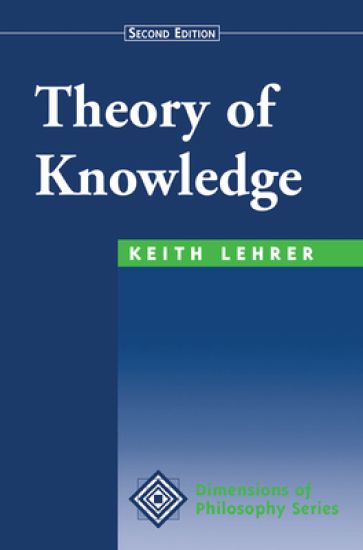
Theory Of Knowledge

Theory Of Knowledge

Keith Lehrer

Routledge
2019
sidottu
In this impressive second edition of Theory of Knowledge, Keith Lehrer introduces students to the major traditional and contemporary accounts of knowing. Beginning with the traditional definition of knowledge as justified true belief, Lehrer explores the truth, belief, and justification conditions on the way to a thorough examination of foundation
Reid-Arg Philosophers

Reid-Arg Philosophers

Keith Lehrer

Routledge
1999
sidottu
This book is available either individually, or as part of the specially-priced Arguments of the Philosphers Collection. The purpose of this series is to provide a contemporary assessment and history of the entire course of philosophical thought. Each book constitutes a detailed, critical introduction to the work of a philosopher of major influence and significance. The author's reason for writing this book is that the philosophy of Thomas Reid is widely unread, while the combination of soundness and creativity of his work is unexcelled.
Reid-Arg Philosophers

Reid-Arg Philosophers

Keith Lehrer

Routledge
2008
nidottu
This book is available either individually, or as part of the specially-priced Arguments of the Philosphers Collection. The purpose of this series is to provide a contemporary assessment and history of the entire course of philosophical thought. Each book constitutes a detailed, critical introduction to the work of a philosopher of major influence and significance. The author's reason for writing this book is that the philosophy of Thomas Reid is widely unread, while the combination of soundness and creativity of his work is unexcelled.
Theory Of Knowledge

Theory Of Knowledge

Keith Lehrer

Westview Press Inc
2000
nidottu
In this impressive second edition of Theory of Knowledge, Keith Lehrer introduces students to the major traditional and contemporary accounts of knowing. Beginning with the traditional definition of knowledge as justified true belief, Lehrer explores the truth, belief, and justification conditions on the way to a thorough examination of foundation theories of knowledge,the work of Platinga, externalism and naturalized epistemologies, internalism and modern coherence theories, contextualism, and recent reliabilist and causal theories. Lehrer gives all views careful examination and concludes that external factors must be matched by appropriate internal factors to yield knowledge. This match of internal and external factors follows from Lehrer's new coherence theory of undefeated justification. In addition to doing justice to the living epistemological traditions, the text smoothly integrates several new lines that will interest scholars. Also, a feature of special interest is Lehrer's concept of a justification game.This second edition of Theory of Knowledge is a thoroughly revised and updated version that contains several completely new chapters. Written by a well-known scholar and contributor to modern epistemology, this text is distinguished by clarity of structure, accessible writing, and an elegant mix of traditional material, contemporary ideas, and well-motivated innovation.