Kirjojen hintavertailu. Mukana 11 342 296 kirjaa ja 12 kauppaa.

Kirjahaku

Etsi kirjoja tekijän nimen, kirjan nimen tai ISBN:n perusteella.

13 kirjaa tekijältä Keith S. Folse

Teaching Vocabulary Is the Writing Teacher's Job

Teaching Vocabulary Is the Writing Teacher's Job

Keith S. Folse

THE UNIVERSITY OF MICHIGAN PRESS
2023
nidottu
While most teachers acknowledge the importance of vocabulary in learning a new language, many assume a reading class or other teacher will cover vocabulary. Yet vocabulary plays an essential role in good writing, especially academic writing. Teaching Vocabulary Is the Writing Teacher’s Job explores the serious nature of ESL students’ lexical plight and looks at vocabulary in relation to reading, speaking, listening, and writing proficiency. It also examines the role of vocabulary in ESL writing assessment. In the conclusion, author Keith Folse discusses eight research-based suggestions for writing teachers, including encouraging students to become vocabulary detectives, teaching collocations, testing vocabulary, and teaching paraphrasing and summarizing.
Vocabulary Myths

Vocabulary Myths

Keith S. Folse

The University of Michigan Press
2004
nidottu
In Vocabulary Myths, Keith S. Folse breaks down the teaching of second language vocabulary into eight commonly held myths. In debunking each myth, he introduces the myth with a story based on his 25 years of teaching experience (in the United States and abroad), continues with a presentation of what empirical research has shown on the topic, and finishes with a list of what teachers can do in their classrooms to facilitate true vocabulary acquisition.The goal of Vocabulary Myths is to foster a paradigm shift that correctly views vocabulary as fundamental in any second language learning process and demonstrates that research supports this goal-that in fact there is a wealth of empirical evidence to support these views. In addition, an important theme is that teachers have overestimated how much vocabulary students really understand, and as a result, the so-called "comprehensible input" is neither comprehensible nor input.The second language vocabulary acquisition myths reexamined in this book are:*In learning another language, vocabulary is not as important as grammar or other areas.*Using word lists to learn L2 vocabulary is unproductive.*Presenting new vocabulary in semantic sets facilitates learning.*The use of translations to learn new vocabulary should be discouraged.*Guessing words from context is an excellent strategy for learning L2 vocabulary.*The best vocabulary learners make use of one or two really specific vocabulary learning strategies.*The best dictionary for L2 learners is a monolingual dictionary.*Teachers, textbooks, and curricula cover L2 vocabulary adequately.
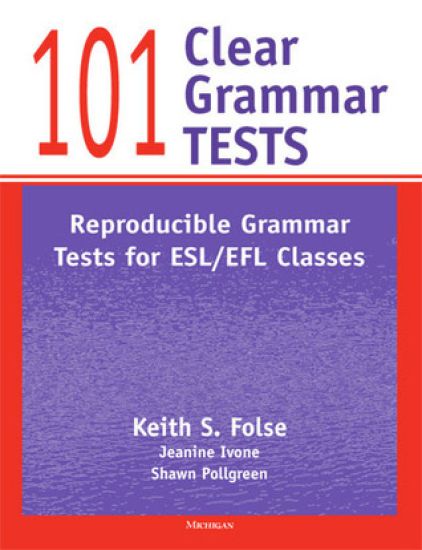
101 Clear Grammar Tests

101 Clear Grammar Tests

Keith S. Folse

The University of Michigan Press
2005
nidottu
101 Clear Grammar Tests contains 101 reproducible tests on common points in the teaching of beginning, intermediate, and advanced ESL grammar. This collection of tests includes a variety of question types and reflects a range of different approaches to testing. As a result, busy teachers will be able to easily find tests that resemble the teaching and learning styles of their own classrooms. The tests in this book are arranged by topic, with two tests per grammar point, in a sequence that matches the one found in the Clear Grammar textbooks, Books 1-4. This test bank also contains a bonus-nine comprehensive advanced grammar tests. Like its predecessor (100 Clear Grammar Tests), this book can be used along with any other ESL grammar series.
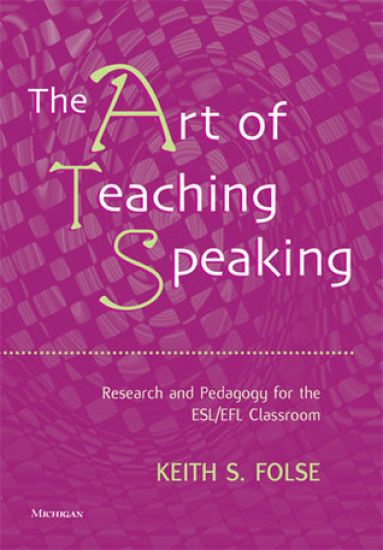
The Art of Teaching Speaking

The Art of Teaching Speaking

Keith S. Folse

The University of Michigan Press
2006
nidottu
*What elements make a speaking activity successful? *Which tasks or activities really help build speaking fluency? *What does the research show regarding speaking activities?*What mistakes do ESL teachers often make in speaking activity design?In this highly accessible and practical resource, Keith S. Folse provides a wealth of information to help ESL/EFL teachers design and use speaking tasks that will actually improve students' speaking fluency. The book presents and discusses the relevant research and assessment issues and includes case studies from twenty different settings and classrooms around the world so that readers learn from others about the problems and successes of using various speaking activities. Teachers will find the chapters on Twenty Successful Activities and Ten Unsuccessful Activities particularly valuable. The successful activities are provided for classroom use and are reproducible. The book also contains five appendixes that explain what teachers need to know about vocabulary, pronunciation, and grammar and how they affect the teaching of speaking. Samples of successful lesson plans and a list of resources useful for teaching speaking are also included.Keith S. Folse, Ph.D., is Coordinator, TESOL Programs, University of Central Florida (Orlando). He is the author of Vocabulary Myths (University of Michigan Press, 2004) and more than 35 second language textbooks, including texts on grammar, reading, speaking, listening, and writing.
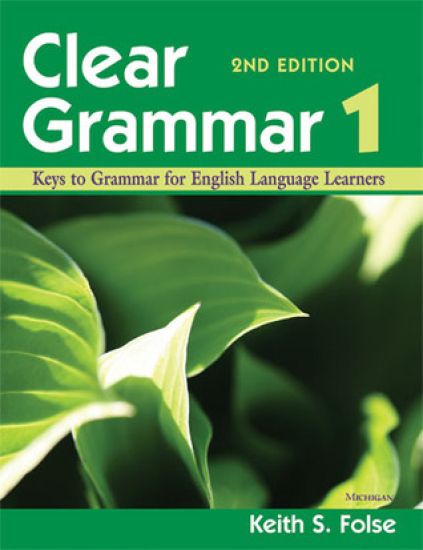
Clear Grammar 1, 2nd Edition

Clear Grammar 1, 2nd Edition

Keith S. Folse

The University of Michigan Press
2010
nidottu
Clear Grammar is a four-level grammar series that features a unique combination of useful grammar information written in clear language with activities that promote more accurate and fluent vocabulary usage, writing, speaking, and reading. Important features of all four new editions of Clear Grammar include:More user-friendly charts to accompany grammar explanations High-frequency, corpus-based vocabulary related to each grammar point Grammar discovery tasks using students’ inductive learning skills A greater variety and increased number of activities, including more practice online Many more activities at the longer discourse level The addition of reading practice at the end of the unit, as well a critical-reading task More writing practice, including one on editing student writing and another for original student writing Two vocabulary practice activities, including a focus on collocations, in each unit, as well as many one-minute mini lessons showing the connection between grammar and vocabulary More speaking practice, with activities that require students to speak and listen to each other while using the target grammar Support for teachers in the form of indicators that reference how to teach the grammar points in the Clear Grammar series from Keys to Teaching Grammar for English Language Learners by Keith S. Folse (978-0-472-03220-4). Clear Grammar 1 offers students and teachers a solid introduction to beginning-level grammar. It also includes an introduction to the present perfect. Clear Grammar 1, 2nd Ed., includes Present tense of be and regular verbs Possessive adjectives and demonstrative words Descriptive adjectives Past tense of be, regular, and irregular verbs Wh- questions Present progressive Count vs. non-count nouns Prepositions Be going to + Verb Review of verb tensesThe book's companion website includes the additional grammar/vocabulary activities indicated in the textbook.
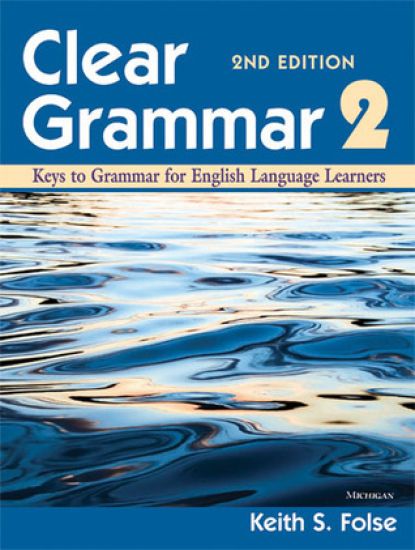
Clear Grammar 2, 2nd Edition

Clear Grammar 2, 2nd Edition

Keith S. Folse

The University of Michigan Press
2012
nidottu
Clear Grammar is a four-level grammar series that features a unique combination of useful grammar information written in clear language with activities that promote more accurate and fluent vocabulary usage, writing, speaking, and reading. Important features of all four new editions of Clear Grammar include:More user-friendly charts to accompany grammar explanations High-frequency, corpus-based vocabulary related to each grammar point Grammar discovery tasks using students’ inductive learning skills A greater variety and increased number of activities, including more practice online Many more activities at the longer discourse level The addition of reading practice at the end of the unit, as well a critical-reading task More writing practice, including one on editing student writing and another for original student writing Two vocabulary practice activities, including a focus on collocations, in each unit, as well as many one-minute mini lessons showing the connection between grammar and vocabulary More speaking practice, with activities that require students to speak and listen to each other while using the target grammar Support for teachers in the form of indicators that reference how to teach the grammar points in the Clear Grammar series from Keys to Teaching Grammar for English Language Learners by Keith S. Folse (978-0-472-03220-4). Clear Grammar 2 offers students and teachers a solid introduction to low-intermediate grammar. Clear Grammar 2, 2nd Ed., includes* Articles* Past tense of irregular verbs * Present perfect tense * Adverbs of frequency * Nouns used as adjectives* Object pronouns* Past progressive tense* One and Other* Possessives *Comparatives and superlatives *ModalsThe book's companion website includes the additional grammar/vocabulary activities that are referenced in the textbook.
Clear Grammar 3, 2nd Edition

Clear Grammar 3, 2nd Edition

Keith S. Folse

The University of Michigan Press
2015
nidottu
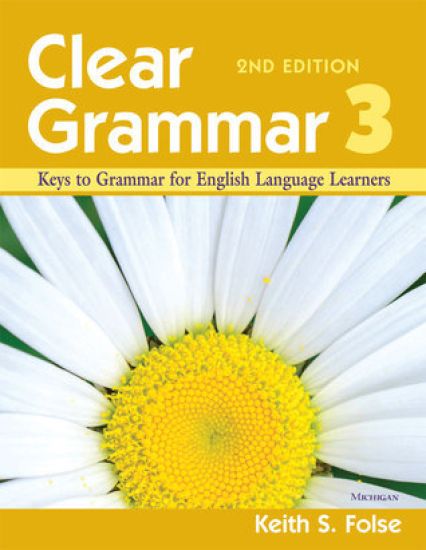
Clear Grammar 3 introduces high-intermediate grammar. Clear Grammar 3, 2nd Ed., includes phrasal verbs infinitives and gerunds participial adjectives: -ing and -ed prepositions after verbs, adjectives, and nouns passive voice adjective clauses adverbs connectors review of verb tenses Clear Grammar 3 concludes with a review of this volume’s contents of high-intermediate grammar points. Clear Grammar is a four-level grammar series that features a unique combination of useful grammar information written in clear language with activities that promote more accurate and fluent writing, speaking, reading, and vocabulary usage. Important features of the new editions of Clear Grammar include:More user-friendly charts to accompany grammar explanations High-frequency, corpus-informed vocabulary related to each grammar point Grammar discovery tasks using students’ inductive learning skills A greater variety and more activities, including practice online (www.press.umich.edu/esl/compsite/cleargrammar/) Many more activities at the longer discourse level The addition of reading practice at the end, plus a critical-reading task More writing practice, including one on editing student writing and another for original student writing Two vocabulary practice activities per unit, with one on collocations; plus many one-minute lessons showing the connection between grammar and vocabulary More speaking practice, with activities that require students to speak and listen to each other while using the target grammar Support for teachers in the form of indicators that reference how to teach the grammar points in the Clear Grammar series from Keys to Teaching Grammar for English Language Learners by Keith S. Folse (978-0-472-03220-4).
Keys to Teaching Grammar to English Language Learners, Second Ed.

Keys to Teaching Grammar to English Language Learners, Second Ed.

Keith S. Folse

The University of Michigan Press
2016
nidottu
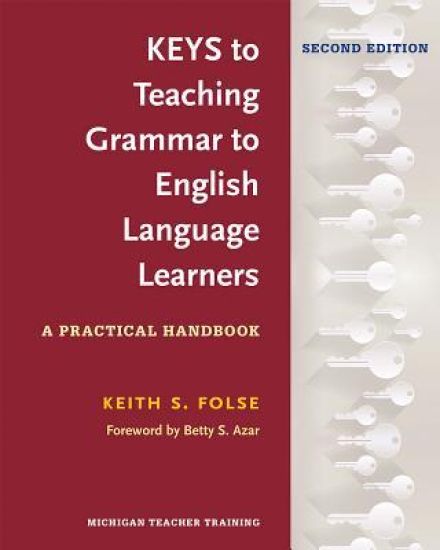
A MICHIGAN TEACHER TRAINING title Keys to Teaching Grammar to English Language Learners: A Practical Handbook is not intended to be an exhaustive reference book about ESL grammar. Written for classroom teachers (K-12, ESL, EFL), this book teaches the most common ESL grammar points in an accessible way through real ESL errors together with suggested teaching techniques. Relevant grammar terminology is explained. The four objectives of this book are to help teachers: (1) identify common ESL grammar points and understand the details associated with each one; (2) improve their ability to answer any grammar question on the spot (when on the “hot seat”); (3) anticipate common ESL errors by grammar point, by first language, and/or by proficiency level; and (4) develop more effective grammar/language learning lessons. These objectives are for all teachers, whether they are teaching grammar directly or indirectly in a variety of classes – including a grammar class, a writing class, a speaking class, an ESP class, or a K-12 class. In the Second Edition, all chapters have been updated and substantively revised. The number of marginal (gray) boxes with tips and extra information has doubled. A 16th Key, on Negating, and three new appendixes have been added. One of the new appendixes provides a sample exercise from an actual ESL textbook plus relevant notes about the designing of grammar activities and suggestions for teaching each grammar point. Also added to each Key is a section on the vocabulary items (e.g., collocations) that are related to the teaching of that particular grammar point. This information is unique to this edition and cannot be found elsewhere on the market. The Workbook for the Second Edition (978-0-472-03679-0), available in 2017, includes numerous activities that practice the essentials of grammar and issues relevant to ESL teachers.
The Grammar Answer Key

The Grammar Answer Key

Keith S. Folse

The University of Michigan Press
2018
nidottu
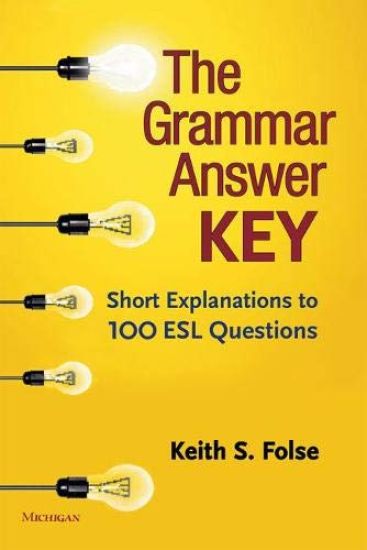
The Grammar Answer Key is a collection of 100 questions submitted by ESL teachers--both novice and experienced and both native and non-native speakers--from many different countries around the world. The questions are real questions that ESL/EFL students have asked teachers about English and are similar to the Hot Seat Questions presented in Keys to Teaching Grammar to English Language Learners, 2nd ed. (Folse, 2016). The 100 questions are organized into 12 chapters on topics that teachers and students can relate to well: adjectives, articles, clauses, connectors, gerunds and infinitives, prepositions, pronouns, pronunciation, subject-verb agreement, suffixes, verbs, and vocabulary-grammar connections. The number of questions in each chapter ranges from 3 to 13 and is based on the questions submitted. Each chapter begins with a short overview of the topic that features key terminology and a chart explaining three common ESL errors. Each question is presented in a box and is followed by an "answer" that can inform instruction, often in chart format. Examples of questions are:How do you know if a word is an adjective? Can I say the Monday or the January? Do you say on July or in July? I received an email from someone that said “Greetings from my wife and I.” Is this right? Why?How do I know which way to pronounce the -ed at the end of a word?Which verb tenses are the most common in English? Which ones should I study?Why do you say turn on the light instead of turn the light? In my language, we have one word for make and do. In English, when should I use make and when should I use do? The book is the ideal teacher resource and professional development tool.
Academic Word Lists

Academic Word Lists

Keith S. Folse

THE UNIVERSITY OF MICHIGAN PRESS
2023
nidottu
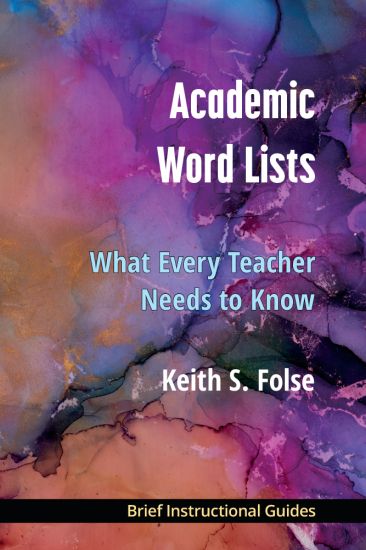
In Academic Word Lists, Keith Folse explains how various lists like the Academic Word List (AWL) have become popular tools in the ESL classroom for teaching vocabulary. Following a discussion on the importance of teaching vocabulary, Folse explains why word lists are useful in language learning and how they can help address the lexical gap. He also outlines what words are on the AWL, how the word families are selected, and what teachers should know about other word lists. The book also includes 10 suggestions for using academic word lists in the classroom, including how to use vocabulary notebooks.
English Structure Practices

English Structure Practices

Keith S. Folse

The University of Michigan Press
1983
nidottu
This workbook, which may be used independently or in conjunction with English Sentence Structure, contains more than 400 exercises that cover beginning- and intermediate-level grammar points such as tenses, articles, count and noncount nouns, modals, verbals, relative clauses, passive voice, adverbs, and conditional sentences.This is the workbook to accompany English Sentence Structure.