Kirjojen hintavertailu. Mukana 11 363 633 kirjaa ja 12 kauppaa.

Kirjahaku

Etsi kirjoja tekijän nimen, kirjan nimen tai ISBN:n perusteella.

12 kirjaa tekijältä Kelly Bulkeley

The Scribes of Sleep

The Scribes of Sleep

Kelly Bulkeley

OXFORD UNIVERSITY PRESS INC
2023
sidottu
Dream journals are a surprisingly powerful resource for psychological and spiritual discovery. Contemporary dream science has shown that, as much as we can learn from single dreams, far more information can be derived from analyzing a series of dreams over time. Many have intuitively understood this point, and carefully recorded their dreams for years, even decades, drawing profound guidance from the patterns they discovered. The Scribes of Sleep is the first book to gather historical and cross-cultural evidence showing the value of dream journals as potent sources of healing, religious experience, and metaphysical insight. Dream researcher Kelly Bulkeley profiles seven remarkable people who kept dream journals: Aelius Aristides, Myoe Shonin, Lucrecia de León, Emanuel Swedenborg, Benjamin Banneker, Anna Bonus Kingsford, and Wolfgang Pauli. Because dreams are so complex and multi-faceted, especially when viewed in a series, Bulkeley employs an interdisciplinary approach to shed light on their meanings, drawing on data science, depth psychology, and religious studies. As the findings of these different methods are woven together and they begin to illuminate each other, it becomes clear that the practice of keeping a dream journal stimulates several specific qualities of religiosity, prompting the dreamers to move in more individualist, mystical, and pluralistic directions-towards becoming a free spirit.
Big Dreams

Big Dreams

Kelly Bulkeley

Oxford University Press Inc
2016
sidottu
Big dreams are rare but highly memorable dream experiences that make a strong and lasting impact on the dreamer's waking awareness. Such dreams can include vivid imagery, intense emotions, fantastic characters, bizarre elements of form and content, and an uncanny sense of being connected to forces beyond one's ordinary dreaming mind. These types of dreams have played significant roles in religious and cultural history, and even today people still experience them and find them intriguing and thought-provoking. Because of their infrequent occurrence and fantastical tendencies, however, big dreams have rarely been studied in light of modern science. While we know a great deal about the religious manifestations of big dreams through history and around the world, we have not yet integrated that cross-cultural knowledge with new scientific research on their psychological roots in the brain-mind system. In this volume, Kelly Bulkeley provides the first full-scale cognitive scientific analysis of highly memorable dreams, with an original theory about their formation, function, and meaning. He draws upon evidence from religious studies, psychology, anthropology, evolutionary biology, and neuroscience to build a very specific argument: big dreams are a primal wellspring of religious experience. They represent an innate, neurologically hard-wired capacity of our species that regularly provokes greater self-awareness, creativity, and insight into the existential challenges and spiritual potentials of human life.
An Introduction to the Psychology of Dreaming

An Introduction to the Psychology of Dreaming

Kelly Bulkeley

Praeger Publishers Inc
1997
sidottu
This text is a one-stop resource on modern dream psychology, from the pioneering theories of Sigmund Freud and Carl Jung to the revolutionary findings of the sleep laboratory.An introduction to the 20th century's major psychological theories about dreams and dreaming, this work offers a detailed historical overview of how these theories have developed from 1900 to the present. To help readers understand the many different approaches modern psychologists have taken, the book examines each approach in terms of three basic questions: How are dreams formed? What functions do dreams serve? How can dreams be interpreted?The book begins with a brief historical review of the most important ideas about dreams proposed in Western antiquity. It then presents comprehensive descriptions of the dream theories of Sigmund Freud, Carl Jung, and other clinical psychologists. It further discusses the revolutionary discoveries of the modern sleep laboratory and the most important research findings of experimental psychologists. The book concludes with an examination of dreams in contemporary popular psychology, a multifaceted analysis of a sample dream, and an extensive bibliography on dream research.
An Introduction to the Psychology of Dreaming

An Introduction to the Psychology of Dreaming

Kelly Bulkeley

Praeger Publishers Inc
1997
nidottu
This text is a one-stop resource on modern dream psychology, from the pioneering theories of Sigmund Freud and Carl Jung to the revolutionary findings of the sleep laboratory.An introduction to the 20th century's major psychological theories about dreams and dreaming, this work offers a detailed historical overview of how these theories have developed from 1900 to the present. To help readers understand the many different approaches modern psychologists have taken, the book examines each approach in terms of three basic questions: How are dreams formed? What functions do dreams serve? How can dreams be interpreted?The book begins with a brief historical review of the most important ideas about dreams proposed in Western antiquity. It then presents comprehensive descriptions of the dream theories of Sigmund Freud, Carl Jung, and other clinical psychologists. It further discusses the revolutionary discoveries of the modern sleep laboratory and the most important research findings of experimental psychologists. The book concludes with an examination of dreams in contemporary popular psychology, a multifaceted analysis of a sample dream, and an extensive bibliography on dream research.
The Wondering Brain

The Wondering Brain

Kelly Bulkeley

Routledge
2004
sidottu
The explosion of new research in cognitive neuroscience has revealed fascinating dimensions of the human brain/mind system. But even as it brings us closer to understanding how the mind works, science is producing more, and perhaps even larger questions. What further powers and abilities are latent within us? The Wondering Brain argues that the profound questions raised by cognitive neuroscience may best be answered through a dialogue with religion. Kelly Bulkeley argues that cognitive neuroscience, seen in the light of religion, is a unique source of insight into the natural groundings of faith, morality, love, ecstasy, and revelation. And religion, seen in the light of cognitive neuroscience, is a powerful cultural system whose most valuable function is to stretch and expand our basic cognitive capacities. Kelly Bulkeley's deep engagement with both religious thinking and the workings of cognitive neuroscience makes for a constantly surprising book, full of stories that catch the reader in the unexpected place between two supposedly irreconcilable ways of being in the world.
The Wondering Brain

The Wondering Brain

Kelly Bulkeley

Routledge
2004
nidottu
The explosion of new research in cognitive neuroscience has revealed fascinating dimensions of the human brain/mind system. But even as it brings us closer to understanding how the mind works, science is producing more, and perhaps even larger questions. What further powers and abilities are latent within us? The Wondering Brain argues that the profound questions raised by cognitive neuroscience may best be answered through a dialogue with religion. Kelly Bulkeley argues that cognitive neuroscience, seen in the light of religion, is a unique source of insight into the natural groundings of faith, morality, love, ecstasy, and revelation. And religion, seen in the light of cognitive neuroscience, is a powerful cultural system whose most valuable function is to stretch and expand our basic cognitive capacities. Kelly Bulkeley's deep engagement with both religious thinking and the workings of cognitive neuroscience makes for a constantly surprising book, full of stories that catch the reader in the unexpected place between two supposedly irreconcilable ways of being in the world.
The Wilderness of Dreams

The Wilderness of Dreams

Kelly Bulkeley

State University of New York Press
1994
pokkari
This interdisciplinary study of the religious dimensions of dreams shows how modern dream research supports and enriches our understanding of religiously meaningful dreams.The Wilderness of Dreams does four things that no other work on dreams has done. First, it surveys the whole range of modern dream research-not just the work of depth psychologists and neuroscientists, but also the findings of anthropologists, content analysts, cognitive psychologists, creative artists, and lucid dreaming researchers. Second, it draws upon new advances in hermeneutic philosophy in order to clarify basic questions about how to interpret dreams. Third, it develops a careful, well-grounded notion of religious meaning-the "root metaphor" concept-to show that seeking religious meanings in dreams is not mere superstition. And fourth, the book reflects on the question of why modern Westerners are so interested in affirming, or debunking, the idea that dreams have religious meanings.
Lucrecia the Dreamer

Lucrecia the Dreamer

Kelly Bulkeley

Stanford Univ Pr
2018
sidottu
Set in late sixteenth-century Spain, this book tells the gripping story of Lucrecia de Leon, a young woman of modest background who gained a dangerously popular reputation as a prophetic dreamer predicting apocalyptic ruin for her country. When Lucrecia was still a teenager, several Catholic priests took great interest in her prolific dreams and began to record them in detail. But the growing public attention to the dreams eventually became too much for the Spanish king. Stung that Lucrecia had accurately foreseen the defeat of the Spanish Armada in 1588, Philip II ordered the Inquisition to arrest her on charges of heresy and sedition. During Lucrecia's imprisonment, trial, and torture, the carefully collected records of her dreams were preserved and analyzed by the court. The authenticity of these dreams, and their potentially explosive significance, became the focal point of the Church's investigation.Returning to these records of a dreamer from another era, Lucrecia the Dreamer is the first book to examine Lucrecia's dreams as dreams, as accurate reports of psychological experiences with roots in the brain's natural cycles of activity during sleep. Using methods from the cognitive science of religion, dream researcher Kelly Bulkeley finds meaningful patterns in Lucrecia's dreaming prophecies and sheds new light on the infinitely puzzling question at the center of her trial, a question that has vexed all religious traditions throughout history: How can we determine if a dream is, or is not, a true revelation?
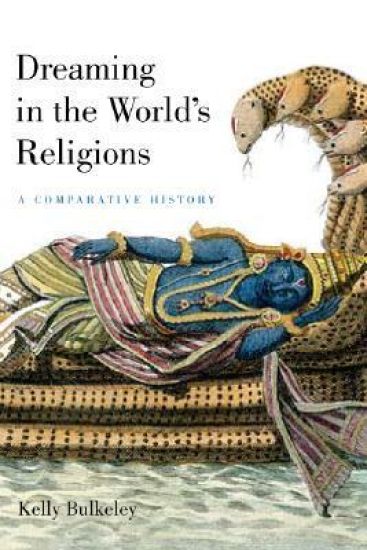
Dreaming in the World's Religions

Dreaming in the World's Religions

Kelly Bulkeley

New York University Press
2008
sidottu
From Biblical stories of Joseph interpreting Pharoh’s dreams in Egypt to prayers against bad dreams in the Hindu Rg Veda, cultures all over the world have seen their dreams first and foremost as religiously meaningful experiences. In this widely shared view, dreams are a powerful medium of transpersonal guidance offering the opportunity to communicate with sacred beings, gain valuable wisdom and power, heal suffering, and explore new realms of existence. Conversely, the world’s religious and spiritual traditions provide the best source of historical information about the broad patterns of human dream life Dreaming in the World’s Religions provides an authoritative and engaging one-volume resource for the study of dreaming and religion. It tells the story of how dreaming has shaped the religious history of humankind, from the Upanishads of Hinduism to the Qur’an of Islam, from the conception dream of Buddhas mother to the sexually tempting nightmares of St. Augustine, from the Ojibwa vision quest to Australian Aboriginal journeys in the Dreamtime. Bringing his background in psychology to bear, Kelly Bulkeley incorporates an accessible consideration of cognitive neuroscience and evolutionary psychology into this fascinating overview. Dreaming in the World’s Religions offers a carefully researched, accessibly written portrait of dreaming as a powerful, unpredictable, often iconoclastic force in human religious life.
Dreaming in the World's Religions

Dreaming in the World's Religions

Kelly Bulkeley

New York University Press
2008
pokkari
From Biblical stories of Joseph interpreting Pharoh’s dreams in Egypt to prayers against bad dreams in the Hindu Rg Veda, cultures all over the world have seen their dreams first and foremost as religiously meaningful experiences. In this widely shared view, dreams are a powerful medium of transpersonal guidance offering the opportunity to communicate with sacred beings, gain valuable wisdom and power, heal suffering, and explore new realms of existence. Conversely, the world’s religious and spiritual traditions provide the best source of historical information about the broad patterns of human dream life Dreaming in the World’s Religions provides an authoritative and engaging one-volume resource for the study of dreaming and religion. It tells the story of how dreaming has shaped the religious history of humankind, from the Upanishads of Hinduism to the Qur’an of Islam, from the conception dream of Buddhas mother to the sexually tempting nightmares of St. Augustine, from the Ojibwa vision quest to Australian Aboriginal journeys in the Dreamtime. Bringing his background in psychology to bear, Kelly Bulkeley incorporates an accessible consideration of cognitive neuroscience and evolutionary psychology into this fascinating overview. Dreaming in the World’s Religions offers a carefully researched, accessibly written portrait of dreaming as a powerful, unpredictable, often iconoclastic force in human religious life.
Lucrecia the Dreamer

Lucrecia the Dreamer

Kelly Bulkeley

Stanford University Press
2018
pokkari
Set in late sixteenth-century Spain, this book tells the gripping story of Lucrecia de León, a young woman of modest background who gained a dangerously popular reputation as a prophetic dreamer predicting apocalyptic ruin for her country. When Lucrecia was still a teenager, several Catholic priests took great interest in her prolific dreams and began to record them in detail. But the growing public attention to the dreams eventually became too much for the Spanish king. Stung that Lucrecia had accurately foreseen the defeat of the Spanish Armada in 1588, Philip II ordered the Inquisition to arrest her on charges of heresy and sedition. During Lucrecia's imprisonment, trial, and torture, the carefully collected records of her dreams were preserved and analyzed by the court. The authenticity of these dreams, and their potentially explosive significance, became the focal point of the Church's investigation. Returning to these records of a dreamer from another era, Lucrecia the Dreamer is the first book to examine Lucrecia's dreams as dreams, as accurate reports of psychological experiences with roots in the brain's natural cycles of activity during sleep. Using methods from the cognitive science of religion, dream researcher Kelly Bulkeley finds meaningful patterns in Lucrecia's dreaming prophecies and sheds new light on the infinitely puzzling question at the center of her trial, a question that has vexed all religious traditions throughout history: How can we determine if a dream is, or is not, a true revelation?