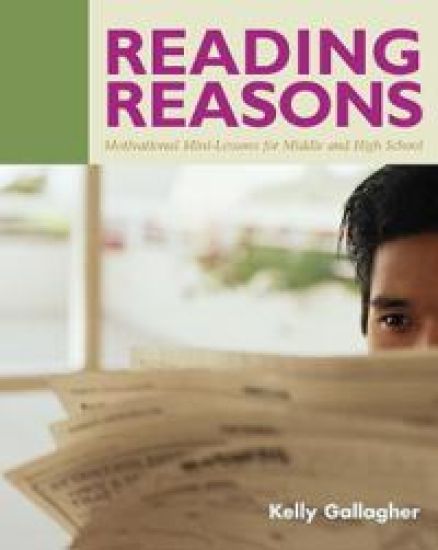
In Reading Reasons: Motivational Mini-Lessons for Middle and High School, author and teacher Kelly Gallagher offers a series of mini-lessons specifically tailored to motivate middle and high school students to read, and in doing so, to help them understand the importance and relevance reading will take in their lives. This book introduces and explains in detail nine specific "real-world" reasons why students should be readers. The book contains 40 practical, classroom-tested and reproducible mini-lessons that get to the heart of reading motivation and that can be used immediately in English and other content-area classrooms. These easy-to-use motivational lessons serve as weekly reading "booster shots" that help maintain reading enthusiasm in your classroom from September through June. The mini-lessons, ranging from 5-20 minutes in length, hit home with adolescents, and in turn, enable them to internalize the importance reading will play in their lives. Rather than telling students reading is good for them, the lessons in this book show them the benefits of reading.
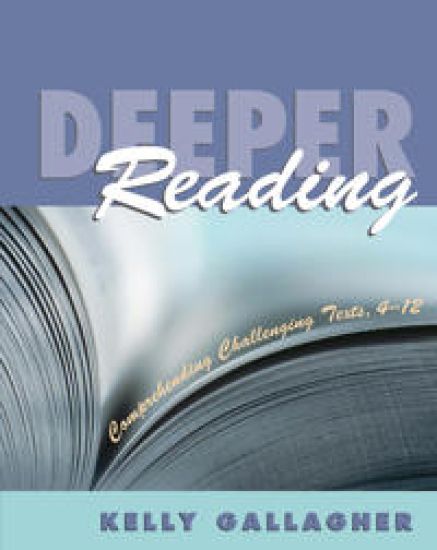
Do your students often struggle with difficult novels and other challenging texts? Do you feel that you are doing more work teaching the novel than they are reading it? Building on twenty years of teaching language arts, Kelly Gallagher shows how students can be taught to successfully read a broad range of challenging and difficult texts with deeper levels of comprehension. In Deeper Reading: Comprehending Challenging Texts, 4-12 , he shares effective, classroom-tested strategies that enable your students to: Accept the challenge of reading difficult books and move beyond a "first draft" understanding Consciously monitor their comprehension as they read and employ effective "fix-it" strategies when comprehension starts to falter Use meaningful collaboration and metaphorical thinking to achieve deeper understanding of texts Reflect on the relevance the book holds for themselves and their peers by using critical thinking skills to analyze real-world issues Gallagher also provides guidance on effective lesson planning that incorporates strategies for deeper reading. Funny, poignant, and packed with practical ideas that work in real classrooms, Deeper Reading is a valuable resource for any teacher whose students need new tools to uncover the riches found in complex texts.
In an increasingly demanding world of literacy, it has become critical that students know how to write effectively. From the requirements of standardized tests to those of the wired workplace, the ability to write well, once a luxury, has become a necessity. Many students are leaving school without the necessary writing practice and skills needed to compete in a complex and fast-moving Information Age. Unless we teach them how to run with it, they are in danger of being run over by a stampede—a literacy stampede. InTeaching Adolescent Writers , Kelly Gallagher shows how students can be taught to write effectively. Gallagher shares a number of classroom-tested strategies that enable teachers to: Understand the importance of teaching writing and how to motivate young writers Show how modeling from both the teacher and real-world texts builds young writers Provide choice of what to write, which helps elevate adolescent writing, and how to fit it into a rigorous curriculum Help students recognize the importance of purpose and audience Assess essays in ways that drive better writing performance. Infused with humor and illuminating anecdotes, Gallagher draws on his classroom experiences and work as co-director of a regional writing project to offer teachers both practical ways to incorporate writing instruction into their day and compelling reasons to do so.
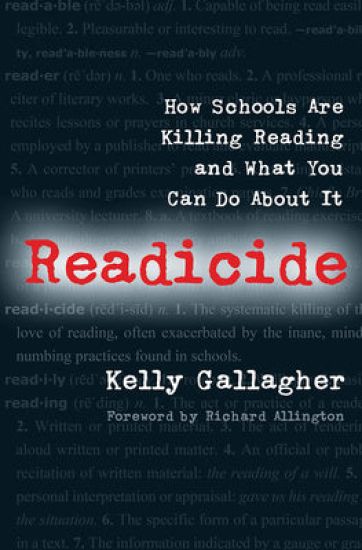
Read-i-cide: The systematic killing of the love of reading, often exacerbated by the inane, mind-numbing practices found in schools. Reading is dying in our schools. Educators are familiar with many of the factors that have contributed to the decline, poverty, second-language issues, and the ever-expanding choices of electronic entertainment. In this provocative book Readicide: How Schools are Killing Reading and What You Can Do About It , author and teacher Kelly Gallagher suggests it is time to recognize a new and significant contributor to the death of reading: our schools. Readicide , Gallagher argues that American schools are actively (though unwittingly) furthering the decline of reading. Specifically, he contends that the standard instructional practices used in most schools are killing reading by:Valuing standardized testing over the development of lifelong readersMandating breadth over depth in instructionRequiring students to read difficult texts without proper instructional support and insisting students focus on academic textsIgnoring the importance of developing recreational readingLosing sight of authentic instruction in the looming shadow of political pressuresReadicide provides teachers, literacy coaches, and administrators with specific steps to reverse the downward spiral in reading-;steps that will help prevent the loss of another generation of readers.
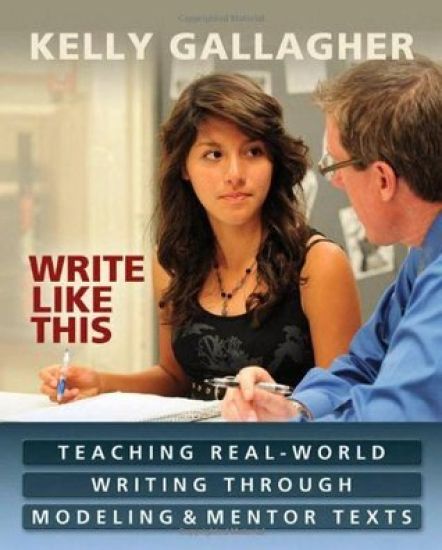
In Write Like This: Teaching Real World Writing Through Modeling and Mentor Texts, author and teacher Kelly Gallagher recognizes that writing well starts with teaching students WHY they should write. He believes we need to move beyond the state standards by introducing young writers to real-world discourses and provide them with authentic texts to influence and develop life-long skills. Each chapter focuses on a specific writing purpose: Express and Reflect: View life experiences in reverse to move forward Inform and Explain: State a point and purpose with information to support it Evaluate and Judge: Focus' on the worth of an object, idea, or person and present' it as 'bad or 'good Inquire and Explore: Propose' a problem or question Analyze and Interpret: Examine phenomena that are difficult to understand or explain Take a Stand/Propose a Solution: Persuade audience to particular position and provide' justification' ' In teaching these lessons, Gallagher provides mentor texts (professional samples as well as models he has written in front of his students), student writing samples, and numerous assignments and strategies proven to elevate student writing. By helping teachers bring effective modeling practices into their classrooms, Write Like This enables students to become better adolescent writers. More important, the practices found in this book will help our students develop the writing skills they will need to become adult writers in the real world. '
In his new book,In the Best Interest of Students: Staying True to What Works in the ELA Classroom , teacher and author Kelly Gallagher notes that there are real strengths in the Common Core standards, and there are significant weaknesses as well. He takes the long view, reminding us that standards come and go but good teaching remains grounded in proven practices that sharpen students' literacy skills.Instead of blindly adhering to the latest standards movement, Gallagher suggests:Increasing the amount of reading and writing students are doing while giving students more choice around those activitiesBalancing rigorous, high-quality literature and non-fiction works with student-selected titlesEncouraging readers to deepen their comprehension by moving beyond the four corners of the text-Planning lessons that move beyond Common Core expectations to help young writers achieve more authenticity through the blending of genresUsing modeling to enrich students' writing skills in the prewriting, drafting, and revision stagesResisting the de-emphasis of narrative and imaginative reading and writingAmid the frenzy of trying to teach to a new set of standards, Kelly Gallagher is a strong voice of reason, reminding us that instruction should be anchored around one guiding question: What is in the best interest of our students?
"Teaching is art--creation--and a curriculum map is only as good as the teacher who considers it, who questions it, and who revises it to meet the needs of each year's students." --Kelly Gallagher and Penny Kittle Two teachers. Two classrooms. One school year. 180 Days represents the collaboration of two master teachers--Kelly Gallagher and Penny Kittle--over an entire school year: planning, teaching, and reflecting within their own and each other's classrooms in California and New Hampshire. Inspired by a teacher's question, "How do you fit it all in?" they identified and prioritized the daily, essential, belief-based practices that are worth spending time on. They asked, "Who will these students be as readers and writers after a year under our care?" What we make time for matters: what we plan, how we revise our plans while teaching, and how we reflect and decide what's next. The decision-making in the moment is the most essential work of teaching, and it's the ongoing study of the adolescents in front of us that has the greatest impact on our thinking. With both the demands of time and the complexity of diverse students in mind, Kelly and Penny mapped out a year of engaging literacy practices aligned to their core beliefs about what matters most. They share their insights on managing time and tasks and offer teaching strategies for engaging students in both whole class and independent work. Video clips of Kelly and Penny teaching in each other's classrooms bring this year to life and show you what a steadfast commitment to belief-based instruction looks like in action. 180 Days. Make every moment matter. Teach fearlessly. Empower all students to live literate lives.
Essay. Poetry. Book Clubs. Digital Composition. Penny Kittle and Kelly Gallagher extend their work in 180 Days: Two Teachers and the Quest to Engage and Empower Adolescents by taking a deep dive into four essential studies. Their aim is to move beyond compliance and formula, and to develop students' agency, independence, and decision-making skills. These four practices, they argue, have the power to transform students' relationship with literacy--and truly prepare them for the more demanding work of college. A central belief underlies each of the four studies--that composing involves choosing, picking among options. It is not following a pre-set pattern. But if students are to make these choices, they need to be aware of the moves and possibilities open to them. That's what this book does--it shows how teacher demonstrations, the skillful use of mentor texts, effective feedback (and many other tools) can make choices possible. By reimagining how we teach essay, poetry, book clubs, and digital composition, we can open the door to more engaged, connected, and challenging learning.